YouTube to Blog Workflow That Actually Ranks in 2026
Turn YouTube videos into SEO blog posts with this practical YouTube to blog workflow, including AI tools, editing tips, and a real Zemith example.
You already know the feeling. A YouTube video lands, comments pile up, and a week later the same topic still has nowhere to live on your site except a buried ideas doc and a half-finished outline. The frustrating part isn't the lack of content. It's that the content already exists, it just hasn't been turned into something search can keep working for you.
A YouTube to blog pipeline fixes that gap. YouTube is still one of the biggest distribution engines on the web, with 2.6 billion monthly active users in 2026, more than 200 billion daily Shorts views, and over $40 billion in ad revenue in 2025 (). Blogging is still massive too, with roughly 600 million blogs worldwide, about 3.2 million new blog posts every day, and 77% of internet users regularly read blog posts (). Those aren't vanity numbers, they're the reason repurposing video into articles still makes sense.
Why a YouTube to Blog Pipeline Is Worth Building
A creator publishes a video, the audience responds, and the opportunity usually arrives in the comments. Someone asks for a checklist. Someone else wants the exact steps. A few viewers search for the topic later, land on a rival article, and your video never gets a second chance to rank.
That's why the best youtube to blog workflows treat video and text like partners. The video does the heavy lifting at the top of the funnel, while the article catches search intent, evergreen discovery, and readers who prefer scanning a page instead of scrubbing a timeline. The scale on both sides makes the case clear. YouTube is still huge, and blogging still has a built-in audience and deep infrastructure, especially on WordPress, which powers 43% of all websites and receives about 70 million new posts per month ().
A repeatable pipeline matters more than a one-off transcript dump because not every video is worth turning into a post. Tutorials, demos, opinion pieces with clear structure, and interviews with takeaways usually convert well. Conversational vlogs and rambling updates usually need heavier rewriting, or they'll read like a transcript wearing a trench coat.
Practical rule: if the video can't be summarized in a useful headline and three clean subtopics, it probably needs editing before it deserves a blog URL.
For creators trying to build a durable content engine, a good starting point is paired with a repurposing system that turns each strong upload into an evergreen asset. Zemith's own also fit neatly here if you're building the process around a larger editorial calendar instead of random uploads.
Capture and Clean the Transcript Like an Editor
The transcript is raw material, not copy. If you paste captions straight into a post, you'll get broken phrases, repeated clauses, and the kind of sentence fragments that make readers feel like they've wandered into a voice memo with headers. That's why the cleanup pass matters more than most tools admit.

Start with the built-in YouTube transcript when it's available. If captions are missing, messy, or full of technical terms that get mangled, use a transcription tool instead. The point isn't to chase perfection on the first pass. The point is to get a complete text version that you can edit.
Clean for meaning, not just grammar
Strip filler words like um, uh, you know, and like when they don't add rhythm or emphasis. Remove false starts such as “so, what I was going to say is” when the speaker immediately restarts the thought. Restore punctuation where the video clearly pauses between ideas, and capitalize product names, acronyms, and proper nouns correctly.
A transcript should read like a draft written by a smart person on a tired day, not like a subtitle file that escaped custody.
A useful cleanup checklist looks like this:
- Remove repetitions: Delete phrases the speaker says twice in a row when they don't change the meaning.
- Fix fragments: Merge broken lines into complete sentences before adding headings.
- Check terminology: Make sure tools, frameworks, and brand names are spelled correctly.
- Break long blocks: Insert paragraph spacing where the speaker shifts topic or gives a new example.
- Verify claims: If the video mentions a statistic or date, confirm it before publishing.
Zemith's guide is useful here if you want a cleaner starting point before the editorial pass, especially when the transcript will feed multiple content formats.
Reshape the Transcript Into a Real Article
A transcript still sounds like a transcript even after cleanup. The biggest shift happens when you stop asking, “How do I shorten this?” and start asking, “What's the article's angle?” That's the move that separates a searchable post from a barely disguised upload summary.
A weak opening sounds like this: “In today's video, I talk about content repurposing and show a few tips.” A stronger opening sounds like this: “Most creators leave traffic on the table because their best video never becomes a searchable article.” Same source material, very different job. One invites a click. The other announces that it's been auto-generated by a caffeine-deprived intern.
Build the outline from the viewer's logic
Use the video's natural sequence, but don't preserve every detour. If the speaker starts with a story, moves into a framework, and ends with a tool demo, those become your main sections. If they repeat the same point three times, keep the clearest version and cut the rest. If one part is a tangent that doesn't help the reader, it's gone.
A simple before-and-after helps:
That structure matters because spoken language drifts. Written content has to land faster. A good rule is to keep the best explanation, merge overlapping points, and cut anything that only exists because someone on camera kept talking.
A separate conclusion helps too, because the ending of a video often trails off. Your article should close with a real takeaway or next step, not a vague “thanks for watching” in paragraph form. If the source material doesn't provide that, write it yourself from the editorial angle of the post.
Use Zemith's YouTube to Blog Tool Without Losing Your Voice
A good AI workspace should speed up the grunt work, not flatten the voice. Zemith's YouTube to Blog converter fits that middle ground because it takes a YouTube URL, produces a blog draft, and lets you preview the result before you treat it like publishable copy. That's useful when you're moving fast, but it still leaves room for editorial judgment.
Here's the cleanest way to use it. First, drop the YouTube URL into the converter. Then review the draft for structure, not just wording. If the output gets the skeleton right but the transitions feel stiff, move the copy into the Smart Notepad or another editing surface and rewrite the openers, the subheads, and the close so it sounds like your site instead of a generic repurpose machine.
Zemith's multi-model AI access helps when you want to compare versions of the same video across different model outputs. One model may handle tone better, another may give you tighter structure, and a third may be better at summarizing. The point isn't to worship the model. It's to pick the draft that gives your editor the least amount of cleanup.
If you're worried about whether an AI draft looks too machine-made, the is a helpful reminder that the issue isn't just detection, it's whether the output still sounds like a human edited it with intent. Zemith's piece also lines up with this approach, because the workflow works best when AI helps generate options and a person picks the voice.
Edit for SEO Without Sounding Like a Robot
Search optimization still matters here, but the article has to read like a person wrote it for another person. The easiest mistake is stuffing the phrase into every other paragraph and calling that strategy. That's not SEO. That's a cry for help with a keyword planner open on the second monitor.

The keyword should appear where it earns its keep, in the H1 title, the intro, at least one subheading, and the URL slug. That matches the standard conversion advice for these posts, along with writing a meta title, meta description, and clean structure for readability (). If the phrase doesn't appear early and naturally, the article can feel disconnected from the search query it's supposed to answer.
Keep the page useful first
The best edits make the page easier to scan. Short paragraphs help. Clear H2s help more. Internal links keep readers moving through your site, and an embedded video gives the post a source of visual proof instead of turning it into a wall of text. That's especially helpful for tutorials and demos, where readers may want to compare the article with the original clip.
A finishing checklist keeps the page from drifting into bot territory:
- Trim repetitive phrasing: If two sentences say the same thing, keep the stronger one.
- Add descriptive alt text: Don't leave images nameless if they illustrate a process or result.
- Check the slug: Keep it short, readable, and obviously tied to the topic.
- Link related posts: Give the article a place inside your site architecture.
- Read it aloud: If a sentence sounds like a template, rewrite it.
Zemith's guide fits naturally with this stage if you want to compare a repurposed draft against a more standard editorial workflow before publishing.
Licensing, Attribution, and Quality Control
Most youtube to blog tutorials skip the two questions that matter. Can you republish the script, and should you even try if the video is mostly rambling? Those aren't side issues. They decide whether the post is a helpful asset or a legal and editorial headache.

If the video is yours, the path is straightforward. You still need to edit for clarity, but the ownership question is easy. If it's an interview, a guest talk, or commentary that includes someone else's words, the source should be credited clearly, and embedding the video can be safer than treating the transcript like open season. That gap is one of the most overlooked parts of the repurposing process, even though many transcript-first guides focus almost entirely on speed and SEO ().
Know when rewriting is fine
Rewriting works best when you're transforming your own material, or when you're publishing a substantial original article that uses the video as source material rather than as a script to copy. For interviews, demos, and panel clips, the editorial job is to extract the useful ideas, not preserve every spoken line. If the source is conversational, the article should become more structured than the original, not less.
Quality control starts with a blunt test. If the cleaned transcript still feels thin after the first pass, the video probably doesn't have enough substance for a standalone post. In that case, an embedded video with a short written summary may serve the reader better than a forced rewrite. That's especially true for casual vlogs and updates that don't contain a clear teaching arc.
If you wouldn't recommend the transcript to a reader in its current form, don't pretend headings will save it.
A practical attribution rule set is simple:
- Own video: Rewrite freely, but still edit for clarity and flow.
- Interview or guest content: Credit the speaker, quote selectively, and avoid flattening their point.
- Mostly conversational video: Add a summary, embed the clip, and skip the fake article treatment if the substance isn't there.
- Source-heavy demo: Add screenshots or callouts so the post teaches rather than merely repeats.
The best posts in this category feel edited, not extracted. That difference is obvious to readers, and it's what keeps your blog from filling up with thin pages that look busy but don't do anything useful.
Automate the Pipeline and Keep It Human
Once the workflow works once, turn it into a weekly habit. Friday is a good day for this because the editorial brain is already tired enough to respect a checklist. Use Zemith's alongside the Prompt Gallery, Notepad, and Library to keep the process repeatable instead of improvised.
A simple five-step routine is enough:
- Pick one strong video. Choose the clip with clear structure and real teaching value.
- Pull the transcript. Clean the rough edges before you touch the headline.
- Generate the draft. Use the converter to get a starting point, not a final answer.
- Edit for voice and SEO. Rewrite the intro, tighten the sections, and fix the metadata.
- Publish and track what happened. Watch which posts rank, how much time you saved per video, and whether the post drives email signups.
That last part matters because speed alone doesn't build a content system. Taste does. The best repurposed posts feel like they were written on purpose, for a reader with a specific problem, not assembled by a script and hope.
If you want the workflow to stick, store your prompts, topic clusters, and reusable structures in one place, then reuse them every week without rethinking the whole process. That's how the pipeline gets boring in the best way.
If you want a faster way to turn strong videos into search-friendly articles without sacrificing editorial control, try . It gives you a practical YouTube to Blog workflow, plus the tools to clean, rewrite, and organize the draft before it goes live.
Explore Zemith Features
Everything you need. Nothing you don't.
One subscription replaces five. Every top AI model, every creative tool, and every productivity feature, in one focused workspace.
Every top AI. One subscription.
ChatGPT, Claude, Gemini, DeepSeek, Grok & 25+ more








Always on, real-time AI.
Voice + screen share · instant answers
What's the best way to learn a new language?
Immersion and spaced repetition work best. Try consuming media in your target language daily.
Voice + screen share · AI answers in real time
Image Generation
Flux, Nano Banana, Ideogram, Recraft + more

Write at the speed of thought.
AI autocomplete, rewrite & expand on command
Any document. Any format.
PDF, URL, or YouTube → chat, quiz, podcast & more
Video Creation
Veo, Kling, Grok Imagine and more

Text to Speech
Natural AI voices, 30+ languages
Code Generation
Write, debug & explain code
Chat with Documents
Upload PDFs, analyze content
Your AI, in your pocket.
Full access on iOS & Android · synced everywhere
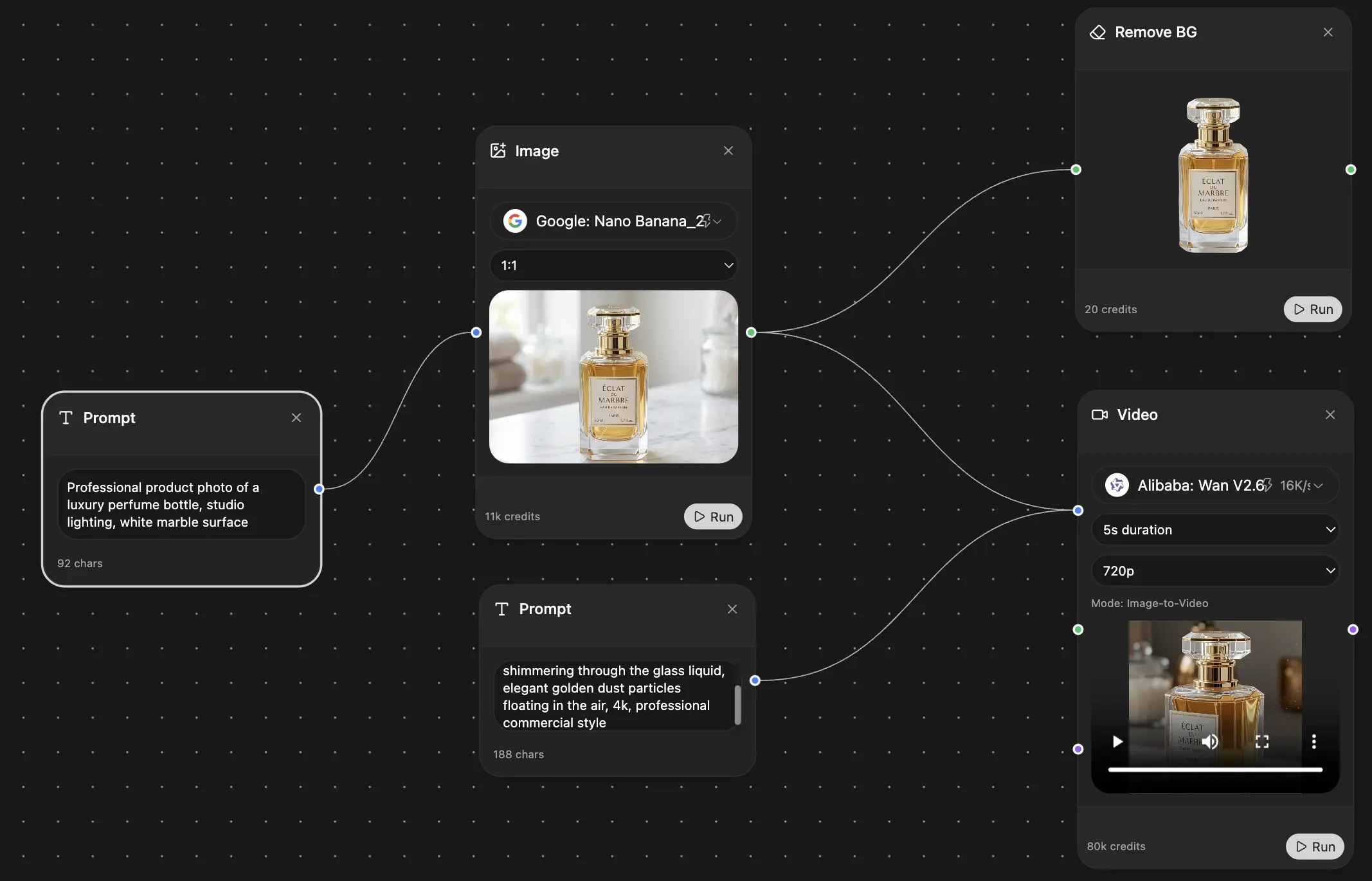
Your infinite AI canvas.
Chat, image, video & motion tools — side by side
Save hours of work and research
Transparent, High-Value Pricing
Trusted by teams at






Free
No credit card required
- 100 credits daily
- 3 AI models to try
- Basic AI chat
Plus
- 1,000,000 credits/month
- 25+ AI models — GPT, Claude, Gemini, Grok & more
- Agent Mode with web search, computer tools and more
- Creative Studio: image generation and video generation
- Project Library: chat with document, website and youtube, podcast generation, flashcards, reports and more
- Workflow Studio and FocusOS
Professional
- Everything in Plus, and:
- 2,100,000 credits/month
- Pro-exclusive models (Claude Opus, Grok 4, Sonar Pro)
- Motion Tools & Max Mode
- First access to latest features
- Access to additional offers
What Our Users Say
Great Tool after 2 months usage
simplyzubair
I love the way multiple tools they integrated in one platform. So far it is going in right dorection adding more tools.
Best in Kind!
barefootmedicine
This is another game-change. have used software that kind of offers similar features, but the quality of the data I'm getting back and the sheer speed of the responses is outstanding. I use this app ...
simply awesome
MarianZ
I just tried it - didnt wanna stay with it, because there is so much like that out there. But it convinced me, because: - the discord-channel is very response and fast - the number of models are quite...
A Surprisingly Comprehensive and Engaging Experience
bruno.battocletti
Zemith is not just another app; it's a surprisingly comprehensive platform that feels like a toolbox filled with unexpected delights. From the moment you launch it, you're greeted with a clean and int...
Great for Document Analysis
yerch82
Just works. Simple to use and great for working with documents and make summaries. Money well spend in my opinion.
Great AI site with lots of features and accessible llm's
sumore
what I find most useful in this site is the organization of the features. it's better that all the other site I have so far and even better than chatgpt themselves.
Excellent Tool
AlphaLeaf
Zemith claims to be an all-in-one platform, and after using it, I can confirm that it lives up to that claim. It not only has all the necessary functions, but the UI is also well-designed and very eas...
A well-rounded platform with solid LLMs, extra functionality
SlothMachine
Hey team Zemith! First off: I don't often write these reviews. I should do better, especially with tools that really put their heart and soul into their platform.
This is the best tool I've ever used. Updates are made almost daily, and the feedback process is very fast.
reu0691
This is the best AI tool I've used so far. Updates are made almost daily, and the feedback process is incredibly fast. Just looking at the changelogs, you can see how consistently the developers have ...