Workflow Optimization for Dummies (and Smart People Who Like Saving Time) in 2026
Master workflow optimization with practical frameworks, AI tactics, and unified tools like Zemith. Cut chaos and boost team productivity in 2026.
Workflow optimization is just a fancy way of saying, "Let's stop wasting time on dumb stuff." It's about decluttering how work gets done so your team isn't constantly switching tabs, paying for five tools that do the same thing, or losing critical info during handoffs. Think of it like finally organizing that junk drawer in your kitchen—you keep the essentials, toss the ancient soy sauce packets, and wonder why you didn't do it sooner.
Understanding the Core Idea (Without the MBA Jargon)

Workflow optimization isn't about making one person type faster. It's about fixing the entire relay race, not just one runner's sprint.
Getting an approval signed in one day instead of three is great, but if the next person has no clue what the project is about and spends an hour digging through emails? You haven't optimized a thing. You've just moved the bottleneck. The real win is cutting the total time it takes to get from "idea" to "done," reducing those "oops, my bad" errors, and lowering the brain drain that leaves everyone feeling fried by 3 PM.
Here's my personal cheat sheet:
- Map the whole process. You can't fix a leaky pipe if you don't know where the leak is.
- Consolidate your tools. Seriously, how many project management apps does one team need? Those subscriptions add up.
- Build for humans. A perfect process nobody follows is just a pretty flowchart.
- Measure what actually matters: time saved, fewer mistakes, and whether people are actually using the new, better way of doing things.
"Optimization is about flow, not speed alone." I keep this on a sticky note. It stops me from trying to automate a process that’s already a hot mess.
Quick Comparison Table: What to Fix
Stop! Don't Automate That Messy Process.
A word of warning: automating a broken process just makes things go wrong faster and at a much larger scale. It's like putting a rocket engine on a car with crooked wheels. Always map out your workflow first. Then, and only then, automate the parts that are stable and make sense.
Practical Next Steps You Can Steal Today
- Grab your team for a 30-minute "where does it hurt?" session. Map one single process on a whiteboard.
- Find the top 3 pain points that cause the most delays or frustration. Ignore the rest for now.
- Ditch one redundant tool this week. Just one. See what happens in two weeks.
Small wins build momentum. If you want to dig deeper, our guide on is your next click. Fix the flow, and the rest gets a whole lot easier—and cheaper.
Why Most Teams Get Workflow Optimization Wrong
Most teams think buying more apps is the answer. In reality, it's like trying to solve a puzzle by buying more puzzle pieces from different boxes. You just end up with more clutter, more context switching, and a team suffering from serious "tool fatigue."
Imagine a content team juggling five different tools for writing, editing, and planning. They spend more time making sure the right version is in the right app than they do actually creating content. It’s like trying to cook a meal with ingredients scattered across three different kitchens. It’s not efficient; it’s just chaotic.
Busywork masquerades as productivity when everyone is focused on their little part of the puzzle, but no one is looking at the whole picture.
And don't get me started on AI. People treat it like a magic wand. But here’s the secret: automating a bad process just creates bad results faster. You have to understand your workflow before you can effectively apply AI to it.
Common Goofs and How to Fix Them
- Confusing activity with progress: Stop counting how many tasks are completed. Start measuring how long it takes to get something done (cycle time) and how many times you have to redo it (error rate).
- Thinking AI is plug-and-play: It's not. Start small. Pilot AI on one specific, annoying part of your workflow and see if it helps before you roll it out everywhere. A platform like Zemith helps here by bringing multiple models into one place, so you're orchestrating a symphony, not a cacophony.
- Optimizing in a bubble: Don't just make one person's job easier if it makes someone else's harder. Fix the handoffs between people.
The simplest fix? Consolidation. Getting your team onto a single, unified workspace like Zemith is like moving all your cooking ingredients into one kitchen. Suddenly, everything is within reach, and you can actually focus on making a great meal.
A No-Nonsense Checklist
- Spend 30 minutes mapping one key process. Find the exact spot where information gets lost.
- Decide what needs to be automated versus what just needs a clearer owner.
- Pick one redundant app and put it on the chopping block this week. See if anyone screams. (They probably won't.)
Key Insight: When you consolidate tools, you don't just save money on subscriptions. You save your team's sanity, and that's priceless.
How Zemith Changes the Game
Instead of paying for five different AI tools and trying to make them talk to each other, bundles multi-model AI, document automation, and organized Workspaces into one platform. It shifts the question from "What shiny new app should we buy?" to "How can we make this process simpler and faster for everyone?"
The Metrics That Actually Matter (Hint: It's Not "Tasks Completed")
Measuring your workflow optimization efforts is crucial. Otherwise, you're just rearranging deck chairs on the Titanic. Focus on metrics that show real impact.
- Cycle Time: How long does it really take to get from start to finish? This shows you where the hidden delays are.
- Error Rate: How often do things need to be redone? This points to quality issues and frustrated teams.
- Time Saved Per Employee: This turns your improvements into something everyone understands: more time to do meaningful work.
- Adoption Depth: Are people actually using the new process, or did they revert to their old ways after a week?
- ROI: This is the magic number that translates time and quality improvements into dollars and cents for your boss.
How to Build a Scorecard That Doesn't Suck
- Pick 4-6 key metrics.
- Get a baseline measurement before you change anything.
- Track trends weekly or monthly.
- Keep it simple. If you can't explain a metric in one sentence, it's too complicated.
"If you can't explain the metric in one sentence, it's too complicated for the team."
Aim for a 20-40% reduction in cycle time for painful processes and cut your error rate in half. If more than 70% of your team is using the new workflow, you're golden.
Here's a fun fact: teams that track cycle time, error rate, AND adoption see 3x higher ROI. Why? Because they're measuring what leads to lasting change, not just a temporary speed boost.
Common Measurement Traps to Avoid
- Obsessing over task counts. It makes you feel busy, but not effective. Focus on outcomes.
- Overcomplicating things. Use simple formulas and automate data collection where you can.
- Forgetting the human element. If no one adopts the new process, all your work was for nothing.
Example Scorecard Table
With a unified platform like , you can track these metrics without creating a spreadsheet nightmare. It helps you build a business case your CFO will actually love.
A Practical Framework You Can Steal Immediately
Look at this infographic. It's your new best friend. It shows the five metrics to watch as you go through the five phases of workflow optimization.

The secret sauce? Track cycle time and error rate alongside adoption. Do that, and you’re on your way to a 3x higher ROI.
But first, you have to map your process. It's non-negotiable. It’s the only way to find the bottlenecks, the endless email chains, and the approvals that go nowhere.
Map first so you don't automate a mess. It's the golden rule.
Quick Phase Overview
How To Decide What To Automate
- Find the tasks that are slow or prone to errors.
- Ask: will automation fix the root problem or just speed up a broken step?
- Prioritize things that save significant time or eliminate frequent mistakes.
Your Step-by-Step Implementation Plan
- Map one workflow with your team. It should take less than 90 minutes.
- Find the top 3 bottlenecks.
- Create a simple automation or template for the easiest win. Measure adoption for two weeks.
- Use a platform like to connect your tools and ensure context travels with the work.
- Review your metrics monthly and adjust.
Here’s a hot tip: think of orchestration as a traffic cop for your work. It directs tasks to the right person or tool at the right time. A shared workspace like a Zemith Project does this beautifully, cutting down on confusion and wasted time.
What Success Looks Like
- Your cycle time drops, your error rate plummets, and you can actually calculate the money you're saving.
- Your team is actually using the new process (adoption depth > 70%).
- You're seeing that sweet, sweet 3x ROI.
Small, smart changes are better than big, dumb ones. Map, cut, automate, orchestrate, measure. Repeat.
Want to apply this to your bigger goals? .
AI Tactics That Actually Move the Needle in 2026
Let's be real: most "AI tools" are just another tab to keep open. The real magic happens when AI is woven directly into your workflow, eliminating friction instead of adding it. Imagine feeding a 20-page report into a system and getting back a 5-minute audio summary and a quick quiz. That’s not science fiction; that’s smart workflow optimization.
With a platform like , you can do exactly that. It's about turning dead documents into live, interactive assets that save you time and brainpower.
What is Model Orchestration and Why Should I Care?
It's like having a team of specialized robots. One robot is great at summarizing, another is a whiz at fact-checking, and a third is cheap and fast for simple tasks. Model orchestration is the foreman that assigns the right robot to the right job, all within one workflow. This saves you money and gets you better results.
Key insight: Using the right AI model for the right task is like using a screwdriver instead of a hammer for a screw. It just works better.
Document Automation That Doesn't Suck
- Turn dense documents into searchable, structured data.
- Automatically generate flashcards, quizzes, or even podcast scripts to help your team learn faster.
- Instantly see what’s changed between different versions of a document.
This kills manual research time and the endless back-and-forth that comes from confusing handoffs.
Real-Time Collaboration, Powered by AI
Imagine having an AI assistant in your meetings that takes notes, summarizes discussions, and creates action items in real-time. That's the power of AI-assisted collaboration. It turns scattered conversations into clear, actionable context for your entire team.
Supercharge Your Developers
For tech teams, AI coding assistants can write tests, generate code snippets, and even create previews on the fly. When this is integrated into a shared workspace, context travels with the code, making everyone faster and more efficient.
Let's Get Practical
- Example: Transform a single PDF into an executive summary, a 7-minute podcast, a 5-question quiz, and a task card with a built-in checklist—all with a few clicks in .
- Pro-Tip: Chain AI models together. For example: extract key data -> summarize it -> check for accuracy -> generate action items.
How to Know if It's Working
- Track time saved per employee on document-heavy tasks.
- Measure the reduction in review cycle time.
- See if your team is actually using the AI-generated summaries, quizzes, and other assets.
"When AI is woven into the workspace instead of bolted on top, it becomes a multiplier—not a mess."
Start with one workflow, get a baseline, then layer in document automation and model orchestration with a tool like . You'll be amazed at the results.
Real-World Wins and Lessons Learned (The Good, The Bad, and The Ugly)
Let me tell you a story. A content team was drowning. They cut their production time in half, not by buying a new shiny tool, but by fundamentally changing how they worked.
Here’s their ridiculously simple playbook:
- They mapped their entire editorial process.
- They cut out a bunch of useless approval steps.
- They used document automation to create summaries and checklists automatically.
Boom. Cycle time dropped from 10 days to 5. The best part? Everyone loved it because their work stopped getting lost in email chains.
Another one: a research lab automated its literature reviews. An AI pipeline would extract data, summarize findings, and generate an annotated bibliography. The result? A 60% reduction in manual work. Junior researchers could finally get up to speed without spending weeks reading papers.
"Small automations that carry context beat big automations that ignore it."
Now, for the mistakes. Oh, the mistakes I've seen.
- Automating a broken process. It just creates a faster disaster.
- Adding more tools without consolidating. It's like trying to put out a fire with gasoline.
- Ignoring adoption. A brilliant new process is useless if no one uses it.
Checklist from the Trenches
- Spend 30 minutes mapping your single worst handoff.
- Pilot one small automation that keeps the context with the work.
- Track cycle time and adoption for a month before you even think about scaling.
One small dev shop shipped features 40% faster by ditching multiple issue trackers for a unified workspace in . They used a coding assistant and tracked hours saved per developer. That simple number was all they needed to justify the switch.
Why You Need to Track This Stuff
- Time saved per employee = ROI your boss can understand.
- Error rate = Proof that you're not just moving faster, but smarter.
- Adoption depth = The ultimate test of whether your change will stick.
Mini Case Study Table
The lesson is simple: start small, celebrate your wins, and learn from your face-plants. Fix the flow, measure the impact, and then sprinkle in some focused AI. That's the recipe for success, especially when you use a single platform like to keep it all together.
Putting It All Together With Zemith

Think of your workflow as a relay race. Every handoff is a baton pass. Without a unified platform, it's like your runners are on different tracks, shouting at each other across the field. is the single track where everyone runs together, passing the baton seamlessly.
The Document Assistant turns boring documents into interactive summaries, quizzes, and even podcasts. Your team gets the context they need instantly, slashing review times.
The Smart Notepad helps you draft ideas and get AI-powered suggestions, preserving your train of thought so editors know exactly what you meant. Less back-and-forth, more high-fives.
"When context travels with the work, errors drop and speed rises."
How It All Fits Together
- Document Assistant saves hours by automating summaries and data extraction.
- Multi-model access saves money by using the right AI for the right task.
- Organized Workspaces ensure the baton never gets dropped between teammates.
Your 3-Step Pilot Plan
- Pick one painful process and move it into a Zemith Project.
- Set up a Document Assistant workflow: extract data -> create summary -> run a QA check.
- Track cycle time, error rate, and adoption for 30 days.
A quick ROI calculation can be your secret weapon. If a 3-person team saves 2 hours a week each, that's 312 hours a year. At an average of $50/hour, you've just saved the company $15,600. Now you're speaking the language of the CFO.
Why This Works
The biggest reason new processes fail is a lack of adoption. By keeping everything in one place—docs, chats, decisions— makes the right way the easy way.
An Example You Can Copy
Move your weekly content pipeline into Zemith. Store briefs, run a Document Assistant pass to generate summaries and checklists, and use approval toggles. Measure your cycle time before and after. You'll likely see a 20-40% improvement.
Tip: Start small, measure what matters, and expand. Don't automate a mess.
Ready to stop the chaos and see what real workflow optimization feels like? Try and let us help you run a pilot that delivers real, measurable ROI.
Explore Zemith Features
Everything you need. Nothing you don't.
One subscription replaces five. Every top AI model, every creative tool, and every productivity feature, in one focused workspace.
Every top AI. One subscription.
ChatGPT, Claude, Gemini, DeepSeek, Grok & 25+ more








Always on, real-time AI.
Voice + screen share · instant answers
What's the best way to learn a new language?
Immersion and spaced repetition work best. Try consuming media in your target language daily.
Voice + screen share · AI answers in real time
Image Generation
Flux, Nano Banana, Ideogram, Recraft + more

Write at the speed of thought.
AI autocomplete, rewrite & expand on command
Any document. Any format.
PDF, URL, or YouTube → chat, quiz, podcast & more
Video Creation
Veo, Kling, Grok Imagine and more

Text to Speech
Natural AI voices, 30+ languages
Code Generation
Write, debug & explain code
Chat with Documents
Upload PDFs, analyze content
Your AI, in your pocket.
Full access on iOS & Android · synced everywhere
Your infinite AI canvas.
Chat, image, video & motion tools — side by side
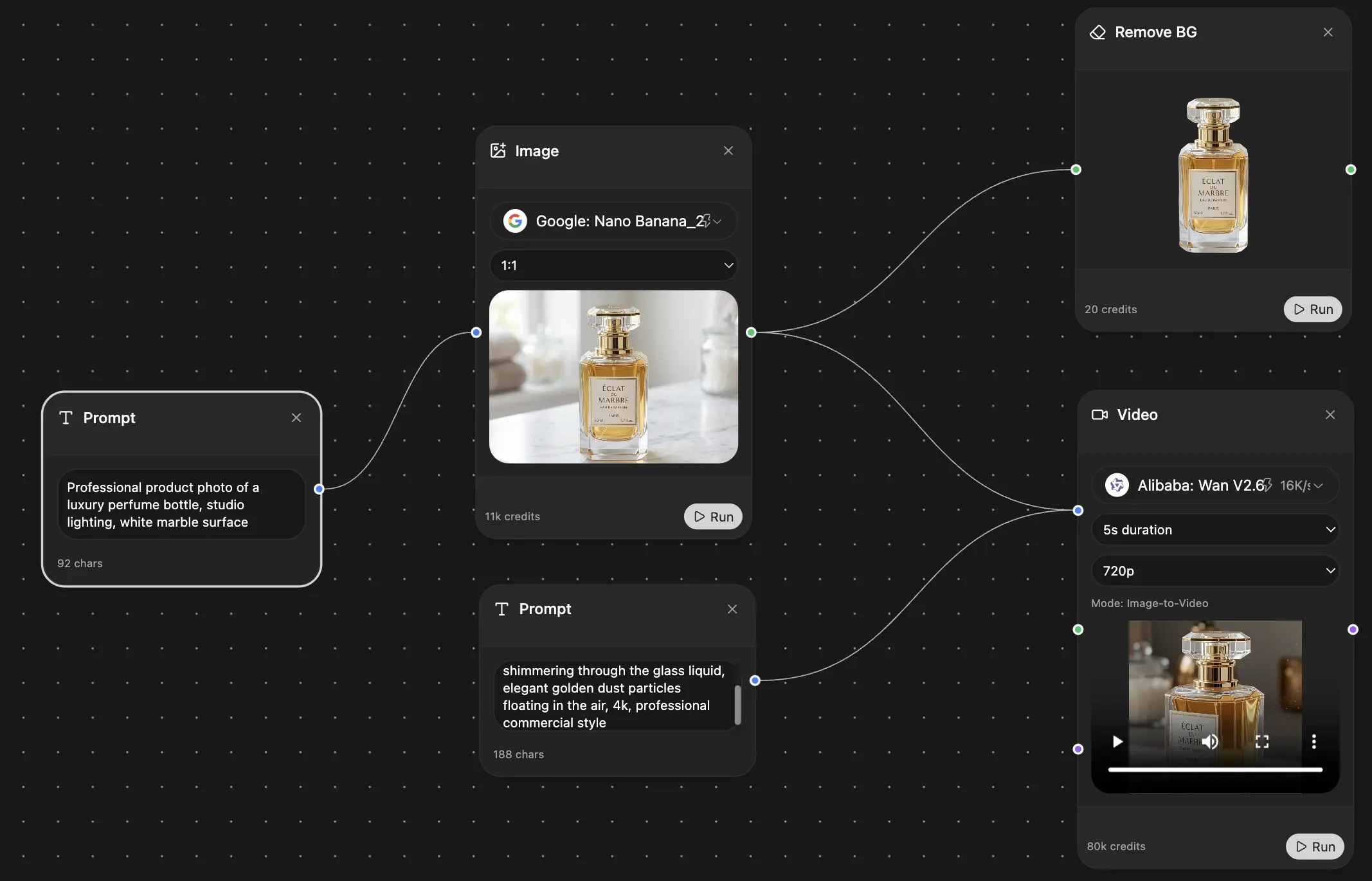
Save hours of work and research
Transparent, High-Value Pricing
Trusted by teams at






Free
No credit card required
- 100 credits daily
- 3 AI models to try
- Basic AI chat
Plus
- 1,000,000 credits/month
- 25+ AI models — GPT, Claude, Gemini, Grok & more
- Agent Mode with web search, computer tools and more
- Creative Studio: image generation and video generation
- Project Library: chat with document, website and youtube, podcast generation, flashcards, reports and more
- Workflow Studio and FocusOS
Professional
- Everything in Plus, and:
- 2,100,000 credits/month
- Pro-exclusive models (Claude Opus, Grok 4, Sonar Pro)
- Motion Tools & Max Mode
- First access to latest features
- Access to additional offers
What Our Users Say
Great Tool after 2 months usage
simplyzubair
I love the way multiple tools they integrated in one platform. So far it is going in right dorection adding more tools.
Best in Kind!
barefootmedicine
This is another game-change. have used software that kind of offers similar features, but the quality of the data I'm getting back and the sheer speed of the responses is outstanding. I use this app ...
simply awesome
MarianZ
I just tried it - didnt wanna stay with it, because there is so much like that out there. But it convinced me, because: - the discord-channel is very response and fast - the number of models are quite...
A Surprisingly Comprehensive and Engaging Experience
bruno.battocletti
Zemith is not just another app; it's a surprisingly comprehensive platform that feels like a toolbox filled with unexpected delights. From the moment you launch it, you're greeted with a clean and int...
Great for Document Analysis
yerch82
Just works. Simple to use and great for working with documents and make summaries. Money well spend in my opinion.
Great AI site with lots of features and accessible llm's
sumore
what I find most useful in this site is the organization of the features. it's better that all the other site I have so far and even better than chatgpt themselves.
Excellent Tool
AlphaLeaf
Zemith claims to be an all-in-one platform, and after using it, I can confirm that it lives up to that claim. It not only has all the necessary functions, but the UI is also well-designed and very eas...
A well-rounded platform with solid LLMs, extra functionality
SlothMachine
Hey team Zemith! First off: I don't often write these reviews. I should do better, especially with tools that really put their heart and soul into their platform.
This is the best tool I've ever used. Updates are made almost daily, and the feedback process is very fast.
reu0691
This is the best AI tool I've used so far. Updates are made almost daily, and the feedback process is incredibly fast. Just looking at the changelogs, you can see how consistently the developers have ...