What Movie Is This Picture from? 5 Easy Methods
Stuck wondering 'what movie is this picture from'? Learn 5 methods from simple reverse image search to powerful AI tools to solve the mystery in seconds.
You're staring at a screenshot and your brain is doing that annoying thing where it says, “I know this movie” and then immediately refuses to help. Maybe it's a meme, maybe it's a random frame from a stream, maybe it's your friend sending you a grainy still like some kind of cinematic hostage note. Either way, the hunt has begun, and the good news is this isn't guesswork anymore, it's a proper little detective job with a few reliable maps.
If your memory is rusty, a quick refresher on visual recall can help before you go spelunking through screenshots, and that's why a lot of people pair movie hunting with something like . The trick is to stop treating the picture like a magic answer key and start treating it like evidence. One clean frame can be enough, but only if you know how to read it like a film nerd who's had three coffees and a suspiciously good eye for set dressing.
That Nagging Feeling of Movie Déjà Vu
Start with the irritation, because that is usually the primary clue. A still pops up in your feed, your brain says, “I know this movie,” and the image just sits there, refusing to hand over the title. That is the point where sloppy guessing wastes time and a tighter workflow saves it.
Treat the frame like evidence and build from there. A quick refresh on visual recall can help before you go digging through screenshots, and a lot of people pair movie hunting with for that reason. Then use a proper chain of evidence, start with reverse image search, crop for the strongest visual anchor, and verify the result against databases like IMDb or TMDb before you call it solved. That order matters because a frame can match several films at first glance, especially after reposts, compression, or meme edits have blurred the details.
Practical rule: if your first guess comes from vibes alone, you're still in the guessing stage, not the confirming stage.
That mindset changes the whole job. You are not just asking, “What movie is this picture from?” You are reading what the image gives you, what it withholds, and which clue will survive a trip through the internet. Once you approach it that way, the search feels less like trivia and more like a clean little case file.
Your First Stop Reverse Image Search
A blurry screenshot can waste time fast, so start with the cleanest frame you have. The usual workflow is simple, use the whole image first, then crop around the most distinctive visual anchor if the first pass turns up junk, then verify the title with another source before you trust the result (). That order gives the search engine context before you strip anything away, which matters when the background is busy or the shot has been reposted half a dozen times.

Google Images and TinEye are still the first tools I reach for, and for good reason. Verification handbooks recommend reverse-searching the photo itself with tools like Google Image Search or TinEye, and they point out that screenshots and thumbnails are the practical entry point for video stills, since there is no free tool that reverse-searches an entire clip the same way (). If one engine stares back blankly, the other may pull up a repost, a captioned version, or a different crop that gets you much closer to the title.
Common pitfalls that trip people up
Low image quality. If the frame is tiny, blurry, or badly lit, search results drift. Use the best file you can find, not a tiny thumbnail. The cleaner the image, the less the engine has to guess.
Cropping the wrong thing first. A random background slice rarely helps. Crop around the object that tells the story, a face, a jacket, a sign, a prop, or a bit of set design that feels specific to one film.
Ignoring wardrobe and styling clues. For fashion-heavy frames, costume details can matter as much as faces and scenery. A practical reference like is useful when the outfit is the strongest clue in the shot.
Treating the first hit as final. Reverse search can surface the same still in a dozen different places, and the first match is not always the right one. Check whether the image is a poster, a screenshot, or a fan edit before you call it solved.
The video below walks through the same process in a more hands-on way, which is handy if you want to see how the crop changes the result set in real time.
Quality still matters more than people expect. Low resolution, bad lighting, or blur can push the results in the wrong direction, so use the clearest file available and skip tiny thumbnails when you can (source). A sharper frame is less glamorous than a lucky guess, but it saves you from confidently naming the wrong movie from the wrong decade.
Using Specialized Movie Finder Tools
General search engines are good at finding the web. Specialized movie finders are good at finding the movie. That's the difference between wandering through a giant library and walking straight to the film shelf with a librarian who already knows your taste and your bad habits.

Modern movie-identification tools are built for speed. Some services say they can identify a film from a screenshot, poster, or still frame and return the title, cast, and release year in seconds, while another says it can recognize a movie from an uploaded image, or even text descriptions, “instantly” (). That speed is the appeal, especially when your screenshot clearly comes from a film but isn't common enough to show up in a plain web search.
Where these tools win
Dedicated tools shine when the frame is recognizable but not famous. They're designed around movie content, so they're more likely to treat a poster, still, or scene as a film problem instead of a generic image problem. Some also support blurrier or more awkward inputs, which is helpful when all you've got is one useful image and a stubborn memory.
A movie finder is fastest when the frame is clean, but it's still useful when the frame is messy and your only alternative is guessing with confidence you don't deserve.
The smart way to use these tools is to treat them as specialists, not oracles. Run your image, read the title suggestions, then check whether the results line up with the kind of scene you've got, because a fast result is not the same thing as a verified one. If you're comparing options, a is useful because it frames image understanding as interpretation, not just lookup.
The big advantage here is convenience. You're not manually hunting through forums or squinting at random posters. You're using a tool that's already biased toward film metadata, film visuals, and film context, which is exactly what you want when the image is from a movie but the web is being coy about it.
Unleash Your Inner Detective with Visual Cues
Sometimes the picture is too generic for a clean match. A hallway is just a hallway, a face is just a face, and a beige apartment interior could belong to half of Hollywood's back catalogue. That's when the human brain gets back in the game, ideally before you start accusing every thriller of being the one you saw on an airplane once.

A practical way to narrow it down is to combine one scene description with two specific trivia clues, then check candidates against the cast, release year, and one irreversible plot event (). Tiny, concrete clues are easier to verify than fuzzy memory. A prop, a shooting choice, or a strange behind-the-scenes detail can narrow the field faster than a vague “it feels like a 90s movie.”
The clues worth hunting
- Props and objects. Look for a weapon, sign, newspaper, vehicle, or gadget that feels tied to a time period.
- Visible text. Background signage, storefront names, packaging, or a title card can give you searchable words.
- Era signals. Clothing cuts, cars, hairstyles, camera texture, and color palette can point to a decade.
- Scene logic. If you remember a line of dialogue, pair it with the visual and search both together.
Poster details can help too. The is useful because poster formats, crops, and artwork styles can show whether a still belongs to a theatrical campaign or a later promotional image. That may sound small, but small clues are what usually break a stubborn identification case. I've had frames that went nowhere until the poster style gave away the era.
If the image includes location clues, use signs, landmarks, or other visible cues to confirm where the frame was taken. You can even pair that with mapping tools like Google Maps or Street View to check whether the background fits the place (). If you want a cleaner way to turn those visual details into search-friendly text, a can help you turn the frame into a useful query. That is practical, not mystical. The frame stops being a mystery picture and starts becoming a place, a costume, and a production choice all at once.
The AI Powerhouse for When Standard Tools Fail
A screenshot can hit a dead end fast. Face-only stills, generic interiors, heavily edited memes, and background frames with almost no context can leave reverse search stuck, especially when the image looks like it was cropped by someone in a hurry. A next-gen AI approach helps because it reads the frame as a scene, not just a bitmap.

For awkward images that are not distinctive enough, visible text, props, and file metadata can improve the odds, which is why AI movie-finder tools that handle detailed scene descriptions often do better than simple image matching (). The shift is practical. Instead of asking, “What exact image already exists online?” ask, “What is happening in this frame, and what would someone type if they described it clearly?”
What to ask the AI to do
AI works better when you treat it like a scene reader, not a yes-or-no machine. Ask it to describe the image in plain language, flag likely era signals, list visible objects, or turn the frame into a stronger search query. That helps when the picture is fuzzy enough to frustrate human eyes but still detailed enough for the model to pull out context.
The same logic shows up in , where the point is to extract usable clues instead of guessing from a single glance. If the model can tell you about wardrobe, setting, text in the frame, or camera style, you have something concrete to test. Those clues are much easier to verify than a vague hunch.
The best use case is the messy one. A meme cropped too tight. A TV scene captured from another screen. A costume shot with no obvious stars. AI helps reconstruct the missing context, which is exactly the gap traditional reverse search does not always cover. If your screenshot feels like a puzzle with half the pieces missing, this gives you a fresh way to sort the edges.
Pairing image analysis with audio can help too, especially if the scene is remembered by a line, a song cue, or a background effect. A guide on is useful when the clue is part image, part sound, which is a very film-nerd problem to have. It is not flashy, but it gets results.
Pro Tips and Final Verification
The last check is the one that keeps you from calling it too early. A title that looks right is still only a working guess until it matches the cast, plot, and release details on a trusted database such as IMDb or TMDb, which is why practical guidance points toward a multi-stage evidence check instead of trusting a single query.
A simple checklist keeps the search honest:
- Cross-check the title. Make sure the candidate fits the image, not just your memory.
- Inspect cast and year. Look for the actors, release window, and scene context together.
- Compare the plot. One clear plot event should line up with what you remember.
- Ask the crowd if needed. Reddit's movie communities and tip-of-the-tongue corners can rescue a stubborn frame.
If the movie fit requires three separate mental contortions, it probably isn't the right one.
The strongest workflow is still the boring one, and boring usually wins. Start with a clean frame, try more than one reverse search engine, crop the most distinctive anchor, then check the result against an external database before you call it solved. That sequence does more than answer what movie is this picture from. It also keeps you from confidently announcing the wrong title in front of friends, which is a social risk nobody needs.
The practical habit is to treat every hit as a clue, not a verdict. Visual cues narrow the field, reverse search gets you the first pass, and a final database check separates the actual match from the near miss. If the frame still feels slippery after that, a next-step AI tool like Zemith can help you describe the image more clearly, build better search terms, and spot details that are easy to miss when you are staring at the same screenshot for the tenth time. That gives you a full workflow, from old-school detective work to the last verification pass, without pretending one tool does everything.
If you want a faster way to handle tricky screenshots, odd crops, and image analysis that goes beyond basic matching, visit . It gives you a practical AI workspace for describing images, building better search clues, and getting unstuck when reverse image search taps out. When the picture is muddy and the title is hiding, Zemith makes the whole detective routine a lot less annoying.
Explore Zemith Features
Everything you need. Nothing you don't.
One subscription replaces five. Every top AI model, every creative tool, and every productivity feature, in one focused workspace.
Every top AI. One subscription.
ChatGPT, Claude, Gemini, DeepSeek, Grok & 25+ more







Always on, real-time AI.
Voice + screen share · instant answers
What's the best way to learn a new language?
Immersion and spaced repetition work best. Try consuming media in your target language daily.
Voice + screen share · AI answers in real time
Image Generation
Flux, Nano Banana, Ideogram, Recraft + more

Write at the speed of thought.
AI autocomplete, rewrite & expand on command
Any document. Any format.
PDF, URL, or YouTube → chat, quiz, podcast & more
Video Creation
Veo, Kling, Grok Imagine and more

Text to Speech
Natural AI voices, 30+ languages
Code Generation
Write, debug & explain code
Chat with Documents
Upload PDFs, analyze content
Your AI, in your pocket.
Full access on iOS & Android · synced everywhere
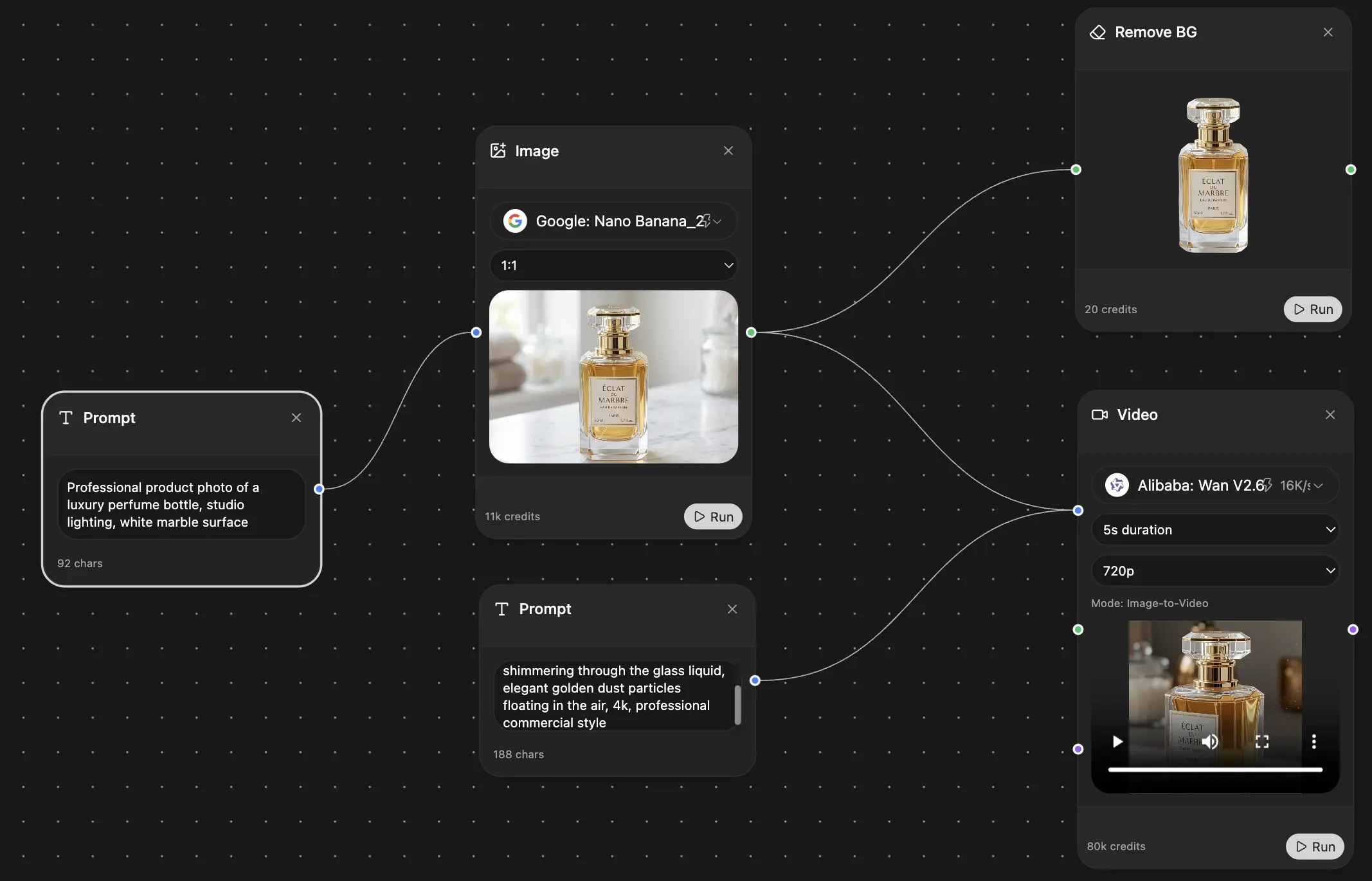
Your infinite AI canvas.
Chat, image, video & motion tools — side by side
Save hours of work and research
Transparent, High-Value Pricing
Trusted by teams at

Free
No credit card required
- 100 credits daily
- 3 AI models to try
- Basic AI chat
Plus
- 1,000,000 credits/month
- 25+ AI models — GPT, Claude, Gemini, Grok & more
- Agent Mode with web search, computer tools and more
- Creative Studio: image generation and video generation
- Project Library: chat with document, website and youtube, podcast generation, flashcards, reports and more
- Workflow Studio and FocusOS
Professional
- Everything in Plus, and:
- 2,100,000 credits/month
- Pro-exclusive models (Claude Opus, Grok 4, Sonar Pro)
- Motion Tools & Max Mode
- First access to latest features
- Access to additional offers
What Our Users Say
Great Tool after 2 months usage
simplyzubair
I love the way multiple tools they integrated in one platform. So far it is going in right dorection adding more tools.
Best in Kind!
barefootmedicine
This is another game-change. have used software that kind of offers similar features, but the quality of the data I'm getting back and the sheer speed of the responses is outstanding. I use this app ...
simply awesome
MarianZ
I just tried it - didnt wanna stay with it, because there is so much like that out there. But it convinced me, because: - the discord-channel is very response and fast - the number of models are quite...
A Surprisingly Comprehensive and Engaging Experience
bruno.battocletti
Zemith is not just another app; it's a surprisingly comprehensive platform that feels like a toolbox filled with unexpected delights. From the moment you launch it, you're greeted with a clean and int...
Great for Document Analysis
yerch82
Just works. Simple to use and great for working with documents and make summaries. Money well spend in my opinion.
Great AI site with lots of features and accessible llm's
sumore
what I find most useful in this site is the organization of the features. it's better that all the other site I have so far and even better than chatgpt themselves.
Excellent Tool
AlphaLeaf
Zemith claims to be an all-in-one platform, and after using it, I can confirm that it lives up to that claim. It not only has all the necessary functions, but the UI is also well-designed and very eas...
A well-rounded platform with solid LLMs, extra functionality
SlothMachine
Hey team Zemith! First off: I don't often write these reviews. I should do better, especially with tools that really put their heart and soul into their platform.
This is the best tool I've ever used. Updates are made almost daily, and the feedback process is very fast.
reu0691
This is the best AI tool I've used so far. Updates are made almost daily, and the feedback process is incredibly fast. Just looking at the changelogs, you can see how consistently the developers have ...