Translation from Spanish to Chinese: AI Workflow for 2026
Master your translation from Spanish to Chinese using our AI workflow. Learn pre-processing, post-editing, and Zemith for professional results in 2026.
You've got a Spanish document on one screen, a Chinese-speaking client waiting for a reply, and that sinking feeling that a fast machine translation could turn a polite offer into something stiff, weird, or accidentally funny. That's the core problem with translation from Spanish to Chinese. It's rarely about converting words. It's about carrying intent, hierarchy, and commercial meaning across two systems that don't naturally line up.
Most advice online still falls into the same tired debate: use AI or use a human. In practice, that's the wrong framing. For this language pair, the workflow that holds up under pressure is hybrid. Let AI do the first heavy lift. Then bring human judgment to the points where tone, terminology, and regional usage can go off the rails. That's how teams move faster without shipping nonsense.
Why Spanish to Chinese Translation Is So Tricky
A lot of people start with the obvious point: Spanish and Chinese are different languages. True, but that barely scratches it. The hard part is that they encode meaning differently, prioritize context differently, and break in different places when you force a literal translation.

The structural gap is massive
Spanish gives you visible clues. Verb endings, gender, articles, sentence rhythm. Chinese handles far more through context, word order, and character-based meaning. That mismatch matters in every serious workflow, especially when source text is informal, overloaded, or written by five different people who all think they're “being clear.”
The business stakes are large too. The Spanish-to-Chinese translation pair is critical for global trade, as China and Latin American nations have seen bilateral trade volumes surge to over $450 billion annually, yet the linguistic complexity is immense: Spanish uses a 27-letter alphabet while functional literacy in Chinese requires mastering around 3,500 logographic characters, according to .
That's why basic word swapping fails. A good translation from Spanish to Chinese has to decide what the sentence is doing, not just what it says.
Culture is where clean drafts go to die
A Spanish sales line that sounds warm can come across as vague in Chinese. A Chinese rendering that sounds appropriately formal in one business setting can feel cold or overdone in another. Humor gets flattened. Softening phrases disappear. Tiny status markers suddenly matter a lot.
Practical rule: If the message affects money, trust, or compliance, never accept the first machine output as final.
One thing that helps is understanding how meaning is layered before you translate. If you're working with product copy, negotiations, or customer messaging, semantic intent matters as much as terminology. A useful primer on that is .
Why hybrid beats the fake AI-versus-human argument
Pure human translation is careful but slower. Pure AI is fast but often too literal in the wrong places. The sweet spot is a hybrid loop:
That last part matters. Hybrid isn't magic. It works because you stop asking one tool or one person to do everything. And yes, it saves you from the classic “our slogan now reads like a customs warning” situation.
Setting Up Your Spanish Text for AI Success
Bad source text creates bad translations. I've seen teams blame the engine when the actual issue was the Spanish draft: long sentences, mixed audiences, legal phrasing jammed into marketing copy, and regional slang dropped into operational instructions like everybody on earth grew up in the same neighborhood.

Clean the source before you translate it
When preparing translation from Spanish to Chinese, the best first move is editing the Spanish for clarity. Not dumbing it down. Clarifying it.
Use this pre-flight checklist:
- Break long sentences: Spanish tolerates winding syntax better than many translation systems do. Split multi-clause paragraphs into shorter units with one idea each.
- Remove hidden ambiguity: If “su” could point to the client, the distributor, or the end user, rewrite it.
- Flag regionalisms: Words that feel normal in Mexico, Spain, Colombia, or Chile may not transfer cleanly into a neutral business baseline.
- Standardize terminology: Pick one term for each product, process, and department. Don't alternate just to sound fancy.
- Label the audience: Is this for procurement, consumers, internal training, or a distributor? AI performs better when that intent is explicit.
Fix the messy inputs first
The biggest gains often come before translation even starts. If the source file is a PDF, scanned contract, or brochure export, extract the text cleanly first instead of pasting fragments with broken line wraps and random headers. A practical guide to that step is .
Then review the Spanish draft for three high-risk items:
If your source text reads like someone wrote it during a coffee shortage and a deadline panic, the translation will show it.
Build an AI-friendly master copy
My preferred approach is to create one “master Spanish” version before any AI draft gets generated. That version should be plain, specific, and free of ornamental clutter. If a sentence exists only because someone wanted it to “sound more premium,” it usually deserves a second look.
A solid master copy has a few characteristics:
- One audience per document
- One tone per section
- One approved term per concept
- One explicit meaning per sentence
That prep work feels slow the first time. It isn't. It saves time on the back end because you spend less effort untangling mistranslations and less money paying someone to fix text that was confusing before it ever left Spanish.
Choosing Your AI Engine on Zemith
Using one default model for translation from Spanish to Chinese is like bringing a butter knife to a machine shop. Technically, you brought a tool. Practically, you're going to suffer.
Different AI models make different bets. Some are better at preserving structure in technical documents. Others produce more natural marketing language. Some follow instructions tightly. Others improvise in ways that are useful until they absolutely are not.

One model won't cover every failure mode
Regional language is where single-model confidence starts to wobble. Current Spanish-to-Chinese translation tools often fail to handle regional dialects, with 68% of Mexican exporters reporting translation errors due to ignored idioms when dealing with partners in Guangdong or Fujian provinces, as noted by .
That doesn't mean AI is useless. It means testing matters. If one model smooths over a Mexican idiom into bland generic Spanish before translating, and another preserves the local meaning better, you want to see both outputs side by side.
Compare outputs, don't marry the first one
A multi-model workflow proves its worth. Instead of asking one engine to be perfect, compare several drafts and judge them by purpose.
A simple evaluation grid works well:
For teams exploring the broader tooling options, is a useful comparison read because it frames platform choice around workflow, not hype.
The practical move is to test a representative sample first. Don't evaluate on your easiest paragraph. Feed the system the ugly stuff: a negotiation email, a pricing note, a product claim with regional language, a paragraph with implied politeness. That's where weak engines expose themselves.
Prompt for audience and intent
A lot of mediocre AI translations come from lazy prompting. “Translate this into Chinese” is too thin. Better prompts include:
- Audience: distributor, procurement lead, end customer, operations manager
- Tone: formal, neutral business, customer-friendly, technical
- Variant guidance: Simplified Chinese, preserve brand names in Latin script where appropriate
- Non-negotiables: do not translate glossary terms, retain legal qualifiers, avoid slang
If you want to see how side-by-side testing works in practice, are worth studying.
A short walkthrough helps too:
A useful habit: Keep a “winner notes” file. Track which model handles which content best. After a few projects, your selection process gets much faster.
Handling Tough Spanish to Chinese Nuances
This is the part that separates a decent translation from one that helps a deal move forward. Machines can draft. They still struggle when meaning depends on social position, implied tone, or context that sits outside the sentence.
Formality is not decoration
Spanish gives you visible choices like tú and usted. Chinese can encode similar respect differences, but not always in a one-to-one way. If you flatten everything into generic politeness, the translation may sound serviceable yet socially off.
That risk gets sharper in live trade communication. There is severe demand for real-time, low-latency speech translation that preserves tone and formality levels, and 42% of surveyed trade professionals report mistranslated respect levels that damage negotiations, according to .
Here's the practical implication for documents too: you need a style policy before translation starts.
A simple policy might define:
- when the Chinese output should sound deferential
- when neutral corporate language is enough
- which customer-facing materials can sound warmer
- how to handle requests, refusals, and conditions
Idioms need replacement, not worship
The worst source text for translation from Spanish to Chinese is often “friendly” copy. The writer thinks they're making it lively. The translator inherits a small disaster.
Take phrases that depend on local humor, understatement, or double meaning. Literal transfer rarely works. The right move is usually to replace the idiom with the business function behind it.
For example:
A translation doesn't fail only when it's wrong. It also fails when it's technically accurate but socially awkward.
Brand names, nouns, and gender need rules
Spanish marks gender all over the place. Chinese usually doesn't. That sounds simple until your source text leans on adjective agreement, role labels, or gendered phrasing as part of the message. If you don't normalize that carefully, the Chinese output can feel oddly repetitive or lose a nuance the original relied on.
Proper nouns create another trap. Teams often let AI make naming decisions sentence by sentence, which is how one product ends up with three renderings in the same file.
Use a project glossary with at least these fields:
- Approved source term
- Approved Chinese rendering
- Keep in original language or translate
- Context note
- Forbidden alternatives
That sounds bureaucratic. It isn't. It's what keeps your documentation from drifting.
If you want a reminder of how much nuance can hide in a “simple” language pair, a good parallel example is . The languages differ, but the lesson is similar: formality, context, and domain language break naive automation fast.
Use iterative correction instead of one-shot perfection
The strongest practitioners I know don't expect the first draft to nail nuance. They interrogate it. They ask targeted questions.
Good revision prompts sound like this:
- Does this paragraph sound appropriately formal for a supplier negotiation?
- Is this sentence too direct for a first outreach message?
- Keep the meaning, but remove local slang from the Chinese output.
- Preserve the legal caution in this clause without sounding hostile.
That iterative loop beats the old “translate once, pray once” method every time.
Polishing Your AI Draft Like a Pro
The first draft is where speed shows up. Post-editing is where professionalism shows up. This is the stage where you stop treating translation like text conversion and start treating it like editorial work.

Review in passes, not all at once
Trying to fix everything in one read is inefficient. Split the review into separate passes so your brain isn't checking tone, terminology, and formatting at the same time.
A practical review sequence:
- Pass one for accuracy: Did the meaning survive?
- Pass two for terminology: Are key terms consistent?
- Pass three for tone: Does it sound right for the audience?
- Pass four for flow: Would a native reader trip over this?
- Pass five for layout: Did lists, tables, headings, and labels stay intact?
Ask better editorial questions
AI once again proves more useful. Not as the final judge, but as a fast editorial assistant. Instead of asking “is this good,” ask pointed questions that force a specific check.
Examples:
One reason this workflow is becoming standard is market pressure. The translation services market is forecasted to grow to $36.35 billion by 2030, with growth specifically driven by the “increasing use of AI-assisted translation workflows,” according to .
What pros actually check before sign-off
A final quality check should answer four questions:
- Did the Chinese text preserve intent, not just wording?
- Are all business-critical terms stable across the document?
- Does the tone match the audience and relationship level?
- Would a native reader think this was written carelessly?
Final check: Read the Chinese output as if you were the buyer, not the translator. That catches stiffness faster than line-by-line comparison alone.
If the document matters, get a native reviewer with domain familiarity to do the last pass. Not because AI is hopeless. Because the cost of a subtle mistake is often paid in trust, not grammar.
Taking Your Translation Live with AI
Documents are the easy part. Live conversations are where translation from Spanish to Chinese gets serious. In a negotiation, onboarding call, factory discussion, or training session, you don't have the luxury of pausing for a perfect rewrite. You need support that's fast, coherent, and socially aware.
Real-time translation has different stakes
In live settings, a small tone error lands harder than it does on paper. A direct phrase can sound rude. A softened commitment can sound evasive. A mistranslated honorific can make the other side wonder whether your team understands the relationship at all.
That's why the formality issue matters so much in speech workflows, as noted earlier. The goal isn't robotic literalism. The goal is keeping the conversation moving without flattening the human signals that keep business interactions smooth.
Build a system around the call
The best live setup is operational, not magical. Prepare the same way you would for a document, just faster.
Use a simple live checklist:
- Share key terms beforehand: product names, departments, shipping terms, compliance language
- Define the relationship level: first meeting, active vendor, executive review, training session
- Keep one monitor for notes: track recurring terms and corrections during the call
- Debrief right after: capture phrases that caused confusion and add them to your glossary
For teams building broader automated workflows around multilingual operations, is a handy reference for thinking about how translation, task routing, and follow-up systems can work together.
If you're exploring conversational setups, is the kind of implementation thinking that helps. The same principle applies here: live AI works best when it has boundaries, context, and human oversight.
The old argument about AI replacing translators misses the point. The key upgrade is that AI can handle the repetitive load, surface options quickly, and support real-time multilingual work, while humans stay focused on judgment calls. That's the workflow that scales.
If you handle multilingual documents, meetings, or research and want one workspace for drafting, comparing AI outputs, revising, and live collaboration, is worth a look. It brings multi-model AI, document interaction, writing support, and live AI tools into one place, which is exactly the kind of setup that makes tricky language pairs easier to manage without juggling a pile of separate apps.
Explore Zemith Features
Everything you need. Nothing you don't.
One subscription replaces five. Every top AI model, every creative tool, and every productivity feature, in one focused workspace.
Every top AI. One subscription.
ChatGPT, Claude, Gemini, DeepSeek, Grok & 25+ more







Always on, real-time AI.
Voice + screen share · instant answers
What's the best way to learn a new language?
Immersion and spaced repetition work best. Try consuming media in your target language daily.
Voice + screen share · AI answers in real time
Image Generation
Flux, Nano Banana, Ideogram, Recraft + more

Write at the speed of thought.
AI autocomplete, rewrite & expand on command
Any document. Any format.
PDF, URL, or YouTube → chat, quiz, podcast & more
Video Creation
Veo, Kling, Grok Imagine and more

Text to Speech
Natural AI voices, 30+ languages
Code Generation
Write, debug & explain code
Chat with Documents
Upload PDFs, analyze content
Your AI, in your pocket.
Full access on iOS & Android · synced everywhere
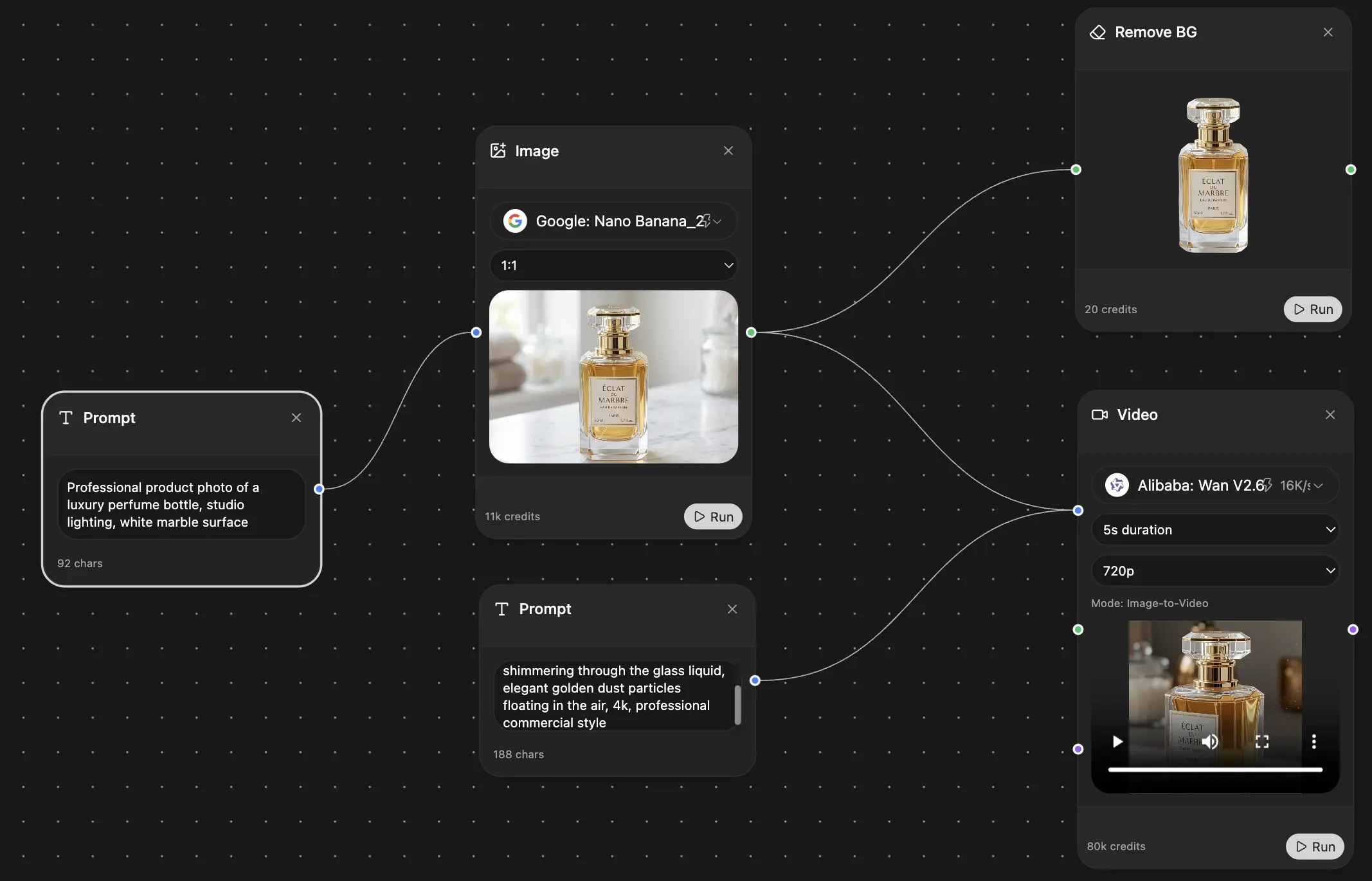
Your infinite AI canvas.
Chat, image, video & motion tools — side by side
Save hours of work and research
Transparent, High-Value Pricing
Trusted by teams at






Free
No credit card required
- 100 credits daily
- 3 AI models to try
- Basic AI chat
Plus
- 1,000,000 credits/month
- 25+ AI models — GPT, Claude, Gemini, Grok & more
- Agent Mode with web search, computer tools and more
- Creative Studio: image generation and video generation
- Project Library: chat with document, website and youtube, podcast generation, flashcards, reports and more
- Workflow Studio and FocusOS
Professional
- Everything in Plus, and:
- 2,100,000 credits/month
- Pro-exclusive models (Claude Opus, Grok 4, Sonar Pro)
- Motion Tools & Max Mode
- First access to latest features
- Access to additional offers
What Our Users Say
Great Tool after 2 months usage
simplyzubair
I love the way multiple tools they integrated in one platform. So far it is going in right dorection adding more tools.
Best in Kind!
barefootmedicine
This is another game-change. have used software that kind of offers similar features, but the quality of the data I'm getting back and the sheer speed of the responses is outstanding. I use this app ...
simply awesome
MarianZ
I just tried it - didnt wanna stay with it, because there is so much like that out there. But it convinced me, because: - the discord-channel is very response and fast - the number of models are quite...
A Surprisingly Comprehensive and Engaging Experience
bruno.battocletti
Zemith is not just another app; it's a surprisingly comprehensive platform that feels like a toolbox filled with unexpected delights. From the moment you launch it, you're greeted with a clean and int...
Great for Document Analysis
yerch82
Just works. Simple to use and great for working with documents and make summaries. Money well spend in my opinion.
Great AI site with lots of features and accessible llm's
sumore
what I find most useful in this site is the organization of the features. it's better that all the other site I have so far and even better than chatgpt themselves.
Excellent Tool
AlphaLeaf
Zemith claims to be an all-in-one platform, and after using it, I can confirm that it lives up to that claim. It not only has all the necessary functions, but the UI is also well-designed and very eas...
A well-rounded platform with solid LLMs, extra functionality
SlothMachine
Hey team Zemith! First off: I don't often write these reviews. I should do better, especially with tools that really put their heart and soul into their platform.
This is the best tool I've ever used. Updates are made almost daily, and the feedback process is very fast.
reu0691
This is the best AI tool I've used so far. Updates are made almost daily, and the feedback process is incredibly fast. Just looking at the changelogs, you can see how consistently the developers have ...