Technical Writing Tool Features Every Team Actually Needs
Find the right technical writing tool for your team. Learn must-have features, evaluation checklists, real workflows, and how AI platforms fit in.
Your docs looked fine on Monday. Then the release landed, the screenshots were outdated, the API reference had drifted, the onboarding email still named the old workflow, and someone in support was now answering questions with a confidence that exceeded the documentation's actual truth. That's usually the moment a team starts googling technical writing tool options, not because they want a shinier editor, but because the current stack can't keep pace with the product.
That search gets messy fast. A lot of tools look helpful in a demo and then fall apart the second a release train starts moving, a subject matter expert goes on vacation, or a compliance reviewer asks who approved the last change. The useful way to think about a technical writing tool is not “Which app has the prettiest writing surface?” It's “Which system keeps documentation accurate when the product, people, and process all keep changing?”
The Documentation Fire That Started This Search
The classic failure mode is simple. A product team ships on Tuesday, and by Friday the in-app help, the public docs, the PDF manual, and the onboarding email all describe different behavior. Nobody on the team is lazy, they're just trapped in a tool stack that doesn't carry change cleanly from draft to publish. When this happens, the problem isn't prose. It's workflow.
That's why a technical writing tool is closer to a documentation operating system than a fancier notebook. It has to keep structure, review, version history, and publishing tied together so edits don't disappear into copy-paste limbo. If your stack still relies on one person remembering to update four places by hand, you're not using a system, you're using hope with a toolbar.
The market is also telling the same story. One report values the global technical writing tool market at USD 2.38 billion in 2024 and projects USD 5.0 billion by 2035, while another estimates USD 289.1 million in 2022 and USD 480.5 million by 2030. The absolute numbers differ, but the direction doesn't, and that matters because buyers are clearly treating documentation software as part of digital operations, not sidecar writing software.
For teams trying to reduce document sprawl, a good starting point is how documentation automation changes the way content moves across systems, not just how quickly someone types. is a useful companion read if your current problem is repeat manual updates.
What a Technical Writing Tool Does
A technical writing tool turns messy expert knowledge into content people can trust. That job is wider than a plain editor can handle. Source material usually comes from interviews, specs, screenshots, code comments, meeting notes, and the occasional “this should be obvious” Slack message that turns out to be anything but obvious.
It's a kitchen, not a word processor
A word processor is a countertop. A technical writing tool is the whole kitchen. It gives you prep space, a recipe system, storage bins, timers, and a cleanup routine, so the same ingredients can become different meals without creating chaos. One source of truth goes in, and help articles, API references, release notes, and compliance docs come out in a consistent shape.

The practical difference is control. A generic wiki can work well for shared memory, but it usually does not enforce modular reuse, controlled output formats, or the review discipline that keeps regulated or fast-moving docs from drifting. A real technical writing tool gives writers a structured workspace where content can be assembled once and republished in multiple ways without turning the docs team into a copy-paste repair crew.
Practical rule: If the tool cannot help you preserve truth across edits, it helps you write, but it does not help you publish trustworthy documentation.
Modern AI assistance fits here too. In stronger setups, the tool does more than draft text. It helps collect context, rephrase, compare versions, and keep the review loop tight enough that humans can still verify the result. Screen Charm's is a useful outside comparison if you are sorting through categories and want a practical lens rather than vendor copy.
Essential Features That Actually Matter Day to Day
Most feature lists treat everything as equal, which is how teams end up paying for shiny extras while the release notes still drift. The features that matter are the ones that remove a specific pain point, like duplicated paragraphs, SME bottlenecks, or review chaos. If a feature doesn't make one of those problems smaller, it's probably decoration.
The seven clusters worth caring about
Authoring should mean structured blocks, variables, and conditional text, not just another rich text box with prettier buttons. Collaboration means review comments, permissions, and real-time editing that doesn't create merge-conflict theater. Versioning needs readable history and diffs, not a mystery log that only the admin understands.
Single-sourcing is the superpower. Update one approved paragraph, then let that change flow into help pages, PDFs, and release notes without copy-paste archaeology. Publishing matters because teams rarely need one output, they need several, and the same content has to survive help centers, Markdown, PDFs, and developer portals.
Review workflows need approvals, SME sign-off, and audit trails, especially when product and compliance both care about who changed what. AI assistance is useful for drafting, summarizing, and surfacing claims that need citations, but humans still need to verify facts, especially when terminology or release details matter. Independent writing guidance says fact-checking belongs near the end, after structure and clarity checks, with product features confirmed against official docs and dates, versions, compatibility, and statistics cross-checked against primary sources.
You can tighten the actual content workflow with Zemith's writing and documentation guidance too. Their resource lines up with the same operational reality, which is that structure and review beat last-minute polish every time.
A tool that helps you draft faster but makes review harder is usually a net loss for teams shipping real docs.
How Tool Categories Stack Up Against Each Other
Not every team needs the same category of tool. A three-person docs team probably doesn't need a heavy CCMS, and an API platform team usually doesn't want to manage a giant manual-first system. The point is to match the tool to the documentation architecture, not to the marketing page.
Technical writing tool categories at a glance
A word processor works when the document is basically a draft. It breaks down when a team needs repeatable publishing, traceable edits, or modular reuse. Help-authoring tools are stronger for manuals and regulated content because they keep structure intact, but they can feel like overkill if your team lives inside Git and ships docs with code.
Docs-as-code platforms are usually the right lane for engineering-heavy teams. They're excellent for Markdown, Git review, and release alignment, but non-technical reviewers often struggle unless there's a friendlier layer on top. AI-native workspaces are the newest category, and they're interesting because they collapse note-taking, drafting, research, and review into one environment instead of sending writers across half a dozen tabs.
That's where the current situation gets practical. If your team spends more time moving content between tools than improving the content itself, a workspace that combines drafting and collaboration is worth a serious look. ProdShort's guide on how to is a handy example of how much time can disappear into context-switching before anyone even starts writing.
For teams comparing collaboration layers, Zemith's article is worth a read because the review experience usually determines whether a tool sticks or gets abandoned by week two.
An Evaluation Framework You Can Use Next Week
Vendor demos are designed to make everything look smooth. Your scorecard should be designed to catch the ugly parts, because the ugly parts are what your team will live with. If you're buying a technical writing tool, evaluate it on whether it helps you keep content accurate after the first release, not whether the interface looked nice in a browser tab.
Use weighted criteria, not vibes
Give content reuse real weight. If the tool can't let you update once and publish many times, the team is still doing manual maintenance somewhere else. Give review workflow weight too, because approval paths and SME sign-off are where docs either get trusted or ignored.
Output formats deserve their own score because you often need more than one. If you need help center pages, PDFs, and Markdown exports, the tool has to handle the handoff cleanly. Add AI governance, integration, security, and total cost after that, because clever drafting features won't matter much if the tool can't sit inside your existing process.

A simple 1 to 5 rubric works well. At 1, the tool can't support the workflow at all. At 3, it works, but only with extra manual cleanup. At 5, it supports the workflow cleanly enough that the team can trust it without building side systems around it. The point isn't perfection, it's spotting where the hidden labor will land.
Before you buy, ask vendors a few hard questions. Can you trace who approved a change? Can you keep terminology consistent across releases? What happens when source material changes after the draft is written? How does the tool help prevent hallucinations, stale claims, and version mismatches? If the answers sound fuzzy, the product is probably fuzzier than the demo.
For a practical brainstorming aid when you're mapping messy inputs into a documentation plan, Zemith's piece can help teams think through side-by-side evaluation without turning it into a spreadsheet graveyard.
Three Real Workflows From Real Teams
The cleanest way to judge a tool is to watch what it does at 2 p.m. on a Wednesday. That's when the release notes are due, the screenshots are stale, and someone just asked whether the API change is already reflected in the customer portal. Real teams don't need abstract feature lists, they need workflows that hold up under pressure.
Developer docs, product help, and research all look different
In a developer-API workflow, the input is usually code change history, reference docs, and maybe an engineering spec. The technical writing tool should let the writer import that context, reshape it into reference content, and produce updated API docs alongside the release. That's where version awareness matters more than pretty formatting.
In a SaaS help-center workflow, the inputs are often screen recordings, product notes, and SME feedback. The writer needs to restructure raw material into a help article, then route it through review before publishing into the in-app knowledge base. If the tool can't handle review comments cleanly, the team spends more time chasing feedback than writing.
The research workflow looks different again. Here the inputs are source papers, transcripts, notes, and citations. The tool needs to support deep reading, source tracing, and a clean final output, usually a report or a summarized brief. That's exactly where AI-native workspaces start to earn attention, because they can combine document chat, first-draft support, and research in one place.
A practical AI workspace can collapse a lot of that churn. Zemith, for example, combines Document Assistant, Smart Notepad, Deep Research, and multi-model access in one workspace, which is useful when a writer needs to move from raw notes to a verified draft without bouncing through a stack of separate apps. That kind of consolidation matters most when the bottleneck is switching, not typing.
Rolling Out a New Tool Without Burning the Team Out
Adoption kills more tools than features do. Teams buy software with a clean rollout in mind, then someone imports the wrong folder, the style guide forks, screenshots disappear, and half the team keeps writing in the old system because that's where the muscle memory lives. A rollout plan has to be boring in the right way.
Move in small, owned slices
Start with one pilot doc family in week one. Pick the family with enough pain to matter, but not so much chaos that you can't tell whether the new tool helped. By week three, migrate those pilot docs and make one person responsible for the family so questions don't bounce around forever.
By week six, expand to a second team once the first workflow is stable. Don't widen the blast radius before the first group has resolved the naming convention, screenshot handling, and review path. By then, the legacy system should be close to locked out for the pilot content so the team isn't maintaining two sources of truth.
The traps are predictable. Shadow wikis show up when people don't trust the new path. Conflicting style guides show up when the tool migrates content but not standards. Lost screenshots show up when assets get moved without a clean import rule. A single import script and one owner per doc family prevent a lot of that nonsense.
Practical rule: Phase AI in like a helper, not a referee. Start with summarizing and rephrasing, then draft-from-outline, and leave autonomous behavior for later, if at all.
If your team is juggling parallel projects during rollout, Zemith's guidance is a useful companion because migration work tends to pile up right when normal documentation work refuses to slow down.
Bringing It All Together With a Single Workspace
The honest payoff is this: teams don't need six best-of-breed tools glued together with manual habits. They need one workspace where research, drafting, review, and publishing stop fighting each other. That's especially true now that the job has shifted toward verification, context handling, and release alignment instead of plain drafting.
The seven feature clusters all point in the same direction. Authoring needs structure, collaboration needs clean review loops, versioning needs readable change history, single-sourcing needs reuse, publishing needs flexible outputs, review workflows need sign-off, and AI assistance needs guardrails. If one platform can hold those pieces together, the docs team spends less time reconciling tools and more time fixing the actual content.
That's why an AI-native workspace like Zemith is worth considering for small and mid-sized teams. It combines a Smart Notepad, Document Assistant, Deep Research, and multi-model AI in a single environment, so a writer can move from rough notes to verified content without stitching together separate subscriptions for writing, research, and review. It's not magic, it's just fewer handoffs.
The decision for this week is simple. Pick one doc family that keeps drifting, then test whether a single workspace can reduce the cleanup. If it can't, the tool isn't ready for your workflow. If it can, you've probably found the part of the stack that's been wasting your team's time all along.
If you're trying to reduce documentation drift, tame SME bottlenecks, and keep AI from freelancing past your facts, Zemith gives you a single workspace for drafting, research, and review. Take a look at and see whether your next pilot doc family fits better in one stack than in five disconnected tools.
Explore Zemith Features
Everything you need. Nothing you don't.
One subscription replaces five. Every top AI model, every creative tool, and every productivity feature, in one focused workspace.
Every top AI. One subscription.
ChatGPT, Claude, Gemini, DeepSeek, Grok & 25+ more







Always on, real-time AI.
Voice + screen share · instant answers
What's the best way to learn a new language?
Immersion and spaced repetition work best. Try consuming media in your target language daily.
Voice + screen share · AI answers in real time
Image Generation
Flux, Nano Banana, Ideogram, Recraft + more

Write at the speed of thought.
AI autocomplete, rewrite & expand on command
Any document. Any format.
PDF, URL, or YouTube → chat, quiz, podcast & more
Video Creation
Veo, Kling, Grok Imagine and more

Text to Speech
Natural AI voices, 30+ languages
Code Generation
Write, debug & explain code
Chat with Documents
Upload PDFs, analyze content
Your AI, in your pocket.
Full access on iOS & Android · synced everywhere
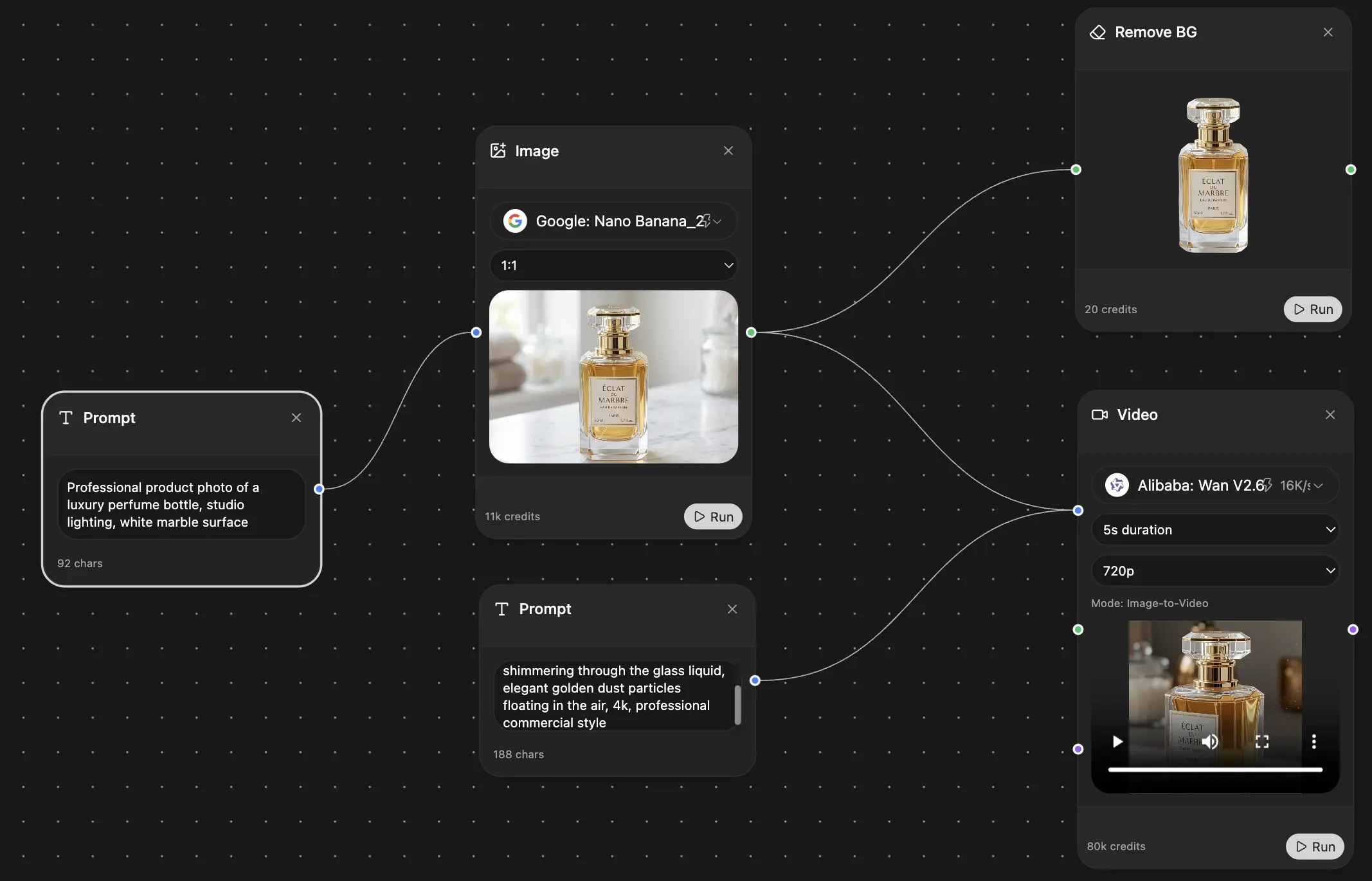
Your infinite AI canvas.
Chat, image, video & motion tools — side by side
Save hours of work and research
Transparent, High-Value Pricing
Trusted by teams at






Free
No credit card required
- 100 credits daily
- 3 AI models to try
- Basic AI chat
Plus
- 1,000,000 credits/month
- 25+ AI models — GPT, Claude, Gemini, Grok & more
- Agent Mode with web search, computer tools and more
- Creative Studio: image generation and video generation
- Project Library: chat with document, website and youtube, podcast generation, flashcards, reports and more
- Workflow Studio and FocusOS
Professional
- Everything in Plus, and:
- 2,100,000 credits/month
- Pro-exclusive models (Claude Opus, Grok 4, Sonar Pro)
- Motion Tools & Max Mode
- First access to latest features
- Access to additional offers
What Our Users Say
Great Tool after 2 months usage
simplyzubair
I love the way multiple tools they integrated in one platform. So far it is going in right dorection adding more tools.
Best in Kind!
barefootmedicine
This is another game-change. have used software that kind of offers similar features, but the quality of the data I'm getting back and the sheer speed of the responses is outstanding. I use this app ...
simply awesome
MarianZ
I just tried it - didnt wanna stay with it, because there is so much like that out there. But it convinced me, because: - the discord-channel is very response and fast - the number of models are quite...
A Surprisingly Comprehensive and Engaging Experience
bruno.battocletti
Zemith is not just another app; it's a surprisingly comprehensive platform that feels like a toolbox filled with unexpected delights. From the moment you launch it, you're greeted with a clean and int...
Great for Document Analysis
yerch82
Just works. Simple to use and great for working with documents and make summaries. Money well spend in my opinion.
Great AI site with lots of features and accessible llm's
sumore
what I find most useful in this site is the organization of the features. it's better that all the other site I have so far and even better than chatgpt themselves.
Excellent Tool
AlphaLeaf
Zemith claims to be an all-in-one platform, and after using it, I can confirm that it lives up to that claim. It not only has all the necessary functions, but the UI is also well-designed and very eas...
A well-rounded platform with solid LLMs, extra functionality
SlothMachine
Hey team Zemith! First off: I don't often write these reviews. I should do better, especially with tools that really put their heart and soul into their platform.
This is the best tool I've ever used. Updates are made almost daily, and the feedback process is very fast.
reu0691
This is the best AI tool I've used so far. Updates are made almost daily, and the feedback process is incredibly fast. Just looking at the changelogs, you can see how consistently the developers have ...