10 Prompt Questions Examples for Better AI Results
Explore 10 prompt questions examples for writing, research, coding, and brainstorming—with practical variations and Zemith workflow tips.
Have you ever asked AI a perfectly reasonable question and received an answer that's bland, bloated, or oddly off-target? The problem often isn't the model. It's the question. A useful prompt gives the AI a clear role, a specific goal, enough context, practical constraints, a defined output format, and an obvious next step.
That structure has become standard since ChatGPT's public launch on November 30, 2022, which helped move prompting from a niche machine-learning technique into everyday work across education, software, research, and business . The best prompt questions examples don't just request information. They guide the model toward something you can learn from, edit, test, publish, or use to make a decision.
Below are ten practical patterns for writing, research, coding, learning, decision-making, and brainstorming. Each one turns a first AI response into a usable result inside a connected workflow. Zemith gives you one place to test prompts across models, work with documents, refine writing, research sources, review code, save successful versions, and keep the surrounding project in context. Less tab juggling, fewer lost prompts, and ideally fewer moments where the AI confidently explains something nobody asked about.
1. The Socratic Method Prompt Ask Better Questions to Get Better Answers
A direct question often produces a direct answer. That sounds useful until you're trying to understand a difficult paper, learn a technical concept, or uncover the assumptions behind a business idea. The Socratic approach changes the interaction by asking the AI to guide you with follow-up questions instead of immediately handing over a conclusion.
Try this:
“Act as a patient tutor. Don't give me the answer immediately. Ask one question at a time, assess my response, and gradually guide me toward understanding quantum computing. Start with a simple question about particles existing in multiple states.”
A student can use Zemith's Document Assistant instead of asking for a generic summary. “What problem does this paper attempt to solve, and who benefits most from the solution?” creates a path into the document. A researcher might ask, “What patterns do you notice in how our competitors position their pricing versus their actual feature set?” That question invites analysis rather than a pasted list of features.
Make the conversation cumulative
Start broad, then narrow the discussion through follow-ups. Keep the conversation in Zemith's chat interface so earlier answers remain useful, then capture important discoveries in the Smart Notepad. For brainstorming, move the emerging ideas onto the Whiteboard, where relationships and unanswered questions become easier to see.
A good Socratic prompt should also tell the AI when to challenge you, when to explain a term, and when to pause. For more ideas on creating productive exchanges, see this guide to . The technique earns its place when the outcome is understanding, not merely receiving a polished paragraph.

2. The Role-Playing Prompt Become Anyone Or Anything to Unlock Fresh Perspectives
Role-playing prompts are useful when your normal point of view has become too familiar. Tell the AI who it should be, what that person knows, what they care about, and what kind of feedback they should provide. You're not pretending the model has lived experience. You're giving it a lens that changes which considerations it brings forward.
A content creator might write:
“Respond as a Gen Z TikTok creator explaining cloud computing to a skeptical beginner. Use plain language, a quick analogy, and a strong opening hook. Avoid technical jargon.”
A product manager could ask, “You're a frustrated user of our competitor's app. What problems do you face daily, and which missing feature would make you switch?” A developer might ask, “Review this React component as a performance-focused senior engineer. Identify unnecessary renders, unclear state management, and risks in production.”
Define the persona beyond a job title
“Act as an economist” is too broad. Add the persona's audience, expertise, priorities, and tone. Ask a finance-minded reviewer to focus on assumptions and incentives. Ask a customer to focus on friction and unmet needs. Ask a technical architect to separate architectural risks from style preferences.
Zemith's multi-model access lets you compare how different models interpret the same role. Use the Library to save persona templates for recurring work, then pair technical roles with the Coding Assistant. For content, generate an intentionally rough version in character and polish it with Zemith's rewriting tools afterward. The role should expand the analysis, not become an excuse for theatrical fluff. A noir detective explaining database normalization may be entertaining, but your production schema still needs accurate advice.

3. The Chain-of-Thought Prompt Show Your Work for Transparent AI Reasoning
A final answer hides the path that produced it. For learning, debugging, and research, that path often matters as much as the conclusion. Ask the AI to break the task into observable steps, state assumptions, identify uncertainty, and explain how it reached each result.
Use a prompt such as:
“Trace this algorithm step by step using the sample input. Explain the purpose of each stage, identify edge cases, and mark the first point where the output could become incorrect. Don't skip intermediate values.”
A student learning calculus might ask for every stage of a differential equation solution. A researcher comparing market statistics can request a source-by-source explanation of what each figure measures, where definitions differ, and which conclusions the data can't support. In statistical workflows, explicit instructions can require checks for normality and equal variances before a t-test, followed by the test statistic, degrees of freedom, and p-value. That is much more useful than a zero-shot request that says to perform a t-test .
Ask for inspectable reasoning, not blind trust
A transparent explanation still isn't proof. Verify important claims against the source document, code behavior, or underlying data. Zemith's Document Assistant can help analyze papers, while Deep Research supports web searching and fact-checking. The Coding Assistant can provide a walkthrough of a proposed fix, and the Smart Notepad can preserve assumptions beside the resulting argument.
Practical rule: Ask the AI to separate facts, assumptions, calculations, and unresolved questions.
That separation makes review faster. It also exposes when the model has filled a gap with confidence instead of evidence.

Use this walkthrough as a visual companion before trying the pattern on your own work.
4. The Few-Shot Prompt Teach AI by Example Rather Than Explanation
Sometimes an explanation of your preferred style is less effective than showing the AI what “good” looks like. Few-shot prompting supplies examples of the desired input and output, then asks the model to follow the demonstrated pattern. It works especially well for recurring writing, formatting, classification, and coding tasks.
For example:
“Here are three introductions I like. Study their opening rhythm, sentence length, level of specificity, and use of examples. Write introductions for these new topics using the same structural qualities, but don't copy phrases or claims.”
A developer can provide a well-documented function and ask the Coding Assistant to document other functions in the same style. A marketer can share successful email subject lines and request new options with similar tone and length. The examples should represent the range you want. If every sample sounds formal, the model won't magically produce a relaxed voice because you added “make it friendly” at the end.
Choose examples that teach boundaries
Include a strong example, a near miss, and an explanation of why the near miss fails when the task is subjective. Label each example clearly. Remove irrelevant details, because the model may copy patterns you didn't intend, such as a particular topic, phrase, or formatting quirk.
Zemith's Library helps store examples for recurring workflows, while the Smart Notepad gives you a convenient place to annotate them. Test the same prompt across Zemith's available models, since different models may follow demonstrations differently. These principles also appear in practical , where examples make the requested output easier to reproduce.
For image work, Creative Tools can help you describe successful visual outputs and turn that description into a reusable generation pattern. The more consistent your examples, the less time you'll spend correcting the AI's interpretation.
5. The Constraint-Based Prompt Less Freedom Means More Creativity
Open-ended requests create open-ended results. Constraints force the AI to make decisions. Tell it the word count, audience, format, vocabulary, number of options, or prohibited approaches, and the response becomes easier to judge.
Try:
“Explain this algorithm in three sentences. Each sentence must contain exactly fifteen words. Use one analogy, define the main risk, and avoid mathematical notation.”
A marketer might request a social post with an exact character limit and a specified number of emojis. A content creator could ask for a long report compressed into a single text-message-sized paragraph. A product team might ask for ten headline ideas that avoid fear-based language, unsupported promises, and clichés.
Tighten constraints in stages
Start with constraints you can realistically check. If the output misses the target, ask the AI to revise only the failed dimension rather than regenerating everything. Zemith's Smart Notepad and sentence-shortening tools can help trim copy while preserving meaning. The Coding Assistant can support code-length optimization challenges, although shorter code isn't automatically better code. Readability, tests, and maintainability still matter.
Wild constraints are valuable for ideation. Ask for a campaign concept that uses only cooking metaphors, or a product explanation written as a conversation between a skeptical buyer and an engineer. Some results will be ridiculous. That's part of the process. Save combinations that produce useful ideas in your Library, then reuse them when a blank page starts looking personally hostile.
The best constraint prompts distinguish between hard requirements and creative preferences. “Exactly three sentences” is measurable. “Make it energetic” needs examples or a clearer description.
6. The Meta Prompt Ask AI to Improve Its Own Prompts
A weak prompt often contains missing context that the writer can't see. A meta prompt turns the AI into a reviewer of the request itself. Instead of repeatedly nudging an unsatisfactory answer, ask what information is missing, which instruction is ambiguous, and how the output could be made easier to evaluate.
Use this structure:
“Review my prompt for ambiguity, missing context, conflicting instructions, and an unclear output format. Ask me the most important clarifying questions, then rewrite the prompt for a specific, concise response.”
A researcher whose results are too general might ask which population, timeframe, definitions, and evidence requirements should be added. A marketer can ask the AI to rewrite a product brief prompt so it produces usable campaign ideas rather than generic slogans. A developer can explain that debugging answers are too verbose and request a tighter prompt that prioritizes reproduction steps, likely causes, and a minimal patch.
Keep the original and revised versions
Place both prompts side by side in Zemith's Smart Notepad. Store the improved version in a Library folder for prompt iterations, then test it on a fresh example instead of judging it only against the original output. A useful review should make the task clearer, not inflate the prompt with decorative instructions.
For a broader explanation of the discipline behind this process, see . The practice has become iterative in enterprise settings. One study observed a mean per-session edit rate of 0.86 and a median of 0.9, meaning successive inference requests commonly involved prompt edits rather than one-shot use .
That's a strong argument for version control, review notes, and reusable templates. Your prompt is not sacred text. It's a working draft.
7. The Format-Specific Prompt Design the Output Structure Before You Need It
If you don't specify the shape of the answer, the AI will choose one for you. That choice may be perfectly readable and completely inconvenient. A format-specific prompt tells the model what to return, in what order, and with which fields.
An educator might write:
“Create quiz questions about photosynthesis. For each item, return an object with these fields: question, correct answer, three incorrect options, and explanation. Keep each explanation suitable for a beginner.”
A developer can request commented code followed by a line-by-line explanation and a usage example. A marketer might ask for a competitor analysis as a comparison table with columns for company, pricing, unique feature, and market position. The structure helps you move from generation to review without spending an afternoon playing spreadsheet Tetris.
Match the format to the next action
Ask for flashcards when you're studying, a podcast script when you're producing audio, and Markdown when you're moving content into a publishing system. Zemith's Document Assistant can convert documents into summaries, quizzes, flashcards, or podcasts. Its Smart Notepad supports consistent writing formats, while converters can help transform documents or CSV content into Markdown.
Use valid field names when requesting JSON, and state what the model should do when information is unavailable. For research, add a source field and require the model to mark unsupported claims. For code, specify the target language, runtime, and whether tests should accompany the implementation.
Save formats that work in the Library. A good format prompt does more than make an answer look tidy. It reduces the distance between the AI response and the tool, document, lesson, or decision that comes next.
8. The Comparative Prompt Understanding Emerges Through Contrast
An isolated explanation tells you what something is. A comparison tells you when it differs, where the trade-offs appear, and which choice fits a particular situation. That makes comparative prompts valuable for research, product strategy, technical decisions, and education.
Start with:
“Compare REST and GraphQL for a small team building a data-heavy product. Evaluate caching, client flexibility, operational complexity, debugging, and onboarding. End with a recommendation for two different scenarios.”
A student could contrast Keynesian and Austrian economic theory by inflation, employment, and government intervention. A developer might compare how TypeScript handles null and undefined with regular JavaScript. A researcher can compare competing papers by research question, method, sample, limitations, and evidence quality.
Ask for comparable dimensions
The prompt fails when one subject receives a detailed treatment and the other gets a paragraph. Name the dimensions first. Ask the AI to use the same evidence standard for both sides, distinguish factual differences from interpretation, and identify information it couldn't verify.
Zemith's Deep Research tools are useful for fact-backed comparisons with citations. The Document Assistant can place competing reports side by side, and the Whiteboard can turn findings into a comparison matrix. For recurring competitor analysis, save a template that includes audience, positioning, capabilities, constraints, and open questions.
A comparison can also reveal that the original categories are wrong. Ask, “Which important dimension is missing from this comparison?” That follow-up often produces more value than adding another row. For help shaping the final argument, this guide to provides a useful reference point.
The strongest comparative prompts don't ask which option is “best” in the abstract. They ask best for whom, under which conditions, and at what cost.
9. The Adversarial Prompt Ask AI to Argue Against Your Position
People often prompt AI to confirm an idea they already like. That's comfortable, but it can leave weak assumptions untouched. An adversarial prompt asks the model to challenge the proposal, find failure modes, and explain what would make the argument collapse.
An entrepreneur might ask:
“Poke holes in this business plan. Identify the assumptions most likely to fail, the customer behavior that could invalidate the idea, and the operational risks I'm underestimating. Rank the criticisms by seriousness.”
A researcher can request a critique of a proposed methodology. A developer can ask why a caching solution might be unsafe under memory pressure. A marketer can ask why customers might reject a campaign's positioning. The instruction should demand reasons and alternatives, not random negativity.
Turn criticism into a stronger decision
Use the Whiteboard to map each weakness to an assumption, consequence, test, and possible mitigation. Record useful counterarguments in the Smart Notepad. Then ask, “Which criticism can I test most cheaply?” or “How would I respond to the three strongest objections?” This moves the interaction from performance to preparation.
The AI doesn't need to agree with you to be useful. It needs to expose what you haven't examined.
Zemith's AI Live Mode can make this feel more like a real challenge session, while Focus OS can give the analysis a distraction-free home. Don't treat the response as a verdict. Ask for evidence, separate likely risks from speculative ones, and verify important claims through documents or research. An adversarial prompt earns its place before a launch, publication, architecture decision, or high-stakes presentation, when discovering objections early costs less than discovering them publicly.
10. The Iterative Refinement Prompt Build Better Results Through Conversation
The most useful prompt is often the second, third, or fourth version. Start with a rough direction, inspect the response, and give precise feedback. “Make it better” gives the AI almost nothing to work with. “Keep the structure, make the tone less formal, add one concrete example to each section, and cut repeated claims” gives it a target.
A writing workflow might look like this:
- Start with a direction: “Draft an outline about productivity tools for remote teams.”
- Add missing scope: “Focus on research, writing, meetings, and task management.”
- Adjust the voice: “Make it practical and personable, not corporate.”
- Control the revision: “Shorten each section and preserve the examples.”
A developer might move from a caching strategy to memory constraints, Node.js implementation, read-heavy optimization, documentation, and testing considerations. A researcher could begin with EU AI regulations, then narrow into GDPR implications, compare them with US regulations, and finish with practical implications for startups.
Preserve decisions between iterations
Use Zemith Projects to keep the conversation, source material, and working files together. Save checkpoints in the Library after major revisions, and use the Smart Notepad to track decisions and changes. The Whiteboard helps when a writing argument or product concept evolves in several directions. Switching between Zemith's writing, research, coding, and creative tools keeps the workflow connected instead of scattering context across unrelated chats.
A 2025 questionnaire study found that 83.7% of respondents agreed or strongly agreed that clearer, more specific prompts produce better AI results, while nearly two-thirds reported using AI at least twice a week . Iteration works because each revision makes the request more specific.
For repeatable improvements, use a prompt optimizer to diagnose vague instructions, missing context, and formatting problems. Zemith's fits naturally into this review loop. Treat the conversation like collaboration, not a vending machine. You're not inserting coins until a perfect answer falls out.
10 Prompt Question Types Compared
Turn Good Prompt Questions Into a Repeatable System
Don't collect prompt formulas like digital trading cards. Choose one pattern for the next real task on your desk. If you're studying, use the Socratic method. If you're reviewing a proposal, use the adversarial prompt. If you're drafting content, combine examples with constraints and a defined format. The right pattern depends on the work that follows the answer.
A simple workflow keeps the process practical:
- Define the outcome: Say what you need to do with the response.
- Add context: Identify the audience, source material, background, and current situation.
- Set constraints: Include scope, tone, length, exclusions, evidence standards, or technical requirements.
- Request a useful format: Choose bullets, a comparison, code, JSON, flashcards, a lesson plan, or another structure that fits the next step.
- Review the result: Check facts, assumptions, omissions, edge cases, and whether the response serves the job.
- Refine the question: Give concrete feedback and ask the model to improve the weak part.
That last step matters because prompting is rarely a one-shot activity. Research on AI-assisted code generation found meaningful differences between prompt patterns. In one dataset, the “Context and Instruction” pattern reached an average effectiveness score of 97.33 with 8.04 prompts, and in another it reached 97.88 with 7.21 prompts . The practical lesson isn't to chase a magic pattern or copy those figures into your workflow. It's to provide relevant context and clear instructions, then evaluate the result.
Structured prompting can improve task performance across different professional settings. A 2026 case-study paper reported gains ranging from 6% to more than 30% across healthcare, materials science, financial services, and business intelligence tasks when structured techniques were used . Another 2026 study of non-expert users found that clarity, structure, and task-specific framing mattered more than prompt complexity .
You don't need a long prompt to get a better result. You need a question that tells the AI what success looks like. Save proven prompts in Zemith's Library or Prompt Gallery, use Projects for larger work, and move between writing, research, coding, and creative tools from the same workspace. You can also use the as a reminder that useful AI interaction depends on adapting the exchange to the task, not repeating one rigid formula.
The strongest prompt questions examples are reusable because they produce outcomes you can inspect and improve. Define the job, give the model something solid to work with, and make the next action obvious. Better questions, not longer instructions, usually create the biggest improvement.
Zemith brings prompt testing, document analysis, writing refinement, research, coding, creative tools, and organized project work into one workspace. Try one of the prompt patterns above on a real task, save the version that works, and visit to build a repeatable AI workflow without constantly switching between tools.
Explore Zemith Features
Everything you need. Nothing you don't.
One subscription replaces five. Every top AI model, every creative tool, and every productivity feature, in one focused workspace.
Every top AI. One subscription.
ChatGPT, Claude, Gemini, DeepSeek, Grok & 25+ more








Always on, real-time AI.
Voice + screen share · instant answers
What's the best way to learn a new language?
Immersion and spaced repetition work best. Try consuming media in your target language daily.
Voice + screen share · AI answers in real time
Image Generation
Flux, Nano Banana, Ideogram, Recraft + more

Write at the speed of thought.
AI autocomplete, rewrite & expand on command
Any document. Any format.
PDF, URL, or YouTube → chat, quiz, podcast & more
Video Creation
Veo, Kling, Grok Imagine and more

Text to Speech
Natural AI voices, 30+ languages
Code Generation
Write, debug & explain code
Chat with Documents
Upload PDFs, analyze content
Your AI, in your pocket.
Full access on iOS & Android · synced everywhere
Your infinite AI canvas.
Chat, image, video & motion tools — side by side
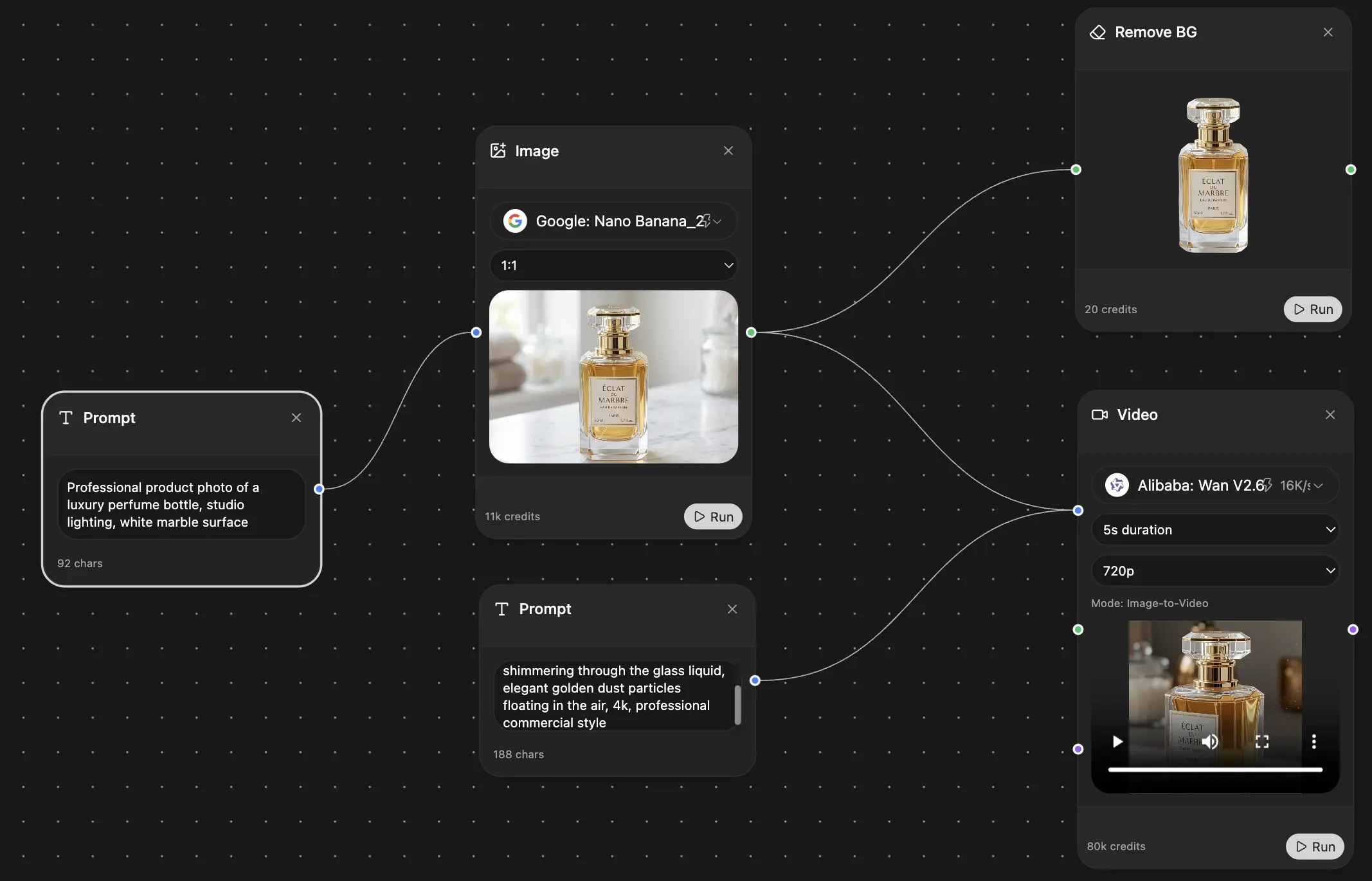
Save hours of work and research
Transparent, High-Value Pricing
Trusted by teams at






Free
No credit card required
- 100 credits daily
- 3 AI models to try
- Basic AI chat
Plus
- 1,000,000 credits/month
- 25+ AI models — GPT, Claude, Gemini, Grok & more
- Agent Mode with web search, computer tools and more
- Creative Studio: image generation and video generation
- Project Library: chat with document, website and youtube, podcast generation, flashcards, reports and more
- Workflow Studio and FocusOS
Professional
- Everything in Plus, and:
- 2,100,000 credits/month
- Pro-exclusive models (Claude Opus, Grok 4, Sonar Pro)
- Motion Tools & Max Mode
- First access to latest features
- Access to additional offers
What Our Users Say
Great Tool after 2 months usage
simplyzubair
I love the way multiple tools they integrated in one platform. So far it is going in right dorection adding more tools.
Best in Kind!
barefootmedicine
This is another game-change. have used software that kind of offers similar features, but the quality of the data I'm getting back and the sheer speed of the responses is outstanding. I use this app ...
simply awesome
MarianZ
I just tried it - didnt wanna stay with it, because there is so much like that out there. But it convinced me, because: - the discord-channel is very response and fast - the number of models are quite...
A Surprisingly Comprehensive and Engaging Experience
bruno.battocletti
Zemith is not just another app; it's a surprisingly comprehensive platform that feels like a toolbox filled with unexpected delights. From the moment you launch it, you're greeted with a clean and int...
Great for Document Analysis
yerch82
Just works. Simple to use and great for working with documents and make summaries. Money well spend in my opinion.
Great AI site with lots of features and accessible llm's
sumore
what I find most useful in this site is the organization of the features. it's better that all the other site I have so far and even better than chatgpt themselves.
Excellent Tool
AlphaLeaf
Zemith claims to be an all-in-one platform, and after using it, I can confirm that it lives up to that claim. It not only has all the necessary functions, but the UI is also well-designed and very eas...
A well-rounded platform with solid LLMs, extra functionality
SlothMachine
Hey team Zemith! First off: I don't often write these reviews. I should do better, especially with tools that really put their heart and soul into their platform.
This is the best tool I've ever used. Updates are made almost daily, and the feedback process is very fast.
reu0691
This is the best AI tool I've used so far. Updates are made almost daily, and the feedback process is incredibly fast. Just looking at the changelogs, you can see how consistently the developers have ...