How to Use AI for Productivity Without Losing Your Mind
A real-world playbook on how to use AI for productivity across writing, coding, research, and meetings, with prompts, workflows, and pitfalls to avoid.
Tuesday morning starts the same way for a lot of people. Fourteen tabs are open, three chat threads are pinging, the draft is half-written, and the next meeting is nine minutes away. The problem isn't that you type too slowly. It's that your day keeps getting eaten by context switching, search, and cleanup.
That's why how to use AI for productivity is mostly a workflow question, not a prompt-writing hobby. AI helps most when it reduces the junk around the work, the hunting for the right snippet, the first-draft grind, the back-and-forth to reconcile sources, and the “where did I put that thing?” tax that eats attention alive. It helps least when you ask it to make judgment calls that need taste, ethics, or real-world context.

For anyone staring at a noisy desk and a louder inbox, that framing matters. AI won't save a chaotic workflow by itself, and it absolutely won't rescue a process that rewards last-minute heroics. It does, however, do a decent job of giving you your brain back for the part of the job that needs one.
The Productivity Problem AI Actually Solves
The biggest productivity drain in knowledge work usually isn't the writing itself. It's the glue work around the writing, the searching, the reformatting, the checking, the “what did we decide last time?” loop that turns a simple task into a scavenger hunt. If you want a sharper picture of the cost, Zemith's overview of is worth a look because that's where a lot of hours disappear.
AI is useful when the task is repetitive and bounded
AI shines when it can handle information triage, first-draft acceleration, and synthesis across sources. A support agent can use it to draft replies faster, a marketer can use it to turn a messy brief into a usable outline, and a researcher can use it to condense several docs into something readable without opening twelve tabs and regretting every life choice.
Practical rule: if the task has a clear “good enough” answer and repeats often, AI is probably worth testing.
That's the pattern behind the measured gains in workplace studies. In a large real-world study of 5,179 customer support agents, access to a generative AI assistant raised productivity by 14% on average, with novice and low-skilled workers seeing 34% gains, which lines up with the broader idea that AI helps most when it structures work and cuts search time in repetitive knowledge tasks ().
AI gets shaky when the task needs judgment
There's a reason people get burned by using AI for emotionally sensitive messages, original strategy, or nuanced performance feedback. Those tasks don't just need words, they need timing, context, and consequences. AI can draft the sentence, but it can't feel the room, and the room will notice.
The cleanest mental model is simple. Use AI where speed, consistency, and pattern recognition matter. Keep humans in charge where stakes, trust, and ambiguity matter. Hours come back only when AI is wired into a deliberate workflow, not bolted onto a messy one.
A Workflow That Turns AI Into Real Hours Back
A lot of people try AI once, get an answer that looks fine, and then never check whether it saved time. That is how subscription graveyards happen. A better approach is to treat each use case like a small process test, and if it does not earn its keep, drop it.
Start with one task you can measure
Pick a recurring task with a clear right answer. A weekly status report works. So do unit tests for a known function, meeting summaries, or a boilerplate customer response. Then measure how long it takes without AI for a week, because vibes are not a metric and memory is generous in all the wrong directions.
After that, run a two-week pilot in one workspace where prompts, drafts, and final outputs stay together. Zemith's angle fits here because the point is not novelty, it is keeping the context in one place so you can compare before and after without playing detective.
Use a simple four-stage test
- Pick the task. Choose something frequent, low-stakes, and repetitive.
- Baseline. Time it for a week without AI.
- Pilot. Use AI for two weeks in a consolidated workspace.
- Scale or kill. Keep it only if rework stays low and quality holds.
A weekly status report is a clean writing test. Ask AI for a first draft from your notes, then edit for accuracy and tone. Unit tests are a clean coding test. Feed the known function, request edge cases, and verify the generated tests before anything ships.
The test is straightforward, which is a positive. If the tool saves drafting time but creates a larger cleanup bill, the workflow is broken, not the model.
Rule of thumb: if AI saves drafting time but creates a bigger cleanup bill, the workflow is broken, not the model.
Matching AI Patterns to Your Daily Tasks
The fastest way to waste time with AI is to use the wrong pattern for the task. A model can be excellent and still be the wrong fit. That's why side-by-side access to multiple models matters, not because people want a shiny toy menu, but because matching capability to task gets faster when you can compare outputs without hopping across tabs like a caffeinated squirrel.
The pattern matters more than the model name. If the task is structured, AI can be a real accelerant. If the task is a judgment call wearing a productivity costume, it tends to produce confident nonsense with excellent punctuation.
Measuring Productivity Gains Without Lying to Yourself
The uncomfortable part of AI productivity is that it often feels faster before it is. In one study cited by the Federal Reserve Bank of St. Louis, developers felt 20% faster but were 19% slower, which is a good reminder that perceived speed and real output are not the same animal (). That gap usually shows up when people spend their saved time fixing, rechecking, or rewriting the model's first pass.
Track four metrics, not just one
A useful dashboard keeps things boring in the best way:
- Throughput: how many tasks finished per week.
- Rework rate: how much AI-assisted output needed substantial revision.
- Time to first draft versus time to shipped: whether the tool helps the whole job or only the middle.
- Quality defects caught in review: mistakes, omissions, or corrections that slipped through.
If you're managing a distributed team, a resource like can help you standardize how those metrics are tracked across people and projects, which matters more than whether everyone has the same favorite chatbot.
Use one thread for the whole experiment
A clean setup in a workspace like Zemith's Projects view keeps the prompt, output, edits, and final version in one thread. That makes before-and-after comparisons easy, and it also makes it harder to fool yourself with a memory of “it felt faster.” If you want a structured way to ground the numbers in the work itself, Zemith's piece pairs well with this habit.
Track the work, not the chatter. Token counts and chat volume are vanity metrics. They look busy, which is not the same thing as useful.
A practical tracking template is simple. Baseline for one week, pilot for two weeks, then compare the same metrics with the same task type. If rework climbs, the time savings are fake. If throughput improves and defects stay flat, you've got something worth keeping.
Role-Specific Playbooks That Actually Ship
A useful AI setup stays inside the work instead of hovering outside it like a helpful intern with no memory for folders. The workflow matters more than the prompt. Zemith fits that pattern because it keeps document work, note capture, coding help, and project organization in one place, so the handoffs are easier to see and the busywork is harder to excuse.
Writers
Writers get real value when the AI sits where the draft sits. Use the Document Assistant to turn a brief into an outline, then move rough voice notes from Smart Notepad into clean bullets before shaping them into prose. Keep the client brief, first draft, and comments together in Projects, because losing the original ask is how content drifts into fan fiction.
Ready-to-paste prompt: “Turn these notes into a 600-word draft with a clear angle, three supporting sections, and a tone that sounds like a real person who has deadlines.”
Developers
For developers, the useful pattern is comparison, not blind generation. Use the Coding Assistant with multi-model access so you can compare different kinds of reasoning, then run accepted snippets in a sandbox before anything reaches the codebase. That keeps AI in the role of accelerant, not replacement, which is usually where the least painful bugs live.
Ready-to-paste prompt: “Write unit tests for this function, explain edge cases, and list any assumptions that need review before merge.”
Researchers
Researchers need fewer flashy answers and more reliable condensation. Use the Document Assistant to summarize PDFs, then cross-check claims across files in the Library before turning the result into a citation-ready brief. The win is not just speed. It also keeps the source trail visible enough that you do not have to reconstruct it later like an academic escape room.

For founders and solo operators, the same pattern shows up in . Keep one task, one workspace, and one review loop. The moment drafts scatter across tools, the time savings start leaking.
What works: one task, one workspace, one review loop. The moment people scatter drafts across tools, the time savings start leaking.
Where AI Productivity Falls Apart

AI usage can rise while real output stays flat. That usually happens when teams confuse access with adoption, or adoption with a usable process. The mess often hides in small pilots, because short tests do not reveal the slow damage that appears when dozens of people invent their own workflow.
The common failure modes are boring and expensive
Context collapse shows up when a chat thread gets too long and nobody remembers the original instruction. Shadow AI shows up when employees paste sensitive material into consumer tools without governance. Prompt drift shows up when people keep reusing the same lazy prompt because it worked once, then wonder why the output got sloppy. The last trap is AI-flavoured filler, where word count rises and meaning does not.
This is usually an organizational problem first, not a prompt problem. EY's 2025 survey found companies can miss out on up to 40% of AI productivity gains when talent foundations are weak, while SAP and WalkMe reported that only 7.5% of employees have received extensive AI training and 51% get conflicting guidance on when and how to use AI at work ().
Run a quick diagnostic this week
- Access controls: who can use AI tools, and on what data?
- Prompt library: do people have shared examples, or are they improvising alone?
- Audit trail: can you tell which prompt produced which output?
- Review norms: is external output fact-checked before it leaves the team?
- Training gap: do people know when to use AI, and when not to?
For a sharper look at verification habits, Zemith's guide fits neatly here. If a team cannot answer those five questions, the productivity gains are probably leaking somewhere between the chatbot and the final deliverable.
Habits That Make AI Productivity Stick
The people who get hours back usually are not doing anything magical. They are just less chaotic about it. They reuse prompts, write tighter briefs, batch similar work, and review AI output like it came from a junior colleague who is quick, bright, and occasionally confident about a citation it did not see.
A small prompt library beats clever one-offs because you stop rebuilding the same request every Tuesday. A short brief written before you ask for help usually gets better output than a vague “make this better.” The smallest model that can handle the task is often the right call, because overkill just adds noise and cleanup.
A weekly friction log helps too. If a workflow creates more rework than savings, drop it. That holds for drafts, summaries, and repetitive admin alike.
Use the workspace features that support the habit
Saved Prompts in a Smart Notepad make reuse less annoying. Projects folders keep related work from scattering. Library recall helps when you need to pull a previous source or draft back into view without starting from scratch again. None of that is glamorous, which is probably why it works.
The difference between a productive AI user and a subscription collector is usually not the number of tools. It is whether they have turned the same few tasks into habits.
The daily reality of a productive user is pretty unexciting. They batch similar work, check output before trusting it, and keep the system simple enough to maintain during a busy week. The subscription-collector version has twelve tabs open, five apps promising “workflow magic,” and no idea where the final draft lives.
Zemith brings documents, notes, coding help, and project organization into one workspace, so AI sits inside the work instead of interrupting it. If you want how to use AI for productivity to feel less like babysitting and more like getting actual hours back, visit and see how the pieces fit together.
Explore Zemith Features
Everything you need. Nothing you don't.
One subscription replaces five. Every top AI model, every creative tool, and every productivity feature, in one focused workspace.
Every top AI. One subscription.
ChatGPT, Claude, Gemini, DeepSeek, Grok & 25+ more







Always on, real-time AI.
Voice + screen share · instant answers
What's the best way to learn a new language?
Immersion and spaced repetition work best. Try consuming media in your target language daily.
Voice + screen share · AI answers in real time
Image Generation
Flux, Nano Banana, Ideogram, Recraft + more

Write at the speed of thought.
AI autocomplete, rewrite & expand on command
Any document. Any format.
PDF, URL, or YouTube → chat, quiz, podcast & more
Video Creation
Veo, Kling, Grok Imagine and more

Text to Speech
Natural AI voices, 30+ languages
Code Generation
Write, debug & explain code
Chat with Documents
Upload PDFs, analyze content
Your AI, in your pocket.
Full access on iOS & Android · synced everywhere
Your infinite AI canvas.
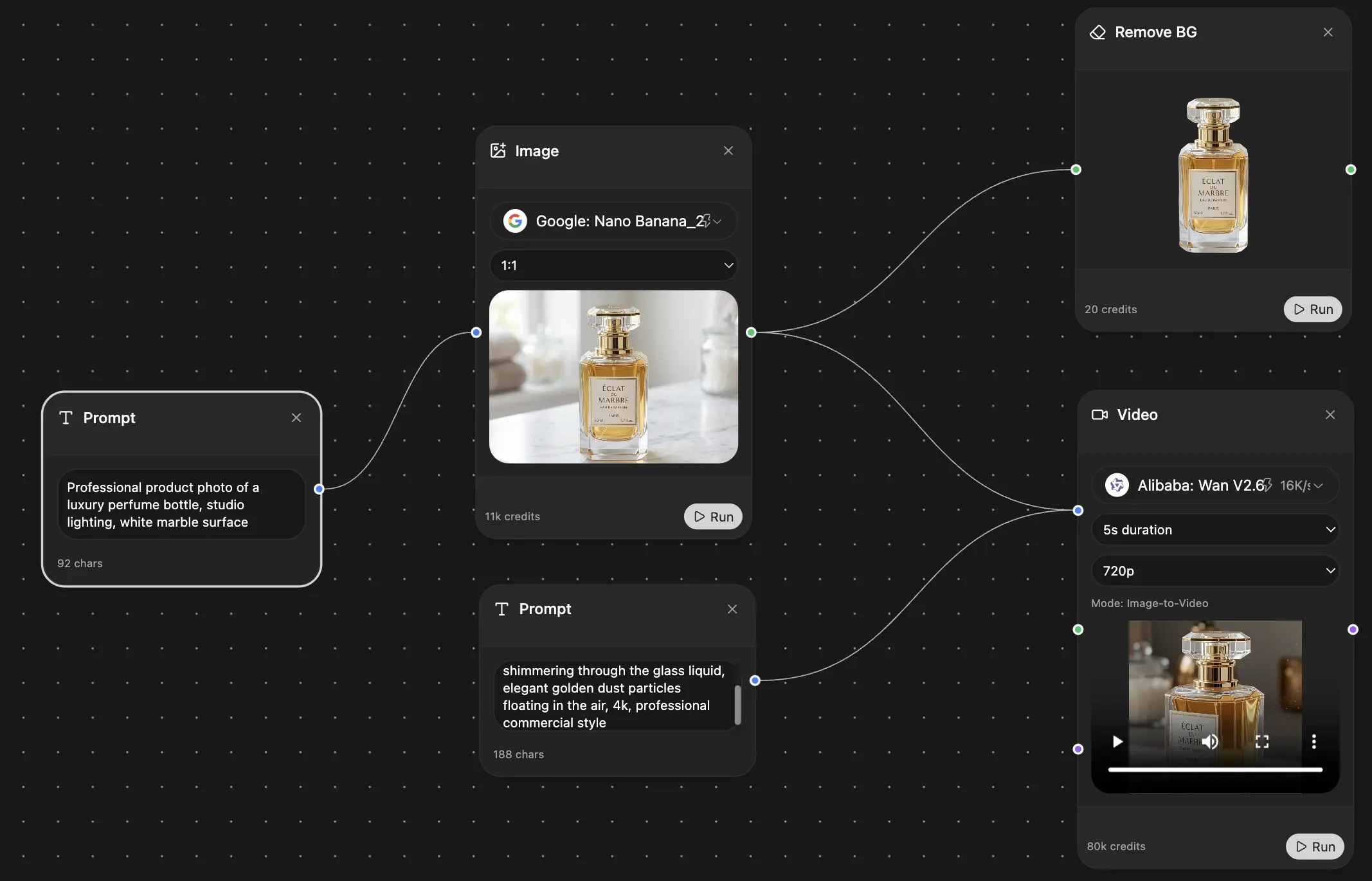
Chat, image, video & motion tools — side by side
Save hours of work and research
Transparent, High-Value Pricing
Trusted by teams at






Free
No credit card required
- 100 credits daily
- 3 AI models to try
- Basic AI chat
Plus
- 1,000,000 credits/month
- 25+ AI models — GPT, Claude, Gemini, Grok & more
- Agent Mode with web search, computer tools and more
- Creative Studio: image generation and video generation
- Project Library: chat with document, website and youtube, podcast generation, flashcards, reports and more
- Workflow Studio and FocusOS
Professional
- Everything in Plus, and:
- 2,100,000 credits/month
- Pro-exclusive models (Claude Opus, Grok 4, Sonar Pro)
- Motion Tools & Max Mode
- First access to latest features
- Access to additional offers
What Our Users Say
Great Tool after 2 months usage
simplyzubair
I love the way multiple tools they integrated in one platform. So far it is going in right dorection adding more tools.
Best in Kind!
barefootmedicine
This is another game-change. have used software that kind of offers similar features, but the quality of the data I'm getting back and the sheer speed of the responses is outstanding. I use this app ...
simply awesome
MarianZ
I just tried it - didnt wanna stay with it, because there is so much like that out there. But it convinced me, because: - the discord-channel is very response and fast - the number of models are quite...
A Surprisingly Comprehensive and Engaging Experience
bruno.battocletti
Zemith is not just another app; it's a surprisingly comprehensive platform that feels like a toolbox filled with unexpected delights. From the moment you launch it, you're greeted with a clean and int...
Great for Document Analysis
yerch82
Just works. Simple to use and great for working with documents and make summaries. Money well spend in my opinion.
Great AI site with lots of features and accessible llm's
sumore
what I find most useful in this site is the organization of the features. it's better that all the other site I have so far and even better than chatgpt themselves.
Excellent Tool
AlphaLeaf
Zemith claims to be an all-in-one platform, and after using it, I can confirm that it lives up to that claim. It not only has all the necessary functions, but the UI is also well-designed and very eas...
A well-rounded platform with solid LLMs, extra functionality
SlothMachine
Hey team Zemith! First off: I don't often write these reviews. I should do better, especially with tools that really put their heart and soul into their platform.
This is the best tool I've ever used. Updates are made almost daily, and the feedback process is very fast.
reu0691
This is the best AI tool I've used so far. Updates are made almost daily, and the feedback process is incredibly fast. Just looking at the changelogs, you can see how consistently the developers have ...