Fact Checking AI: How It Works and How to Use It Right
A practical guide to fact checking AI — how it works, where it fails, and how to use it without getting burned by confident wrong answers.
You've probably seen it happen. An AI tool spits out a polished answer, drops a citation that looks real at a glance, and only after you open the source do you realize the quote was stitched together from something adjacent, or worse, never existed in the first place. That tiny mismatch is exactly why fact checking AI matters, because the core problem isn't whether the model sounds confident, it's whether you can trust the evidence trail it leaves behind.
A 2025 benchmark from Poynter's State of the Fact-Checkers Report found that 53.6% of fact-checkers use AI for preliminary research, while smaller shares use it for content creation (15%), drafting reports (14.3%), and audience engagement (8.6%) (). That's a pretty useful clue about where the field is right now. AI isn't replacing verification, it's becoming part of the workflow, which means the people who get the most value are the ones who know where the handoff from machine to human should happen.
The Moment AI Got It Wrong and Why It Matters
A researcher asks an AI tool to verify a quote for a slide deck, gets back a neat answer, and ships it. Ten minutes later, someone on the team opens the source and discovers the quote was never in that article. The citation existed in the sense that a page was linked, but the claim itself was a near miss, which is the kind of mistake that makes everyone in the room stare at the ceiling for a second.
That's the part people miss. Fact checking AI isn't a truth machine, it's a workflow aid that can search, compare, and rank evidence faster than a person can tab through a browser. The useful question isn't “Can it know?” It's “Can it help me verify this claim without letting me skip the boring parts?”
Why the workflow matters
Journalists need it because speed pressure is real. Marketers need it because a sloppy claim in a launch deck turns into a sloppy claim on a landing page. Students, researchers, and knowledge workers need it because copy-pasting AI output into a paper, report, or memo feels harmless right up until the source trail falls apart.
Practical rule: treat AI as the person who brings you folders, not the person who signs off on the final memo.
If you want a cleaner mental model of how these systems sit inside broader assistant tools, the breakdown in is a useful companion read. For teams that care about transparency, the is also a good reminder that the best systems make their limits easier to inspect, not harder.
What Fact Checking AI Actually Is
Think of fact checking AI as a very fast research assistant that can read a ridiculous amount of material, but still needs you to point at the right question. It's not one magic model sitting in a box with a truth detector. It's a stack of tools that first understand a claim, then look for evidence, then decide what the evidence supports.

The three-stage pipeline
Modern systems are usually built as a claim processor, an evidence retriever, and a verifier because factuality can't be judged reliably from generation alone (). The claim processor splits text into checkable pieces. The retriever goes looking for proof or contradiction. The verifier weighs what came back and decides whether the claim looks supported, contradicted, or still unclear.
That structure matters because it keeps the model from “self-verifying” its own made-up confidence. In plain English, you don't want the same engine inventing the answer and then grading its own homework. You want separate stages, separate failures, and separate evidence.
The mental model to keep in your head
Use this sequence whenever you touch the tool.
- Input claim. What exactly are you checking?
- Find evidence. What sources speak to that claim?
- Judge verdict. Does the evidence support, contradict, or fail to settle it?
If you want a broader view of how this fits into model behavior and analysis, the internal guide on is a useful bridge between “understanding text” and “checking truth.” For a practical comparison of how different assistants behave in research workflows, it also helps to with an eye on where each one stops being helpful and starts being decorative.
The Techniques That Power It
The easiest mistake is to treat fact checking AI like a single feature. It's more useful to think of it as four jobs wearing one trench coat.
The first job is understanding the claim
Natural language processing is the part that reads the sentence and tries to figure out what's being asserted. If someone writes, “The policy changed last spring,” the system has to decide whether the claim is about the date, the policy, or both. That sounds basic until you see how often vague wording creates messy downstream errors.
The second job is hunting evidence
Retrieval is the librarian in the room. It searches the web or a private corpus for documents that might confirm or challenge the claim. If the retriever brings back irrelevant or thin evidence, even a strong verifier will struggle, because the model can only judge what it sees. Good retrieval is boring in the best possible way.
The third job is splitting the sentence apart
Claim detection is where a chunky paragraph gets turned into atomic statements. One sentence can hide three checks, and if you don't split them apart, you end up verifying the whole paragraph as if every piece stood or fell together. That's how obvious errors get buried inside a mostly correct answer.
The fourth job is making a verdict
Verification is the judge. It compares the claim against the evidence and decides whether the claim is supported, refuted, or too under-specified to call. That last category matters more than most vendors admit, because a tidy wrong answer is worse than an honest “not enough evidence.”
Benchmark results show that GPT-3.5 and GPT-4 achieve around 63 to 75% average accuracy on claim verification without contextual information, but performance rises above 80% and to 89% for non-ambiguous verdicts when context is added (). That lines up with how the pipeline works in practice. The model gets better when it has evidence, and it gets shakier when it's forced to guess from the sentence alone.
For a practical lens on assistant behavior, the article to is handy because it makes the differences in research style easier to spot. And if you're building your own internal workflow, the helps show why a system is only as good as the material it can retrieve.
How to Read the Benchmarks Without Fooling Yourself
A lot of benchmark talk sounds impressive until you ask one boring question, which is, “Accuracy on what?” The number matters, but so does the task, the ambiguity of the claim, and whether the model is being tested on isolated headlines or on a messy real-world workflow.

High accuracy can still miss the point
A PNAS study found that an LLM accurately identified 90% of false headlines, but that performance did not significantly improve participants' ability to judge headline accuracy or share accurate news, and for 13 out of 20 true headlines, ChatGPT expressed some uncertainty (). That's the kind of result that should make anyone pause before equating model accuracy with human benefit.
The reason is simple. A model can be good at labeling examples inside a test set and still fail to change what a person does with the result. If the correction feels unsure, awkward, or context-free, users may shrug and keep moving.
Read verdict quality, not just headline numbers
The difference between supported, refuted, and not enough evidence is where much of the value lies. A system that forces every claim into a yes-or-no box is often less useful than one that admits ambiguity. That's not a weakness, it's honesty.
Practical rule: if a claim is underspecified, the best verdict may be “unsubstantiated,” not “false.”
That's also why evidence quality matters more than a shiny score. A tool that surfaces why it's uncertain is usually easier to trust than one that pretends every claim can be settled in one pass. Inside a research workspace, that means keeping the evidence visible instead of burying it behind a single green checkmark.
For teams comparing tools, the helps frame benchmark claims without getting hypnotized by the biggest number on the page. And if a vendor never explains how ambiguity is handled, that's a sign to keep your browser tabs open.
Where Fact Checking AI Quietly Fails
The most useful failures are the ones you can predict. Fact checking AI tends to stumble in the same places humans do, only faster and with nicer formatting.
It struggles where language coverage is thin
A Reuters Institute report notes that generative AI is already helping fact-checkers, but it's proving less useful in small languages and outside the West, where many organizations still rely on reverse image search and geolocation (). That gap isn't just about model quality. It's about access to local sources, language-specific context, and the infrastructure needed to verify claims in the first place.
A tool can't retrieve what it can't reach. If the evidence ecosystem is sparse, the verdict gets brittle fast.
It can be too confident about vague claims
When a claim is sloppy, the model may act tidier than the facts deserve. “The policy changed” sounds checkable until you ask which policy, which jurisdiction, and what counts as a change. If the system refuses to say “not enough evidence,” it may fill the gap with something that looks decisive and isn't.
It doesn't always change minds
A correction can be accurate and still fail socially. People don't just evaluate facts, they evaluate whether a correction fits what they already believe. That's why a highly accurate tool can still get shrugged off when it contradicts someone's prior view.
The messy truth is useful, though. It means the bottleneck isn't only model capability, it's trust, context, and behavior change. If you're building workflows for a newsroom, marketing team, or policy group, the answer isn't “trust the model more.” It's “design the process so a human still owns the final call.”
When teams need to work across regions, the fallback tools still matter, and many practitioners keep coming back to simple verification habits because they work when the fancy stuff doesn't. That's less glamorous than a demo, and a lot more useful on deadline.
A Reproducible Workflow Inside Zemith
A sane verification process starts with one rule, don't trust the first clean-looking answer. Paste the claim or draft into a workspace, break it into smaller claims, then check each one against evidence you can inspect yourself. If you want the machine to help, let it help with sorting, search, and notes, not with the final responsibility.

A workflow you can actually repeat
- Paste the claim into a document assistant. Start with the exact wording you want to verify, not a paraphrase. Small wording changes can hide the thing you really need to check.
- Split it into atomic claims in a smart notepad. One sentence becomes several checkable items. That's where vague prose turns into a list of actual targets.
- Use deep research with real-time web search. Pull sources that are primary when possible, then save them where you can compare them side by side.
- Record a verdict with the citation beside it. If the evidence is mixed, write that down. Don't flatten uncertainty just to make the note look tidy.
That's also where a workspace matters. A setup like Zemith's keeps the research, notes, and citations in one place, which is a lot less annoying than juggling a browser graveyard. For people who want to understand the mechanics behind browser-based evidence gathering, is a useful side read because it helps you think about where data comes from before you even start judging it.
Lateral reading still does the heavy lifting
The University of Maryland's guide recommends lateral reading, which means breaking the response into searchable claims, opening new tabs to check supporting evidence, and judging each claim as true, misleading, or incorrect (). That habit keeps you from trusting the AI's own summary of its citations, which is exactly how people get burned.
Open the source. Read the source. Then decide whether the source actually says what the AI claims it says.
If your team is building a durable internal process, the is worth pairing with this workflow, because reproducibility gets much easier when the evidence lives somewhere structured instead of inside one person's memory.
Ethics, Liability, and Habits Worth Keeping
The ethical line is pretty straightforward. Use AI to speed up research, not to launder weak sourcing into something that looks authoritative. If the citation trail is muddy, the output should stay muddy too.

The habits that keep people out of trouble
- Copyright. Verify source licensing before reuse, especially if the system surfaced material from the open web.
- Provenance. Track where each piece of retrieved data came from, because a claim without origin is a headache waiting to happen.
- Liability. Label AI-generated verdicts clearly in internal notes and published work.
- Habit. Always cross-reference important claims with one human-curated source.
VCU's guide notes that when AI provides a citation, fact-checkers should verify that the cited source exists and inspect it directly for context, and for audio, searching a quoted fragment in quotation marks can help locate the original transcript (). That sounds almost too basic to mention, which is usually a sign it needs mentioning. The fastest way to get into trouble is to assume the citation is right because the formatting looks neat.
Practical rule: if you can't show where the claim came from, you don't really have a claim, you have a guess.
If you're building a workflow that keeps humans in charge without turning them into tab-switching exhausted goblins, the is a solid companion. And if you want an all-in-one place to keep claims, notes, sources, and verdicts together, visit and try it as the research workspace where fact checking AI stays visible, accountable, and usable.
Explore Zemith Features
Everything you need. Nothing you don't.
One subscription replaces five. Every top AI model, every creative tool, and every productivity feature, in one focused workspace.
Every top AI. One subscription.
ChatGPT, Claude, Gemini, DeepSeek, Grok & 25+ more








Always on, real-time AI.
Voice + screen share · instant answers
What's the best way to learn a new language?
Immersion and spaced repetition work best. Try consuming media in your target language daily.
Voice + screen share · AI answers in real time
Image Generation
Flux, Nano Banana, Ideogram, Recraft + more

Write at the speed of thought.
AI autocomplete, rewrite & expand on command
Any document. Any format.
PDF, URL, or YouTube → chat, quiz, podcast & more
Video Creation
Veo, Kling, Grok Imagine and more

Text to Speech
Natural AI voices, 30+ languages
Code Generation
Write, debug & explain code
Chat with Documents
Upload PDFs, analyze content
Your AI, in your pocket.
Full access on iOS & Android · synced everywhere
Your infinite AI canvas.
Chat, image, video & motion tools — side by side
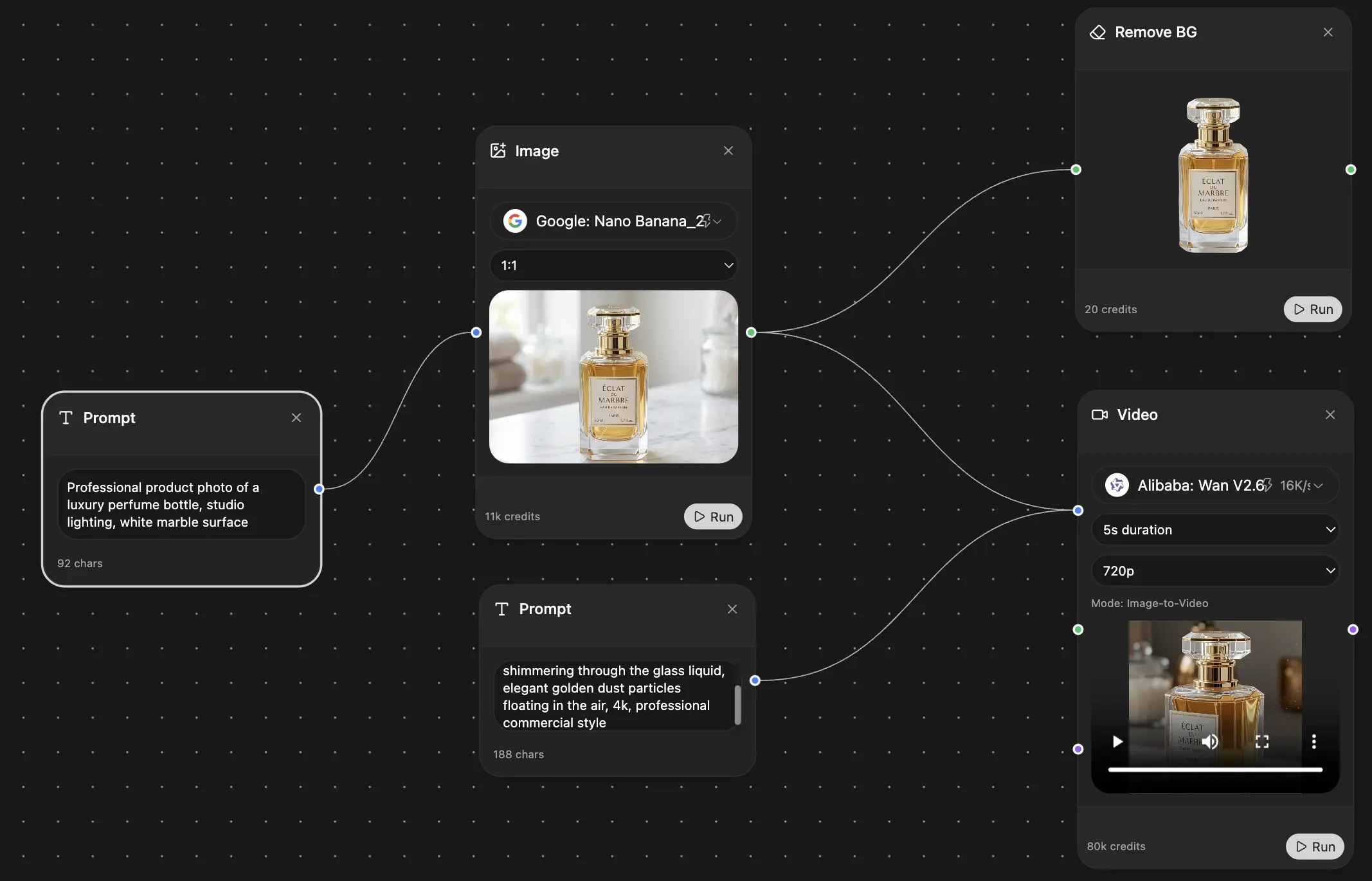
Save hours of work and research
Transparent, High-Value Pricing
Trusted by teams at






Free
No credit card required
- 100 credits daily
- 3 AI models to try
- Basic AI chat
Plus
- 1,000,000 credits/month
- 25+ AI models — GPT, Claude, Gemini, Grok & more
- Agent Mode with web search, computer tools and more
- Creative Studio: image generation and video generation
- Project Library: chat with document, website and youtube, podcast generation, flashcards, reports and more
- Workflow Studio and FocusOS
Professional
- Everything in Plus, and:
- 2,100,000 credits/month
- Pro-exclusive models (Claude Opus, Grok 4, Sonar Pro)
- Motion Tools & Max Mode
- First access to latest features
- Access to additional offers
What Our Users Say
Great Tool after 2 months usage
simplyzubair
I love the way multiple tools they integrated in one platform. So far it is going in right dorection adding more tools.
Best in Kind!
barefootmedicine
This is another game-change. have used software that kind of offers similar features, but the quality of the data I'm getting back and the sheer speed of the responses is outstanding. I use this app ...
simply awesome
MarianZ
I just tried it - didnt wanna stay with it, because there is so much like that out there. But it convinced me, because: - the discord-channel is very response and fast - the number of models are quite...
A Surprisingly Comprehensive and Engaging Experience
bruno.battocletti
Zemith is not just another app; it's a surprisingly comprehensive platform that feels like a toolbox filled with unexpected delights. From the moment you launch it, you're greeted with a clean and int...
Great for Document Analysis
yerch82
Just works. Simple to use and great for working with documents and make summaries. Money well spend in my opinion.
Great AI site with lots of features and accessible llm's
sumore
what I find most useful in this site is the organization of the features. it's better that all the other site I have so far and even better than chatgpt themselves.
Excellent Tool
AlphaLeaf
Zemith claims to be an all-in-one platform, and after using it, I can confirm that it lives up to that claim. It not only has all the necessary functions, but the UI is also well-designed and very eas...
A well-rounded platform with solid LLMs, extra functionality
SlothMachine
Hey team Zemith! First off: I don't often write these reviews. I should do better, especially with tools that really put their heart and soul into their platform.
This is the best tool I've ever used. Updates are made almost daily, and the feedback process is very fast.
reu0691
This is the best AI tool I've used so far. Updates are made almost daily, and the feedback process is incredibly fast. Just looking at the changelogs, you can see how consistently the developers have ...