English to Zulu: A Practical 2026 Translation Guide
Your complete guide to English to Zulu translation. Learn pronunciation, basic grammar, common phrases, and how to use AI tools for accurate results.
You've probably done it already, typed a phrase into a translator, hit enter, and stared at the result like, “That can't be right.” Maybe it sounded stiff. Maybe it felt rude. Maybe it was technically a sentence, but not one a real person would ever say out loud. That is the exact frustration with english to zulu translation, because isiZulu is not English with different words swapped in. It has its own rhythm, its own logic, and a few pleasant surprises that make simple phrasebook tricks fall apart fast.
That is why a good translation workflow matters. South Africa's language situation is multilingual, so a sentence that looks fine on screen can still miss the way people speak. For practical work, the aim is clear, respectful translation that holds up in a message, a class handout, or a business context. A strong first draft should feel like it belongs in the conversation, not like it was assembled from loose parts.
The guide below bridges two common extremes. On one side are phrasebooks that give you useful starters but little explanation. On the other side are dense grammar texts that answer every rule and still leave you wondering how to use them. Here, the goal is to show a practical workflow for getting accurate translations, explain the reason behind the grammar in plain language, and show how modern tools like Zemith fit into that process without turning the job into guesswork.
If you are handling sensitive text, the translation step also raises privacy questions. Pasting customer messages, internal notes, or school material into a tool is not just a language choice, it is a data choice too. A useful side read on that topic is , because good translation includes care with what you share.
Meaning matters more than word swapping. That idea sits close to , which is a useful way to think about why a translation can sound correct on the page and still fail in context. The rest of this article keeps that question front and center, how do you know a translation is good?
Why Your Online Translator Is Lying to You
The classic mistake looks harmless. You type “the dog is here” into a free translator, get a clean-looking result, and assume you're done. Then a native speaker reads it and says, politely or not so politely, “That's not how we'd say it.” The translator did not exactly lie, but it gave you a surface-level answer and skipped the part where isiZulu grammar does the heavy lifting.
A better way to approach english to zulu is to treat the first output as a rough draft. A quick translation can point you in the right direction, but it rarely tells you whether the sentence sounds natural, whether the noun class matches, or whether the wording fits the situation. That is why a practical workflow matters more than a single click, especially if you want the result to feel like something a real person would say in a message, a classroom handout, or a business note.
A useful side read on the care side of translation is , because the moment you paste customer messages, internal notes, or school material into a tool, you are also making a data choice. Good translation includes care with what you share.
Meaning matters more than word swapping. That idea sits close to , which helps explain why a sentence can look correct on the page and still miss the point in context. If you are checking whether a translation is any good, ask whether it carries the same intent, not just the same vocabulary.
The grammar side can feel tricky at first, but it is not random. Zulu noun classes work a bit like sorting laundry into different baskets, each basket changes how the rest of the sentence behaves. If the parts do not agree, the sentence may still be understandable, but it will sound off to a native ear.
Machine translation can help, yet it still needs a human check. A translation platform notes that it compares results from across multiple AI models and uses agreement as part of its selection process, which is a good reminder that even software benefits from comparison. In practice, that means the safest workflow is to generate a draft, test whether the wording fits the context, then adjust the pieces that feel awkward or overly literal.
For everyday use, the key question is simple. Does the translation sound like something a person would naturally say, and does it still carry the original meaning? If the answer feels shaky, the draft needs another pass.
Mastering the Clicks and Sounds of Zulu

A phrase can look fine on screen and still fall apart the moment you try to say it aloud. That is where Zulu often catches English speakers off guard. isiZulu is tonal and includes click consonants that do not exist in English, so a written translation alone is often insufficient for usable communication ().
The three clicks that keep showing up
Start with the sounds you already make without thinking, then shape them into something new.
- The dental click, c sounds a lot like a quick “tsk-tsk” or a tiny disapproving sound.
- The lateral click, x is closer to the sound some people make to call a horse, made from the side of the tongue.
- The alveolar click, q feels like a little pop, almost like a bubble wrap burst from the tip of your tongue.
Try them slowly at first. Don't aim for speed, aim for control. If your mouth feels awkward, that's normal, because your English muscle memory is trying to run the show and isiZulu grammar is politely taking the wheel.
Why tone matters as much as the click
Clicks are only part of the job. The combination of tone and clicks can change a word's meaning, which is why beginner resources that only mention clicks in passing can leave you with half the picture (). Pronunciation guides matter because they show how the written form behaves in real speech, not just on a page.
If you want a smarter way to learn pronunciation from spoken examples, an AI audio workflow can help you compare how words sound before you try them yourself. A tool like can be useful when you are testing how a phrase behaves in speech, especially if you are trying to connect spelling with sound.
The trick is not perfection. The trick is repetition with feedback. Say a phrase, listen to how it feels, and correct one sound at a time. That is how clicks stop being mysterious symbols and start becoming usable speech.
Zulu Grammar Without The Headache
Zulu grammar gets a bad reputation because people expect English rules to apply. They don't. Think of noun classes like sorting laundry into different baskets, once a noun is in a basket, everything else has to match that basket's system. If that sounds odd, good, because it's a better mental model than trying to force English sentence habits onto isiZulu.
A key rule is that there is no single word matching the English definite article “the”. Instead, definiteness is expressed through noun class prefixes and demonstratives, so a literal word-for-word method usually fails (). That's one reason machine translations can sound technically possible but practically wrong.
The part that changes every other part
In isiZulu, noun classes shape the whole sentence. The noun's prefix doesn't just exist in isolation, it influences agreement in verbs, adjectives, and pronouns. So when a beginner asks why one sentence looks “too long,” the answer is often that the language is carrying information in places English doesn't.
A useful comparison is to think of every noun as joining a team. Once it's on a team, the other words have to wear the same jersey. If they don't, the sentence starts looking off fast, even if each individual word is valid. That's why grammar errors in english to zulu often show up as agreement mistakes rather than obvious vocabulary problems.
Short rule: if the prefix is wrong, the sentence usually feels wrong, even before you know why.
Here's the practical payoff. Once you know that word order and agreement matter more than direct substitution, you can spot bad translations faster. You stop asking, “Did it swap the words correctly?” and start asking, “Did it build the sentence in a Zulu-shaped way?” That shift saves time and prevents a lot of awkward content.
For translators working across languages with very different grammar logic, cross-language comparison can help. A well-structured is a useful reminder that translation challenges often come from grammar systems, not just word lists. isiZulu works the same way. The sentence has to feel native, not merely decoded.
Your First Zulu Words and Common Phrases
The fastest way to build confidence is to use a few phrases that fit real situations. Start with greetings, because greetings do more social work than people think. In South Africa, a good greeting shows respect, and in isiZulu that usually means matching the level of formality and number of people you're speaking to.
When to use them without sounding awkward
Sawubona is for one person. Sanibonani is the group version, and using the wrong one isn't a disaster, but it does show you skipped the social part of the language. If you're meeting someone for the first time, Sawubona followed by Unjani? is a safe and friendly pattern.
For gratitude, Ngiyabonga gets you far. It's one of those phrases that works in shops, offices, and casual chats without sounding overdone. If you're asking for something politely, Ngiyacela is your friend, and it's worth practicing because it can soften your request immediately.
A phrase list becomes more useful when you pair it with context. A greeting isn't just “hello,” it's a tiny social handshake. A thank-you isn't just polite filler, it tells the other person you noticed their help. That's how english to zulu phrases stop being memorized lines and start becoming real communication.
If you're the type who likes a quick drill, try this: say the English line, speak the isiZulu line, then say it again as if you were talking to a real person standing in front of you. If it still sounds like a robot, slow down and try again. Your mouth will catch up.
Common English to Zulu Translation Pitfalls
Literal translation is where most mistakes begin. English idioms are especially tricky, because a phrase like “break a leg” isn't meant to be understood word for word. If you translate that word for word, you'll get something that may be grammatically puzzling and culturally useless.
The deeper issue is structural. English-to-Zulu translation is technically difficult because it crosses a major language-family divide, since English is Indo-European and isiZulu is a Southern Bantu language with vastly different morphology (). That means the translator has to do more than swap vocabulary. It has to manage agreement, order, and sense.
Wrong way versus right way
- Wrong way: translate every English word individually and hope the sentence still works.
- Right way: rebuild the meaning using isiZulu grammar, even if the wording changes.
- Wrong way: assume one English phrase has one fixed Zulu equivalent.
- Right way: check context, because one concept can have multiple renderings depending on use.
A good example of why this matters is the English word “fact.” WordHippo lists amaqiniso and into khona as Zulu equivalents, which shows that even a simple term can split into different renderings depending on meaning and context (). That's exactly why a single dictionary hit can't always settle the question.
If a translation looks neat but ignores grammar or idiom, it's probably neat in the wrong way.
Many machine translations encounter a common pitfall: they may produce a string that resembles a sentence, but the sentence can still feel off because the system didn't fully account for isiZulu's structure. When that happens, the best move is to ask what the sentence is trying to do, not just what words it contains.
For a broader comparison of how machine translation behaves across languages, a guide like can help you see that directness and accuracy are not the same thing. The same caution applies here. If the language pair is structurally different, translation needs interpretation, not just substitution.
A Modern Workflow for Accurate Translations with AI
A useful workflow starts with a draft, not a guess. Generate an initial english to zulu version first, then check whether the sentence sounds natural, whether the level of formality fits, and whether a native speaker would understand the intended meaning without pausing to decode it.
A multi-model tool helps because it gives you more than one machine opinion to compare. Zemith's Free AI Translator includes a dedicated English to Zulu translation tool, so you can draft and refine in one place. That matters because the core task is not just producing a translation, it is testing whether the phrasing still works once context, tone, and audience enter the picture.
A helpful way to picture the process is like sorting laundry. Some pieces are easy to stack, while others need a closer look before you know where they belong. Zulu grammar works the same way, especially when a sentence carries respect, technical meaning, or a tone that changes with the situation.
A practical three-pass method
- Draft the sentence. Get a first version from a tool.
- Stress-test it. Ask whether it sounds formal, casual, or culturally odd.
- Refine the tricky parts. Check the words that carry tone, respect, or technical meaning.
Human review still matters. For high-quality English-to-Zulu workflows, human-in-the-loop verification remains critical, and some platforms compare results from over 20 AI models to find a consensus. That is a clear sign that machine translation works best as a first pass, then a person checks whether the result fits the task.

You can make the workflow more useful by asking sharper questions. Try prompts like, “Is this okay in a formal setting?” or “Give me three alternatives with different levels of politeness.” If you work with other language pairs too, a guide like shows the same principle in action, which is that a good translation tool should help you compare meaning, not just swap words.
The best translation setup is the one that helps you catch mistakes before a reader does.
For teams that need to move quickly, AI helps by removing the blank-page problem. The final quality still comes from verification, especially when the content will be read by customers, students, or the public. A tool can give you speed, but a careful workflow gives you confidence. For class-based practice and structured review, can also help teams organize learning around real usage.
Frequently Asked Questions About Zulu Translation

How do I translate new English tech terms into isiZulu?
Zero-equivalence often emerges. A lot of English concepts, especially modern vocabulary, don't have a neat one-word isiZulu equivalent, so a good translation may use a loan word, a descriptive phrase, or even a visual explanation (). Don't force a fake one-word answer if the language doesn't support it.
What should I do when a word has no exact match?
Write the meaning, not just the label. If a direct match doesn't exist, give context, rephrase the sentence, or explain the concept in plain language. That's often more helpful than pretending the word has a perfect equivalent. This is especially true for product names, modern tools, and culturally specific ideas.
Where can I practice or verify my translations?
If you're working with students, a class, or a language program, a platform like can help you organize learning and practice around real usage. For solo learners, the best habit is to compare your draft with a native speaker or a strong reference source, then revise the parts that sound too literal.
Can I trust one dictionary result?
Not always. Even simple English words can split into multiple Zulu forms depending on meaning, as the earlier “fact” example shows. A dictionary result is a starting point, not the final judgment. If the sentence matters, verify the grammar and context before you publish it.
What's the fastest way to improve?
Use a repeatable workflow. Draft, compare, revise, and speak the sentence out loud. If it still feels unnatural, it probably is. Small wins stack up fast when you focus on real phrases instead of isolated vocabulary.
If you want a cleaner way to work through English to Zulu translations, open Zemith, test a sentence, and refine it with a few targeted follow-up prompts. It's a simple way to turn a rough draft into something more usable, whether you're learning, teaching, or publishing.
Explore Zemith Features
Everything you need. Nothing you don't.
One subscription replaces five. Every top AI model, every creative tool, and every productivity feature, in one focused workspace.
Every top AI. One subscription.
ChatGPT, Claude, Gemini, DeepSeek, Grok & 25+ more







Always on, real-time AI.
Voice + screen share · instant answers
What's the best way to learn a new language?
Immersion and spaced repetition work best. Try consuming media in your target language daily.
Voice + screen share · AI answers in real time
Image Generation
Flux, Nano Banana, Ideogram, Recraft + more

Write at the speed of thought.
AI autocomplete, rewrite & expand on command
Any document. Any format.
PDF, URL, or YouTube → chat, quiz, podcast & more
Video Creation
Veo, Kling, Grok Imagine and more

Text to Speech
Natural AI voices, 30+ languages
Code Generation
Write, debug & explain code
Chat with Documents
Upload PDFs, analyze content
Your AI, in your pocket.
Full access on iOS & Android · synced everywhere
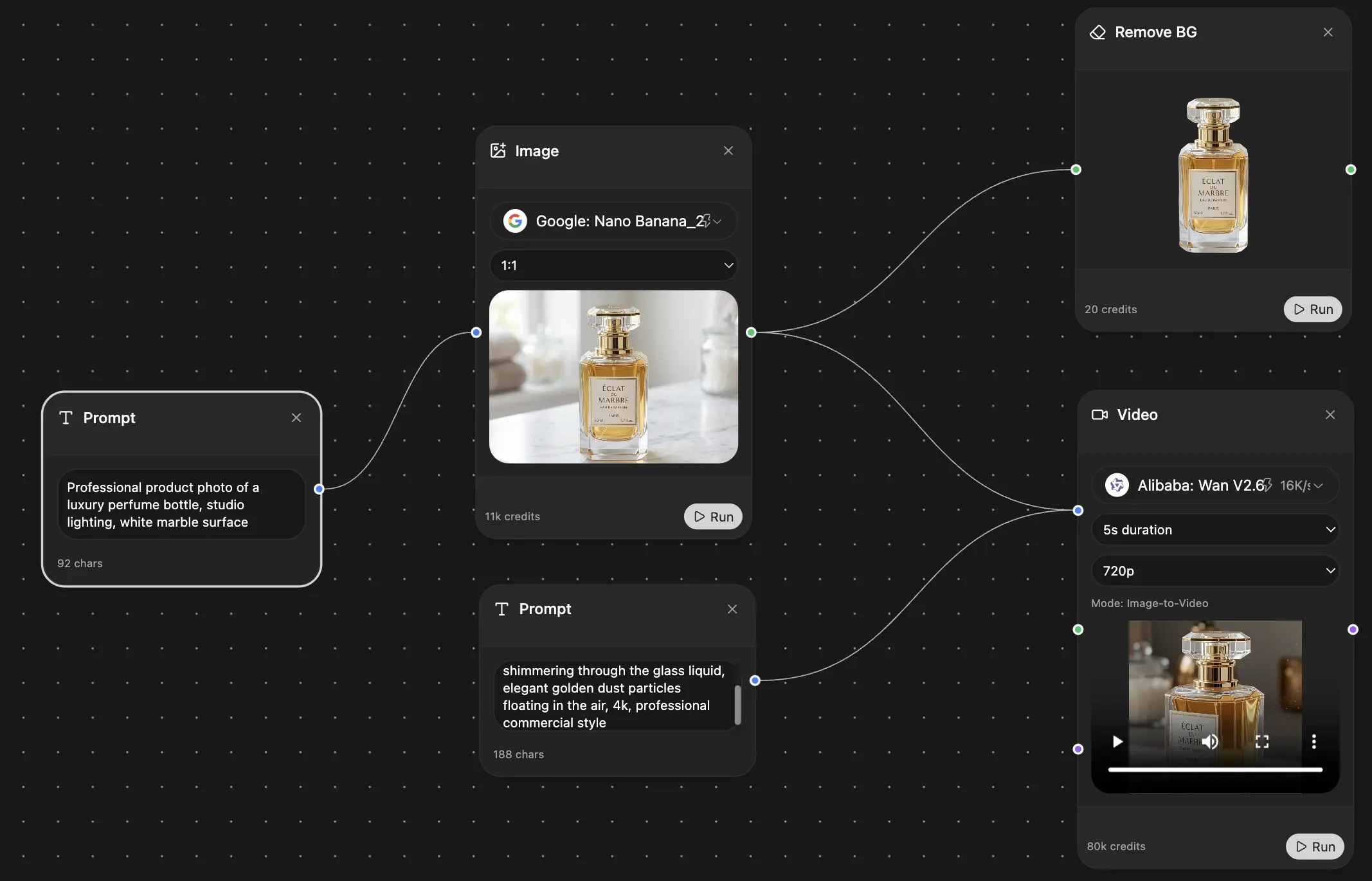
Your infinite AI canvas.
Chat, image, video & motion tools — side by side
Save hours of work and research
Transparent, High-Value Pricing
Trusted by teams at






Free
No credit card required
- 100 credits daily
- 3 AI models to try
- Basic AI chat
Plus
- 1,000,000 credits/month
- 25+ AI models — GPT, Claude, Gemini, Grok & more
- Agent Mode with web search, computer tools and more
- Creative Studio: image generation and video generation
- Project Library: chat with document, website and youtube, podcast generation, flashcards, reports and more
- Workflow Studio and FocusOS
Professional
- Everything in Plus, and:
- 2,100,000 credits/month
- Pro-exclusive models (Claude Opus, Grok 4, Sonar Pro)
- Motion Tools & Max Mode
- First access to latest features
- Access to additional offers
What Our Users Say
Great Tool after 2 months usage
simplyzubair
I love the way multiple tools they integrated in one platform. So far it is going in right dorection adding more tools.
Best in Kind!
barefootmedicine
This is another game-change. have used software that kind of offers similar features, but the quality of the data I'm getting back and the sheer speed of the responses is outstanding. I use this app ...
simply awesome
MarianZ
I just tried it - didnt wanna stay with it, because there is so much like that out there. But it convinced me, because: - the discord-channel is very response and fast - the number of models are quite...
A Surprisingly Comprehensive and Engaging Experience
bruno.battocletti
Zemith is not just another app; it's a surprisingly comprehensive platform that feels like a toolbox filled with unexpected delights. From the moment you launch it, you're greeted with a clean and int...
Great for Document Analysis
yerch82
Just works. Simple to use and great for working with documents and make summaries. Money well spend in my opinion.
Great AI site with lots of features and accessible llm's
sumore
what I find most useful in this site is the organization of the features. it's better that all the other site I have so far and even better than chatgpt themselves.
Excellent Tool
AlphaLeaf
Zemith claims to be an all-in-one platform, and after using it, I can confirm that it lives up to that claim. It not only has all the necessary functions, but the UI is also well-designed and very eas...
A well-rounded platform with solid LLMs, extra functionality
SlothMachine
Hey team Zemith! First off: I don't often write these reviews. I should do better, especially with tools that really put their heart and soul into their platform.
This is the best tool I've ever used. Updates are made almost daily, and the feedback process is very fast.
reu0691
This is the best AI tool I've used so far. Updates are made almost daily, and the feedback process is incredibly fast. Just looking at the changelogs, you can see how consistently the developers have ...