Data Driven Insights: A Practical 2026 Guide
Turn raw numbers into real decisions with data driven insights. A 2026 guide on frameworks, examples, and AI workflows that work.
You're staring at a dashboard with twelve charts, three filters, and enough green arrows to suggest everything is wonderful. Then someone asks, “So what should we do?” Silence. The dashboard has numbers, but it hasn't given anyone a decision.
That's the awkward gap between data and data driven insights. Raw information tells you what happened. Analysis helps explain patterns. A useful insight goes one step further and changes what someone does next. This guide shows how to close the trust gap, reduce the delay between insight and action, and test whether an insight is strong enough to deserve a budget, roadmap slot, or awkward meeting.
So What Are Data Driven Insights Really
A chart isn't automatically an insight. A spreadsheet isn't an insight. A colorful dashboard with a name like “Executive Performance Hub” definitely isn't automatically an insight, although it may be wearing a very expensive costume.
A data driven insight answers a specific question, identifies a meaningful signal, explains why it matters, and points toward an action. “Website visits increased” is an observation. “Visitors from non-branded search are reaching the pricing page but not starting a trial, so the pricing explanation needs testing before more traffic is purchased” is closer to an insight. It connects evidence to a decision.
Think of a kitchen. Raw data is the pile of ingredients. Analysis is chopping, weighing, tasting, and comparing. Interpretation is deciding that the soup needs salt, not another kilogram of carrots. The insight is the clear instruction that follows: add salt, retest the recipe, and don't serve the soup to the entire restaurant until someone tastes it.

The useful distinction
Use this simple ladder when reviewing your work:
- Raw data: Events, measurements, comments, transactions, logs, or documents collected from a source.
- Analysis: Sorting, joining, filtering, grouping, comparing, and calculating patterns in that material.
- Interpretation: Connecting a pattern to context, constraints, user behavior, or business reality.
- Insight: A defensible conclusion that helps someone choose an action.
- Decision: The action, owner, timing, and success measure that follow.
The last two steps matter most. If nobody can explain what changes because of the finding, you probably have analysis, not insight. That isn't failure. Analysis is necessary. It just shouldn't be sent into a meeting pretending to be a strategy.
AI makes this distinction even more important. A found that 65% say AI has improved their productivity and efficiency, with 16% calling the impact “extremely positive” and fewer than 10% saying it had a negative effect. Faster production helps, but faster production of unverified conclusions creates more polished confusion.
Practical rule: If an insight can't survive the questions “Compared with what?”, “Why might this be happening?”, and “What will we do differently?”, keep investigating.
For a deeper foundation, compare this approach with . Anyone can collect data. Turning it into something decision-grade is a different sport.
The Six Stages of Turning Data Into Insight
Treat the workflow like detective work, not a conveyor belt. A detective doesn't collect every clue in the city, polish one suspicious object, and announce the culprit. They gather evidence, remove noise, form a theory, test it, and revise the case when reality disagrees.

Start with a question
Collection begins with the decision you're trying to support. A developer might ask why failed builds are increasing. A researcher might ask which themes appear consistently across a literature set. A marketer might ask which audience is responding to a campaign and which audience is merely clicking politely.
Collect only what can help answer that question. More data feels safe, but it often creates a larger haystack and a smaller chance of finding the needle.
Cleaning is where the glamorous detective work becomes spreadsheet archaeology. Remove duplicates, identify missing values, standardize names, check timestamps, and document transformations. If one system calls a customer “active” after a login and another requires a completed workflow, your chart may be precise while your conclusion is nonsense.
Find the signal, then explain it
Analysis reveals patterns through comparison. Segment users, compare periods, examine cohorts, inspect outliers, and look for relationships that deserve attention. Correlation can help you ask a sharper question, but it doesn't automatically explain cause. If support tickets rise while releases become more frequent, you still need to inspect the release content, affected users, and timing.
Interpretation adds domain knowledge. The same movement can mean different things in different contexts. A drop in engagement might signal a poor experience, a successful task completed faster, a tracking bug, or a seasonal change. Your job isn't to make the most dramatic story. It's to make the most defensible one.
Test before you bet
Validation checks whether the finding is reliable enough to use. Recalculate it, inspect the source, compare it with another signal, ask a subject-matter expert, and record assumptions. Keep an audit trail so another person can reproduce the result without needing to summon the original analyst through ancient office magic.
Action turns the finding into ownership. Name the person responsible, define what they'll change, set a review point, and choose a success measure. Then return to collection. The action creates new evidence, which may confirm, refine, or embarrassingly defeat the original theory.
A practical helps keep sources, definitions, versions, and decisions connected instead of scattered across notebooks and forgotten browser tabs.
Use the video below as a visual companion to the lifecycle, then apply the loop to one live question from your own work.
Why Data Driven Insights Actually Pay Off
The value isn't the report. The value is the improved decision that the report makes possible.
A study of 179 publicly traded firms found that organizations using data-driven decision-making had output and productivity 5 to 6 percent higher than expected after controlling for other investments and IT usage. The authors also reported effects on asset utilization, return on equity, and market value, and used IV methods to reduce the risk that the result was merely reverse causality. You can read the study in the .
The practical meaning is straightforward. Data driven insights can improve how teams allocate time, prioritize work, use assets, and judge opportunities. They're not just a faster way to produce the same monthly report. When teams embed evidence into recurring decisions, the organization changes how it operates.
Translate the payoff by role
A marketer uses insight to decide which audience deserves more testing, which message needs revision, and whether a campaign is producing useful behavior rather than vanity metrics. A product manager uses it to separate a genuine adoption problem from a measurement problem. A researcher uses it to identify which sources support a conclusion and which merely repeat it.
AI can compress the mechanical work inside these workflows. Microsoft's 2026 Work Trend Index, based on 20,000 full-time employed or self-employed knowledge workers across 10 markets, found that 66% of AI users spend more time on high-value work, while 58% say they're producing work they couldn't have a year earlier. The survey ran from February 18 to April 7, 2026, as documented in .
BCG reported that among regular AI-using frontline employees, 42% save eight hours per week, with higher time savings reported in marketing, IT, and HR. The report's useful warning is that strategy matters more than tools, as discussed in . Saving time only creates value when the freed capacity goes toward better questions, validation, and action.
For a practical example of applying evidence to a focused commercial question, can help frame how market signals become product and positioning decisions. The lesson travels well beyond Etsy: collect evidence around a decision, not around your curiosity drawer.
Teams looking for a structured way to work with evidence can also review , especially when the workflow spans documents, metrics, and competing interpretations.
Real Examples for Developers, Researchers, Creators, and Marketers
The value lives in the improved decision that a report makes possible, not in the report itself. A developer may face noisy logs, a researcher may face conflicting papers, a creator may have scattered performance signals, and a marketer may have a deadline pressing close behind. In each case, the work follows the same test: can the finding be trusted, interpreted in context, and converted into a specific action?
The developer's version
Collection means pulling the logs and tickets related to the question, not every record the application has ever emitted. Cleaning aligns deployment times, bug timestamps, severity labels, and duplicate reports. Analysis may show that failures cluster after a particular release pattern, but an engineer still needs to inspect the code path before treating that pattern as causal.
Validation can include reproducing the error, checking whether monitoring captured all affected users, and comparing the finding with support conversations. The action might be a test, rollback, instrumentation change, or review rule. The insight earns its place when it changes engineering behavior and gives the team a way to check whether the change worked.
The researcher's version
A literature dump becomes manageable after the question and coding scheme are defined. Extract claims, methods, populations, limitations, and themes. Keep disagreements visible. Smooth paragraphs are pleasant until a supervisor asks where the evidence becomes weak.
A decision-grade synthesis separates repeated evidence from repeated wording. It also records which conclusions depend on a narrow context. A theme appearing across several papers may still have limited reach if the studies examine similar populations, methods, or settings.
The creator's version
Search and engagement data can suggest demand, but they cannot write the editorial brief. Combine query themes with comments, existing coverage, and the audience's actual problems. A spike may be timely, temporary, poorly matched, or caused by a question that current content fails to answer.
The next action should be specific: publish a comparison, update an outdated section, create a visual explanation, or interview readers. “Make more content” is not an insight. It is a cry for help wearing a content calendar.
The marketer's version
Marketing data becomes actionable when the team follows the customer journey across channels. A click can indicate curiosity, while a completed action signals stronger intent. Customer feedback may explain the gap between those behaviors.
The next move could involve the message, page, audience, offer, or measurement setup. Before increasing spend, check whether the signal survives the four decision-grade questions: is the source reliable, is the definition clear, does the timing fit, and can the team identify the action and its expected result? One excited chart should not receive the budget card.
The Trust Gap Nobody Talks About
More access to data doesn't automatically create better decisions. If teams use different definitions, inherit broken pipelines, or distrust the source, democratization spreads disagreement faster. Congratulations, everyone now has access to the wrong number.
Independent 2026 coverage of BARC's trend monitor describes enterprise priorities around security, data quality, governance, and data literacy, while an Info-Tech 2026 report highlights gaps in accountability for governance and risk management. Together, these concerns point to the operational question many AI discussions avoid: can the team trust the evidence enough to act?

Run four checks before approval
Use this filter before a finding reaches a budget meeting:
- Source: Where did the data originate, and who owns its collection? Check whether the source is complete, reliable, and appropriate for the question.
- Definition: What exactly does each metric mean? Write down terms such as “active user,” “qualified lead,” or “successful session.” If two teams calculate it differently, stop and reconcile the definitions.
- Recency: Does the timing fit the decision? A historical pattern may inform planning, but it may not describe what's happening now. Record the observation window and any known lag.
- Contradiction: What evidence points the other way? Search for missing segments, alternative explanations, measurement changes, and qualitative feedback that challenges the preferred story.
A finding that fails one check isn't useless. It's unfinished. Label the uncertainty, assign someone to resolve it, and avoid presenting a guess with the confidence of a fire alarm.
Data literacy remains uneven. DataCamp's 2025 literacy report says 46% of leaders report mature organization-wide data literacy programs, while 69% say AI literacy is essential and 43% report mature AI upskilling, as documented in the . That combination suggests a familiar problem: people may access generated insights before they can evaluate reliability, limitations, or ethical consequences.
Use as a practical habit, not a final ceremonial step. Ask for sources, inspect the original material, and keep a human accountable for the decision.
How an All-in-One AI Workspace Changes the Loop
A messy research project often lives across browser tabs, PDFs, notes, spreadsheets, screenshots, and a chat window that contains the one useful conclusion you can't find anymore. An all-in-one AI workspace can reduce that switching by keeping evidence and working context closer together.
Zemith provides multi-model AI access, document assistance, Smart Notepad, Deep Research, Library organization, Projects, coding support, image tools, and document or dataset analysis in one workspace. A researcher could upload source material, ask for summaries and themes, compare competing claims, draft a structured brief, and keep the working documents connected instead of rebuilding context in every tool.
The important phrase is compress the loop, not remove the loop. A workspace can help with collection by gathering documents and web evidence. It can support cleaning by identifying duplicates, inconsistent labels, or missing context. It can accelerate analysis through summaries, comparisons, visual prompts, and questions for a dataset. It can also help interpretation by surfacing connections that deserve human review.
That final qualification matters. InsightBench evaluates end-to-end, multi-step data analysis across 100 diverse datasets, including question generation, interpretation, and insight summarization. The benchmark's technical contribution is to evaluate workflow-level performance rather than isolated model accuracy, as described in the . A model can answer one table question correctly and still produce a weak final recommendation if planning, grounding, or summarization fails elsewhere.
A sensible human and AI split
Let the system handle repetitive searching, document comparison, first-pass summaries, formatting, and question generation. Let people define the decision, judge source quality, interpret organizational context, challenge assumptions, approve claims, and accept accountability.
For developers, a coding assistant can explain an error and propose a test, but it shouldn't decide that production behavior is safe without disclosure. For marketers, a research workspace can cluster customer language, but it can't know whether a brand promise is ethically or strategically appropriate without human judgment.
The conversation makes more sense when framed this way. The goal isn't to generate more content or more charts. It's to keep evidence, reasoning, review, and action connected.
Your Decision-Grade Insights Checklist
Use this as a preflight check before acting on any important finding. You don't need a giant governance committee for every question. You do need enough discipline to avoid betting money on a metric nobody can define.
The quick self-audit
- Question: Can you state the decision in one sentence?
- Data: Are the sources relevant, traceable, and clean enough for that decision?
- Definitions: Do the people involved agree on what every important metric means?
- Validation: Did you test the finding against another source, segment, time period, or plausible explanation?
- Action owner: Is one person responsible for the next move?
- Success measure: What observable result would support the action?
- Time to act: How long can the insight remain useful before the situation changes?
If you answer “not sure” to several items, don't throw the analysis away. Mark the gaps. A transparent “we need better data before deciding” is more valuable than a confident recommendation built on mystery arithmetic.
Track the workflow itself, too. Are decisions becoming clearer? Do teams spend less time reconciling definitions? Can another person reproduce the finding? Do owners act within the relevant window? Are failed assumptions discovered early instead of after the budget disappears into the shrubbery?
AI can help measure and improve the workflow, but human review still matters. SHRM's 2026 workplace study surveyed 5,875 U.S.-based workers and found that 41% use AI for work, 68% reported improved work efficiency, 63% reported better work quality, and AI users said they save up to six hours per week, according to . Those gains are useful when teams spend the recovered time checking evidence and making better decisions, not merely filling the calendar with more meetings.
Start with one decision this week. Write the question, define the metric, run the four trust checks, assign an owner, and record what happened. That small loop will teach you more than another dashboard nobody opens.
Zemith brings document analysis, Deep Research, multi-model AI, Smart Notepad, Library organization, and related research and productivity tools into one workspace for turning scattered evidence into clearer decisions. Visit and use it to run one real data driven insights workflow, from source collection through validation and action.
Explore Zemith Features
Everything you need. Nothing you don't.
One subscription replaces five. Every top AI model, every creative tool, and every productivity feature, in one focused workspace.
Every top AI. One subscription.
ChatGPT, Claude, Gemini, DeepSeek, Grok & 25+ more








Always on, real-time AI.
Voice + screen share · instant answers
What's the best way to learn a new language?
Immersion and spaced repetition work best. Try consuming media in your target language daily.
Voice + screen share · AI answers in real time
Image Generation
Flux, Nano Banana, Ideogram, Recraft + more

Write at the speed of thought.
AI autocomplete, rewrite & expand on command
Any document. Any format.
PDF, URL, or YouTube → chat, quiz, podcast & more
Video Creation
Veo, Kling, Grok Imagine and more

Text to Speech
Natural AI voices, 30+ languages
Code Generation
Write, debug & explain code
Chat with Documents
Upload PDFs, analyze content
Your AI, in your pocket.
Full access on iOS & Android · synced everywhere
Your infinite AI canvas.
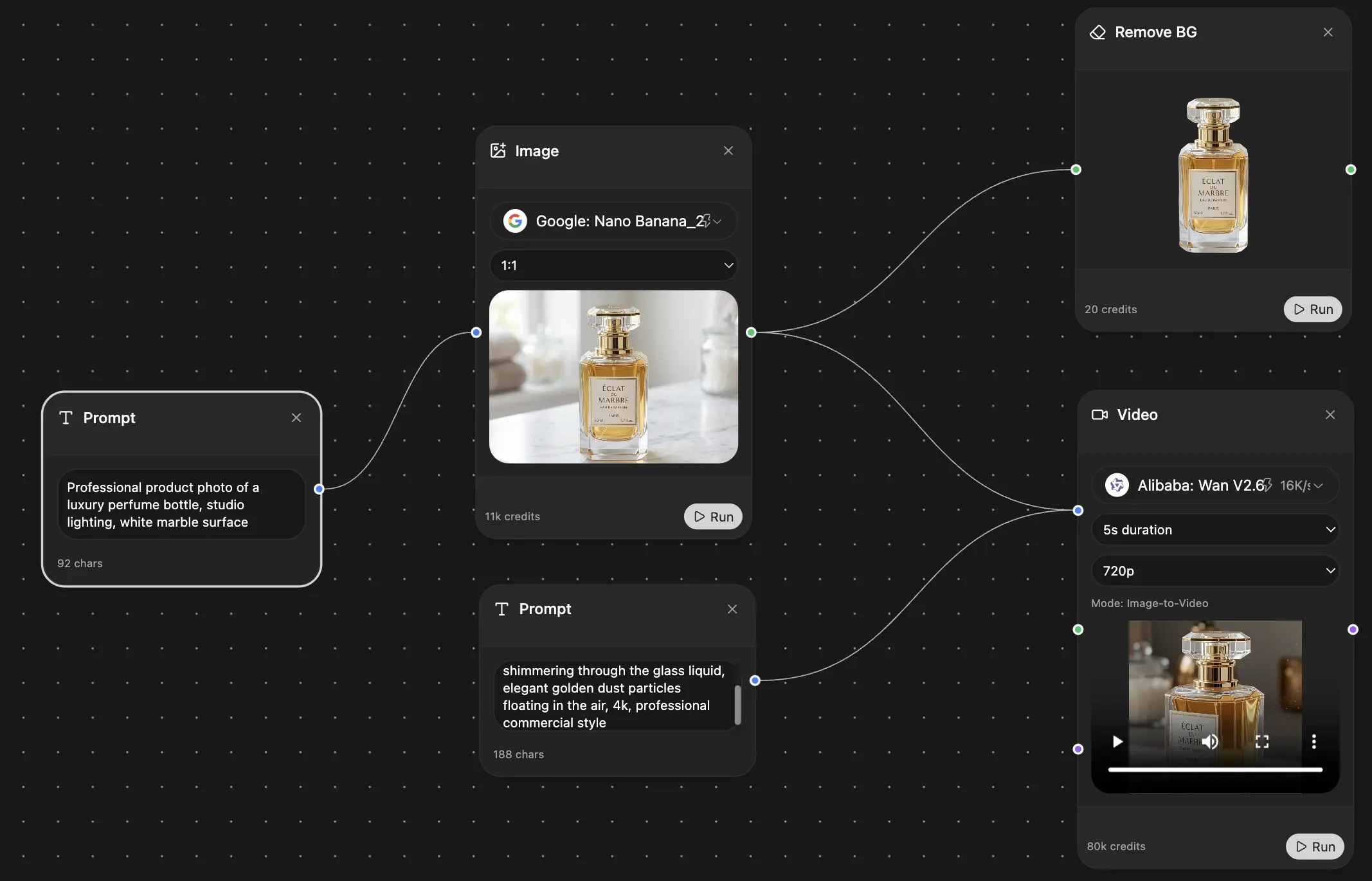
Chat, image, video & motion tools — side by side
Save hours of work and research
Transparent, High-Value Pricing
Trusted by teams at






Free
No credit card required
- 100 credits daily
- 3 AI models to try
- Basic AI chat
Plus
- 1,000,000 credits/month
- 25+ AI models — GPT, Claude, Gemini, Grok & more
- Agent Mode with web search, computer tools and more
- Creative Studio: image generation and video generation
- Project Library: chat with document, website and youtube, podcast generation, flashcards, reports and more
- Workflow Studio and FocusOS
Professional
- Everything in Plus, and:
- 2,100,000 credits/month
- Pro-exclusive models (Claude Opus, Grok 4, Sonar Pro)
- Motion Tools & Max Mode
- First access to latest features
- Access to additional offers
What Our Users Say
Great Tool after 2 months usage
simplyzubair
I love the way multiple tools they integrated in one platform. So far it is going in right dorection adding more tools.
Best in Kind!
barefootmedicine
This is another game-change. have used software that kind of offers similar features, but the quality of the data I'm getting back and the sheer speed of the responses is outstanding. I use this app ...
simply awesome
MarianZ
I just tried it - didnt wanna stay with it, because there is so much like that out there. But it convinced me, because: - the discord-channel is very response and fast - the number of models are quite...
A Surprisingly Comprehensive and Engaging Experience
bruno.battocletti
Zemith is not just another app; it's a surprisingly comprehensive platform that feels like a toolbox filled with unexpected delights. From the moment you launch it, you're greeted with a clean and int...
Great for Document Analysis
yerch82
Just works. Simple to use and great for working with documents and make summaries. Money well spend in my opinion.
Great AI site with lots of features and accessible llm's
sumore
what I find most useful in this site is the organization of the features. it's better that all the other site I have so far and even better than chatgpt themselves.
Excellent Tool
AlphaLeaf
Zemith claims to be an all-in-one platform, and after using it, I can confirm that it lives up to that claim. It not only has all the necessary functions, but the UI is also well-designed and very eas...
A well-rounded platform with solid LLMs, extra functionality
SlothMachine
Hey team Zemith! First off: I don't often write these reviews. I should do better, especially with tools that really put their heart and soul into their platform.
This is the best tool I've ever used. Updates are made almost daily, and the feedback process is very fast.
reu0691
This is the best AI tool I've used so far. Updates are made almost daily, and the feedback process is incredibly fast. Just looking at the changelogs, you can see how consistently the developers have ...