AI Platform for Developers: Build Without the Tool Chaos
Streamline your workflow with an AI platform for developers. Build faster and eliminate tool chaos. Discover the essential guide for 2026.
Most advice about AI for developers still sounds stuck in autocomplete era thinking. The pitch is usually simple, find the smartest model, hook it into your editor, and let it spray code faster than you can type it. That misses the actual bottleneck, because most devs don't lose time writing characters, they lose time bouncing between chat, docs, research, diagrams, debugging, deployment, and then trying to remember which answer came from where.
The market already tells that story. The 2025 Stack Overflow Developer Survey found that 84% of developers either use or plan to use AI tools, up from 76% in 2024, and 51% of professional developers use AI tools every day, but only 29% trust AI outputs to be accurate (). That combination is the whole problem in one snapshot, high adoption, low trust, and a growing need for systems that support review instead of blind faith.
Why Your AI Coding Assistant Is Not Enough
The most useful AI tool I've tested for development wasn't the one that wrote the prettiest function. It was the one that made me stop hopping between five tabs like a caffeinated raccoon. A standalone coding assistant can help with syntax, but shipping software also means checking assumptions, comparing outputs, pulling context from docs, and keeping the team aligned.
The bottleneck is workflow fragmentation
A lot of developers still treat AI like a better autocomplete. That works until the task crosses into research, architecture, testing, or deployment. Then the session breaks apart, and the context you had in one tool does not follow you into the next one.
That is why trust matters more than raw output speed. As noted earlier, adoption is high, but confidence in the answers is still much lower. The setup that wins is usually the one that makes verification easier, because trust has to be earned every time the tool touches real code.
Practical rule: if your AI setup cannot help you verify what it produces, it is not reducing risk, it is moving the risk around.
A better workflow keeps the work in one place long enough to inspect it properly. That can mean comparing model output against source files, checking generated changes against team conventions, or keeping research, code, and review notes together instead of scattering them across separate apps.
For a practical look at how developers are structuring that kind of workflow, the pattern shows up clearly in . The useful takeaway is not “use more AI.” It is “set up a process that makes AI easier to verify.” If you are still comparing scattered tools, to see how different platforms package those pieces together.
What an AI Platform for Developers Actually Is
A real AI platform for developers isn't just a chat box with a code theme. Think of it less like a single tool and more like a workshop, a place where research, generation, testing, and follow-up all happen in one environment. That distinction matters because dev work is rarely one isolated prompt. It's a chain of small decisions that need memory, structure, and enough flexibility to handle different tasks without making you restart from zero.

Platform means multiple capabilities, one workspace
Anaconda defines an AI platform as an integrated set of technologies for developing, testing, deploying, and refreshing machine learning and deep learning models, with tools for different users and a deployment runtime (). That definition is broad, but it's useful because it separates a platform from a feature.
A single-purpose assistant helps with one slice of work. A platform handles several slices in the same place. That may include multi-model access, document chat, image generation, code generation, organized workspaces, and deployment workflows. Google's AI for Developers is a good example of this multi-model pattern, since it exposes Gemini, Imagen, and Gemma through a single API surface and supports custom AI solutions ().
If you're comparing tools and want to see how broad the market has become, is a helpful way to sanity-check how many products solve only one part of the stack.
A platform should lower the number of times you have to explain the same problem.
For a more concrete way to compare categories, is worth scanning before you commit to another half-baked subscription.
Single-purpose tools still matter, but they're not enough
There's nothing wrong with a good chatbot, image generator, or snippet helper. The problem starts when each one becomes a separate destination. Once that happens, you're spending attention on tool selection instead of software delivery. That's the point where “AI help” starts behaving like tool chaos with nicer branding.
Six Features Every Developer AI Platform Should Have
A useful platform does not try to dazzle you with every possible feature. It has the parts that matter, and those parts have to work together. If a product cannot move cleanly from idea to code to proof to handoff, it is just a bundle of demos wearing a serious face.
1. Multi-model access
This is the first filter I use now. If a platform only gives me one model, I am already planning around the limits. Different tasks need different strengths, and forcing one model to do everything usually means accepting mediocre output in at least one area.
The practical benefit is choice without context switching. I can send reasoning-heavy work to one model, draft code with another, and use a separate image model when the task calls for visuals instead of text. That matters more than model hype because the job is getting the right output with the least friction.
2. Coding support that goes beyond snippets
A useful coding assistant should help you inspect, adjust, and preview. Amazon Q Developer's CLI agent is a strong example of where the category is headed, since it can read and write local files, call AWS APIs, run bash commands, generate code diffs, and adapt to feedback in real time (). That is much closer to a working development partner than a chat window that drops syntax into your lap.
The difference shows up when you are trying to ship. Snippet generation saves a few minutes, but a tool that can work with the actual codebase, show the effect, and respond to corrections saves the review cycle that usually burns the most time.
3. Research with traceable evidence
If the platform claims to do research, citation quality matters. Passage-level provenance beats document-level links because it lets you verify the exact claim faster, and support should be dropped when it is not there (). That is not a nice-to-have. It keeps “research” from turning into confident guessing.
For developers, this matters in code review, architecture decisions, and anything that touches external requirements. You do not need a platform that sounds authoritative. You need one that lets you check the source without leaving the workflow.
4. Workspace memory and organization
The best systems preserve context across files and sessions. Related work should stay connected instead of being scattered across disconnected chats, because long projects fail when the platform forgets what you already decided.
A strong workspace layer also makes automation easier to reason about. If your team is comparing how AI fits into repetitive internal work, the workflow patterns in are a useful reference point before you wire anything into production. That kind of structure is what keeps the work manageable instead of archaeological.
5. Creative and format tools
Developers do not only write code. They draft docs, create diagrams, edit visual assets, and convert content between formats. The platforms that hold attention usually treat those as normal work, not side quests. That is where converters, document chat, and image tools stop being extras and start becoming reasons to stay in one workspace.
The value here is simple. Less tab switching means less lost context, fewer mismatched versions, and fewer places for the task to drift. When the platform can handle content in more than one format, the handoff from planning to implementation gets easier.
6. Verification and control
The hardest gap in developer AI right now is workflow design and verification habits. A 2026 synthesis of developer AI usage gaps calls out “prompting without workflow design,” “autocomplete overuse, deeper use underuse,” and inconsistent verification standards, which is basically a polite way of saying teams still have not built guardrails that fit their day-to-day work ().
That is why verification features matter as much as generation features. Auditability, access control, traceable actions, and clear review points give teams a way to trust the output without treating every suggestion as final. If you are evaluating a platform for your own stack, the can also be a useful lens for understanding how work is documented, reviewed, and justified across the development process.
Real Developer Workflows Powered by AI Platforms
A platform earns its keep on an ordinary workday, not during a polished demo. The test is whether it helps when the sprint is live, the deadline is slipping, and nobody cares which model tops a benchmark chart. That is why the conversation should shift from which model writes code best to which platform cuts context switching and keeps verification in the same flow.

A full-stack feature without the tab safari
A backend engineer starts with a product requirement, checks docs, drafts the API contract, and prototypes the first version in one workspace. The coding assistant handles the first pass, the preview catches obvious UI issues, and the research panel helps confirm implementation details without leaving the browser. Integrated context storage means the engineer does not have to paste the same notes into three different places and hope nothing drifts.
That is the value of consolidation. One session can cover ideation, implementation, verification, and handoff. In a fragmented setup, each stage becomes a separate tool, plus the little ritual of re-explaining the task to each one like you are onboarding a very forgetful intern. For a concrete version of this flow, see the breakdown.
For teams thinking about R&D planning and tooling, a useful adjacent read is the , especially if AI work is starting to show up in formal project budgets.
A technical writer who needs more than a chatbot
Technical writing has the same problem, just with different inputs. A writer may need to chat with a product spec, turn notes into polished prose, generate a diagram or image, then convert a long explanation into another format for a tutorial or newsletter. Document chat, smart notepad, image generation, and format conversion become part of a real workflow instead of random extras.
A platform only works here if it keeps the source material, draft text, and output formats in one place long enough to finish the job. That matters when a writer is pulling from product notes, building a tutorial, and preparing the same material for a blog post, a help article, or a newsletter. The more handoffs you add, the more chances there are for terminology to drift or instructions to get rewritten poorly.
A short documentary-style demo can help visualize that kind of flow.
The best takeaway from both workflows is simple. Fewer handoffs mean fewer places for context to die.
How to Evaluate and Migrate to a New AI Platform
Buying AI tools is easy. Getting a team to use them is where things get messy. The safest way to switch is to treat it like a controlled migration, not a leap of faith, and that starts with judging the platform on real work, not demo polish.
Start with the work that hurts most
Pick the workflow that currently wastes the most time. For some teams that's research, for others it's code review, docs, or moving prototype output into production. Run the platform on a real project file, not a toy prompt, because toy prompts hide the exact problems that show up under pressure.
The comparison should focus on four things. Model quality and variety determine whether the platform can adapt to different tasks. Developer experience tells you whether the interface helps or slows you down. Integration and migration decide whether the platform fits your stack without creating a new mess. Cost and scalability matter because subscriptions tend to multiply until somebody notices the credit card statement has become a side quest.
For pricing evaluation, is a useful starting point if you're trying to separate useful value from subscription bloat.
Use a parallel trial before you commit
Run the new platform alongside your current tools for a week. Don't switch everything at once, because that's how teams end up blaming the platform for problems caused by bad migration habits. Move the ugliest friction point first, then build verification checkpoints around it so the team can see where the new setup helps and where it still needs work.
If the new platform doesn't reduce context switching in week one, it probably won't magically fix itself later.
A good go or no-go decision usually comes from whether people keep using it without being reminded. If they reach for it naturally, you're onto something. If they keep escaping back to three separate tabs and a spreadsheet, the platform isn't ready for your workflow yet.
The Case for Consolidating Your AI Toolchain
Tool fragmentation looks harmless until you add up the hidden costs. There's the obvious stuff, like subscriptions for chat, images, coding, and research, but the bigger cost is cognitive overhead. Every extra interface means another prompt style, another login, another place where context can disappear, and another opportunity for a wrong answer to survive because nobody had time to check it.
The market is expanding fast enough that this consolidation question is no longer theoretical. The AI-in-software-development market is estimated at about USD 933 million in 2025 and projected to reach USD 15.7 billion by 2033, with a projected 42.3% CAGR over that period (). That growth doesn't automatically crown a winner, but it does make one thing clear, the category is becoming infrastructure, not a novelty.
There's also the productivity evidence from GitHub Copilot. Independent research reported that developers using it completed a coding task 55.8% faster than the control group, while 78% said they felt more productive and 88% felt more confident in their coding ability (). Those numbers don't prove every tool will deliver the same result, but they do show why integrated AI is attractive when it fits the job.
Zemith is one concrete example of what consolidation looks like in practice. It combines multi-model access, research, writing, coding, images, workspaces, and collaboration-oriented tools like AI Live Mode and whiteboards in one environment. The point isn't that one platform should replace every specialist tool forever. The point is that many teams don't need six separate products to get one feature out the door, they need one place where the work stays intact.
Your Next Steps Toward a Smarter Development Workflow
Start by listing every AI tool your team touches in a normal week, then mark where context gets lost, where verification breaks, and where people duplicate work. That audit usually shows the same pattern, a few tools are very useful, and the rest are just expensive ways to keep everyone busy switching tabs.
Next, run a one-week parallel trial on a real project and force the platform to handle the messiest part of your workflow. If you're evaluating a consolidated option, use the trial to test whether the workspace helps you stay organized, verify outputs, and keep related work together instead of scattering it across chat history. The goal isn't to chase the most advanced model, it's to find the setup that reduces friction across the full development lifecycle.
Finally, build a verification habit. Don't trust any tool by default, check the output, compare it against project context, and keep notes on what gets shipped versus what gets discarded.
Zemith brings multi-model access, research, coding, writing, and organized workspaces into one place, which makes it a strong fit for developers who are tired of tool chaos. If you want to see how an integrated workflow feels in practice, visit and test it against the way you ship code.
Explore Zemith Features
Everything you need. Nothing you don't.
One subscription replaces five. Every top AI model, every creative tool, and every productivity feature, in one focused workspace.
Every top AI. One subscription.
ChatGPT, Claude, Gemini, DeepSeek, Grok & 25+ more







Always on, real-time AI.
Voice + screen share · instant answers
What's the best way to learn a new language?
Immersion and spaced repetition work best. Try consuming media in your target language daily.
Voice + screen share · AI answers in real time
Image Generation
Flux, Nano Banana, Ideogram, Recraft + more

Write at the speed of thought.
AI autocomplete, rewrite & expand on command
Any document. Any format.
PDF, URL, or YouTube → chat, quiz, podcast & more
Video Creation
Veo, Kling, Grok Imagine and more

Text to Speech
Natural AI voices, 30+ languages
Code Generation
Write, debug & explain code
Chat with Documents
Upload PDFs, analyze content
Your AI, in your pocket.
Full access on iOS & Android · synced everywhere
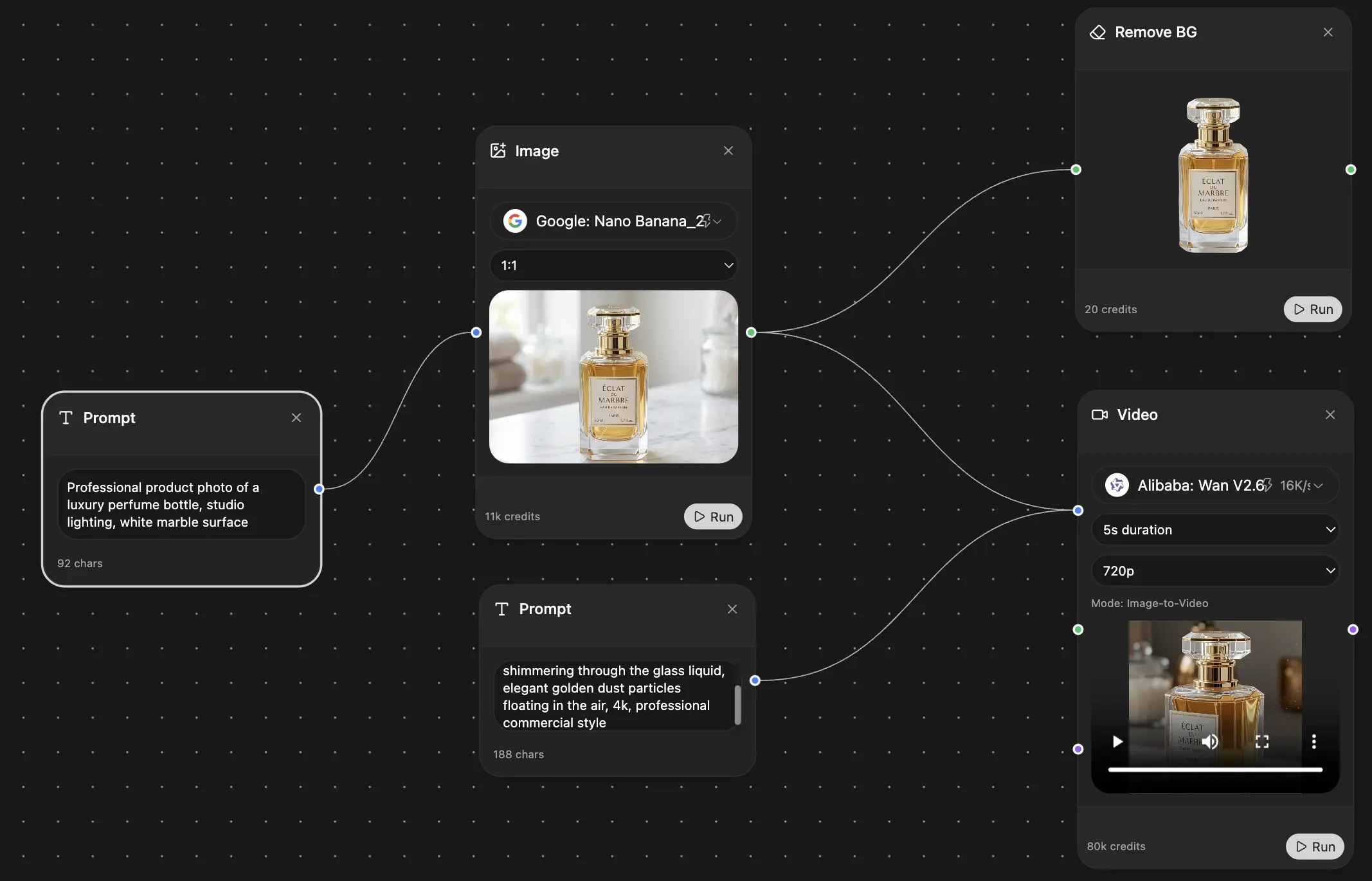
Your infinite AI canvas.
Chat, image, video & motion tools — side by side
Save hours of work and research
Transparent, High-Value Pricing
Trusted by teams at






Free
No credit card required
- 100 credits daily
- 3 AI models to try
- Basic AI chat
Plus
- 1,000,000 credits/month
- 25+ AI models — GPT, Claude, Gemini, Grok & more
- Agent Mode with web search, computer tools and more
- Creative Studio: image generation and video generation
- Project Library: chat with document, website and youtube, podcast generation, flashcards, reports and more
- Workflow Studio and FocusOS
Professional
- Everything in Plus, and:
- 2,100,000 credits/month
- Pro-exclusive models (Claude Opus, Grok 4, Sonar Pro)
- Motion Tools & Max Mode
- First access to latest features
- Access to additional offers
What Our Users Say
Great Tool after 2 months usage
simplyzubair
I love the way multiple tools they integrated in one platform. So far it is going in right dorection adding more tools.
Best in Kind!
barefootmedicine
This is another game-change. have used software that kind of offers similar features, but the quality of the data I'm getting back and the sheer speed of the responses is outstanding. I use this app ...
simply awesome
MarianZ
I just tried it - didnt wanna stay with it, because there is so much like that out there. But it convinced me, because: - the discord-channel is very response and fast - the number of models are quite...
A Surprisingly Comprehensive and Engaging Experience
bruno.battocletti
Zemith is not just another app; it's a surprisingly comprehensive platform that feels like a toolbox filled with unexpected delights. From the moment you launch it, you're greeted with a clean and int...
Great for Document Analysis
yerch82
Just works. Simple to use and great for working with documents and make summaries. Money well spend in my opinion.
Great AI site with lots of features and accessible llm's
sumore
what I find most useful in this site is the organization of the features. it's better that all the other site I have so far and even better than chatgpt themselves.
Excellent Tool
AlphaLeaf
Zemith claims to be an all-in-one platform, and after using it, I can confirm that it lives up to that claim. It not only has all the necessary functions, but the UI is also well-designed and very eas...
A well-rounded platform with solid LLMs, extra functionality
SlothMachine
Hey team Zemith! First off: I don't often write these reviews. I should do better, especially with tools that really put their heart and soul into their platform.
This is the best tool I've ever used. Updates are made almost daily, and the feedback process is very fast.
reu0691
This is the best AI tool I've used so far. Updates are made almost daily, and the feedback process is incredibly fast. Just looking at the changelogs, you can see how consistently the developers have ...