AI Model Pricing Comparison: Tokens, Tiers, and Real Costs
A practical AI model pricing comparison covering token rates, subscription tiers, hidden costs, and how to choose the most affordable model for your workflow.
You sign up for an AI tool thinking the bill will stay cute. One week later you're staring at usage logs, half the prompts are longer than they should be, and the “small experiment” has turned into a real line item that shows up every month like it pays rent.
That's the part nobody puts in the product demo. AI model pricing comparison isn't about picking the cleverest model on paper, it's about not getting mugged by your own workflow. If you've ever looked at an invoice and thought, “Why did summarizing three PDFs cost that much?”, you're in the right place.
The Moment Your AI Bill Stops Being Funny
The first time this happens, it feels like a fluke. You test a chatbot, generate a few drafts, maybe run a small coding assistant, and the usage is still small enough to ignore. Then month two hits, the requests are no longer neat little toy prompts, and suddenly the bill is doing that thing bills do, which is becoming your problem.
I've seen teams blame “AI being expensive” when the underlying issue was a model choice that made no sense for the task. A cheap model can be the right move for drafts, extraction, or classification, but it can also become a trap if the workflow keeps retrying or producing junk that humans need to fix. A premium model can feel painful up front, then turn out cheaper in practice because it lands the answer sooner and burns fewer tokens getting there.
Practical rule: stop asking whether AI is cheap or expensive. Ask whether the model is cheap for the actual task you're paying for.
That's why this topic matters for solo builders, small teams, and content ops. A pricing page only tells you what one million tokens costs. Your invoice tells you whether the model was used sensibly, whether the prompts were bloated, and whether your “assistant” is acting like a slot machine with a billing API attached.
The smart move is to treat AI like any other production cost. If you wouldn't ship a service without watching compute, storage, and request volume, don't ship one with AI and pretend the token bill will take care of itself. The rest of this guide is the hard-earned version of that lesson, without the vendor perfume.
How AI Model Pricing Actually Works
AI pricing looks straightforward until you read the fine print. The big number on the page is usually a per-token rate, but the bill is shaped by what you send in, what the model sends back, and how much context you drag along with every request. For a clean explainer of the underlying mechanics, the primer on is a useful companion if you want the basic vocabulary before you start comparing invoices.
Input, output, and the part that gets you
Input tokens are your prompt, instructions, and context. Output tokens are everything the model generates. The ugly bit is that output tokens typically cost 3 to 8 times more than input tokens because generation takes more compute, and that gap is a major reason cheap-looking prompts become expensive in production . If your app asks for long answers, multi-step reasoning, or verbose code explanations, the output line item can dominate fast.
Context windows are not free real estate
A context window is the maximum amount of text the model can consider in one request. Bigger windows are useful, but they're also where teams burn money by stuffing in everything “just in case.” The lesson is blunt, send only the context the model needs. If a 10K-token context would do the job, shipping 100K tokens is just paying for confidence theater.
The spread is the main story. In one 2026 comparison, Gemini 2.0 Flash is listed at $0.10 per 1 million input tokens and $0.40 per 1 million output tokens, while Claude Opus 4 is listed at $15.00 input and $75.00 output per 1 million tokens, which is a 150x difference on input and 187.5x on output . That's not procurement trivia. That's the difference between shipping a feature and killing it after the first invoice.
If you want to compare your own stack more cleanly, the context-window angle is worth reading alongside , because window size only matters when you relate it to actual workload shape.
The Major Models Side by Side

The honest way to compare frontier models is by what they do to your workload, not by the shine on the product page. Some models are fine for budget drafting and extraction, others make sense when quality matters more than the rate card, and a few are just expensive enough to make you double-check whether the task deserved them at all.
Use case beats vanity metrics
If you're paying for Claude Opus 4, you're usually paying for premium output quality and human preference, not bargain pricing. That lines up with the pricing spread above, and it's the same logic that makes GPT-5.5 Pro a serious choice only when the task needs that class of model. GPT-5.5 itself sits at $5.00 input / $30.00 output per 1M tokens, while GPT-5.5 Pro jumps to $30.00 input / $180.00 output, and both expose a 1,050,000-token context window with 128,000 max output tokens .
That output limit matters more than people admit. If your workload is output-heavy, the expensive tier can hurt faster than the “input” number suggests. So don't get hypnotized by cheap prompt pricing and then act surprised when the generated answer becomes the actual bill.
Where the practical value lands
For reasoning and coding-heavy work, Gemini 3.1 Pro is positioned as stronger value in one comparison, with $2.00 input / $12.00 output per 1M tokens, plus reported benchmark strength on GPQA Diamond and SWE-bench . Claude Opus 4.7 tops Arena ELO in the same comparison, but at $5.00 input / $25.00 output, so that premium makes more sense when human-preference quality is the KPI, not raw efficiency .
A separate market comparison shows consumer subscriptions clustering around a standard tier near $19.99 to $30 per month, while premium plans run much higher, and Mistral Le Chat Pro at $14.99/month appears as the cheapest paid plan with frontier access . If you want a quick pricing snapshot for a mainstream plan, the are a decent reminder that consumer pricing often lives in a tight band even when capabilities don't.
For model-by-model comparison reading, it also helps to cross-check the tradeoffs with , because these choices usually come down to task fit, not brand loyalty.
Real Cost Examples for Common Workloads
The token rate only matters when you map it to a real job. A model that looks cheap on paper can still produce a stupidly large invoice if it writes too much, retries too often, or needs heavy context every time. That's why cost-per-task is the only comparison that matters once you move past toy demos.
Drafting content without lighting money on fire
A content team drafting long-form articles usually pays for three things at once, prompt context, generated output, and the endless little revisions that happen when a first draft is almost right. The expensive part isn't just the writing. It's the back-and-forth, where each correction burns more output tokens than the first pass.
For that kind of workflow, the cheapest model that can produce a usable first draft usually wins. If the model needs several retries or creates sloppy structure that humans must rebuild, the savings vanish fast. That's why “cheap per token” can be a lie if your editing queue is the thing getting billed.
Coding assistants and research jobs are even worse
Developer tooling is where people get burned hardest because code prompts tend to be long and the responses can be long too. A model that's merely okay at code can create extra review cycles, more retries, and more output tokens than the cleaner option. If you're comparing options for that use case, is useful because it frames the choice around coding behavior, not marketing copy.
Research workloads are similar. Long documents, dense prompts, and repeated synthesis turn every marginal token into a real cost. For deep research, the model that handles long context cleanly and keeps the answer tight often beats the one with the lowest sticker price.
Use this rule: price the workflow, not the request. One task with fewer retries is often cheaper than three “cheaper” passes that each create cleanup work.
The best way to sanity-check the workflow side is with the mindset, because structured comparisons force you to ask what the tool costs in practice, not what the homepage wishes you'd believe.

Hidden Costs That Blow Up Your Budget
Token pricing is the part vendors like talking about because it looks tidy. The ugly part sits behind it. Retries, embeddings, storage, fine-tuning runs, guardrails, and the time you spend stitching systems together are where the bill gets creative.
The fees nobody puts in the headline
A “cheap” model wrapped in a complicated pipeline can cost more than a premium model used directly. If the cheap path needs a retrieval layer, a vector store, an evaluation loop, and a fallback route because it fails too often, you are no longer comparing models. You are comparing architecture overhead.
That overhead gets worse when you split work across providers. Every extra dashboard means another place to check usage, another API key to secure, and another bill to reconcile. If your team is bouncing between five consoles to figure out what happened, the operational tax is real even before the token bill lands.
Why the stack, not the model, becomes the problem
Hidden costs often show up after the first month, when the initial setup stops feeling novel. Fine-tuning and evaluation runs consume compute before the feature earns anything back. Storage for logs and embeddings keeps piling up. Observability and moderation layers add their own meters, which is how the “simple assistant” turns into a miniature platform project.
For a closer look at how assistant pipelines add layers of cost and coordination, is the right place to start. Once retrieval, routing, memory, and fallback logic enter the picture, the bill stops reflecting one model and starts reflecting the whole system around it.
A practical note from the cost side, AI spend often lands far above the base rates once output premiums and infrastructure overhead are included. That is why the invoice hurts even when the published token rate looked reasonable.
Direct takeaway: if you cannot explain every line between the prompt and the invoice, you do not have pricing control yet.
That is also where consolidation starts to matter. Fewer systems mean fewer hidden meters, fewer duplicated workflows, and less time spent paying humans to babysit billing screens.
Practical Strategies to Cut Your AI Spend in Half
The fastest savings usually come from boring moves, not clever ones. You don't need to reinvent your stack. You need to stop sending oversized prompts, stop retrying bad requests, and stop feeding premium models problems that a smaller model can handle.
Route the cheap work to cheap models
Simple classification, extraction, and short drafting should not touch your highest-tier model. The pricing comparison from earlier makes that obvious. Use the premium tier only when the task needs better reasoning, better style, or higher reliability.
Trim prompts before you pay for them
Every extra paragraph in the prompt is money. Cut redundant instructions, summarize long inputs, and don't stuff the whole project history into every request because you're nervous. Most prompts are bloated because nobody wants to be the one who deletes the extra text, and yes, that bad habit shows up on the invoice.
Cache what repeats
If your app sees near-duplicate requests, cache the response and stop paying twice for the same answer. Reused prompt prefixes and repeated queries are low-hanging fruit, especially for support bots, document workflows, and internal tools.
Batch the boring stuff
Embeddings, classification jobs, and non-urgent analysis can usually be batched. That cuts overhead and makes usage easier to control. It also makes it much easier to spot when a workflow is leaking money because the batch pattern gets broken.
Mix subscription and API access on purpose
The cheapest setup is often not “all subscription” or “all API.” It's a subscription for interactive work and a low-cost API for high-volume automation. That combination makes more sense than overbuying one channel just because it feels simpler.

One more thing. A flat-rate plan can be cheaper for interactive work, but once you start pushing high-volume automation, the API usually wins on control and predictability. The winning setup is the one that matches your traffic pattern, not the one that looked friendlier in a pricing screenshot.
Why Consolidating Access With Zemith Quietly Saves You More
The obvious savings come from model choice. The quieter savings come from removing the nonsense around it. One workspace, one subscription, one set of usage habits, and fewer reasons to keep switching tabs like a caffeinated raccoon.
Less account sprawl, less billing drag
Zemith is positioned as an all-in-one workspace with access to multiple models and tools in one place, including Gemini-2.5 Pro, Claude 4 Sonnet, GPT o3-mini, Black Forest Labs Flux 1.1 Pro Ultra, Stability Diffusion 3.5, and Google Imagen 3. That matters because the true cost of AI isn't just the model, it's the time spent juggling logins, invoices, and workflows across separate providers. If you've ever kept three subscriptions alive because you forgot which one had the right model, you already know the tax I'm talking about.
The useful parts are workflow parts
The money-saving case for consolidation shows up in actual use. Document Assistant reduces the need to bounce between a chat tool and a document tool. Smart Notepad helps with drafting and rewriting. Coding Assistant keeps development work inside the same environment, and Deep Research keeps research work from turning into browser chaos. Those are workflow cuts, not decorative features.
One platform can support cleaner routing
The better setup is not “use one model forever.” It's “route each job to the right model without building a subscription zoo.” A shared workspace makes that easier because the decision happens inside one interface instead of across five billing systems. If you're already comparing options by capability, the framing is useful, because it forces the question of whether your stack should be assembled from fragments or run from one place.
Consolidation also reduces the hidden stuff from earlier, the extra logins, duplicate context, and endless toggling. That's not glamorous, but it's where a lot of wasted time and money lives.
Choosing the Right Setup for Your Situation
The cheapest setup depends on what you do all day. If you're a solo writer, a developer shipping a product, or a researcher drowning in documents, the right answer changes fast. Anyone selling a universal “best model” is trying to sell you a shortcut, and shortcuts are how budget surprises happen.
Solo writers and small content teams
If your work is mostly drafting, rewriting, and summarizing, start with a subscription-heavy setup and keep the premium API use limited. That gives you predictable monthly spend and avoids paying per request for everything. If the team keeps touching the same docs and prompts, a consolidated workspace is usually less annoying and less wasteful than a pile of separate tools.
Developers building AI features
If you're shipping product features, lean toward a hybrid setup. Use a subscription for interactive work and testing, then route production calls through the cheapest model that meets quality thresholds. For code-heavy tasks, the model choice should be driven by output quality, retry rate, and how often humans have to clean up the result.
Researchers and knowledge workers
If the job is long-context reading, synthesis, and document comparison, a multi-model workspace is the sane default. You need flexibility more than you need one perfect rate card. A tool like Zemith can make sense here because it centralizes models, documents, and research workflows without forcing you to pay for the wrong thing in a separate app.
Before you buy anything else, ask three questions. Does this workload need the premium model? Am I paying for retries? Do I already have another tool that does this job inside my existing stack? If the answer to the last one is yes, stop buying overlap.

If you're done overpaying for AI you don't fully use, spend a few minutes inside and see how much of your current stack can be replaced by one workspace, one bill, and a lot less tab-hopping. If your workflow mixes writing, research, and coding, that consolidation can be the cheapest upgrade you make this quarter.
Explore Zemith Features
Everything you need. Nothing you don't.
One subscription replaces five. Every top AI model, every creative tool, and every productivity feature, in one focused workspace.
Every top AI. One subscription.
ChatGPT, Claude, Gemini, DeepSeek, Grok & 25+ more







Always on, real-time AI.
Voice + screen share · instant answers
What's the best way to learn a new language?
Immersion and spaced repetition work best. Try consuming media in your target language daily.
Voice + screen share · AI answers in real time
Image Generation
Flux, Nano Banana, Ideogram, Recraft + more

Write at the speed of thought.
AI autocomplete, rewrite & expand on command
Any document. Any format.
PDF, URL, or YouTube → chat, quiz, podcast & more
Video Creation
Veo, Kling, Grok Imagine and more

Text to Speech
Natural AI voices, 30+ languages
Code Generation
Write, debug & explain code
Chat with Documents
Upload PDFs, analyze content
Your AI, in your pocket.
Full access on iOS & Android · synced everywhere
Your infinite AI canvas.
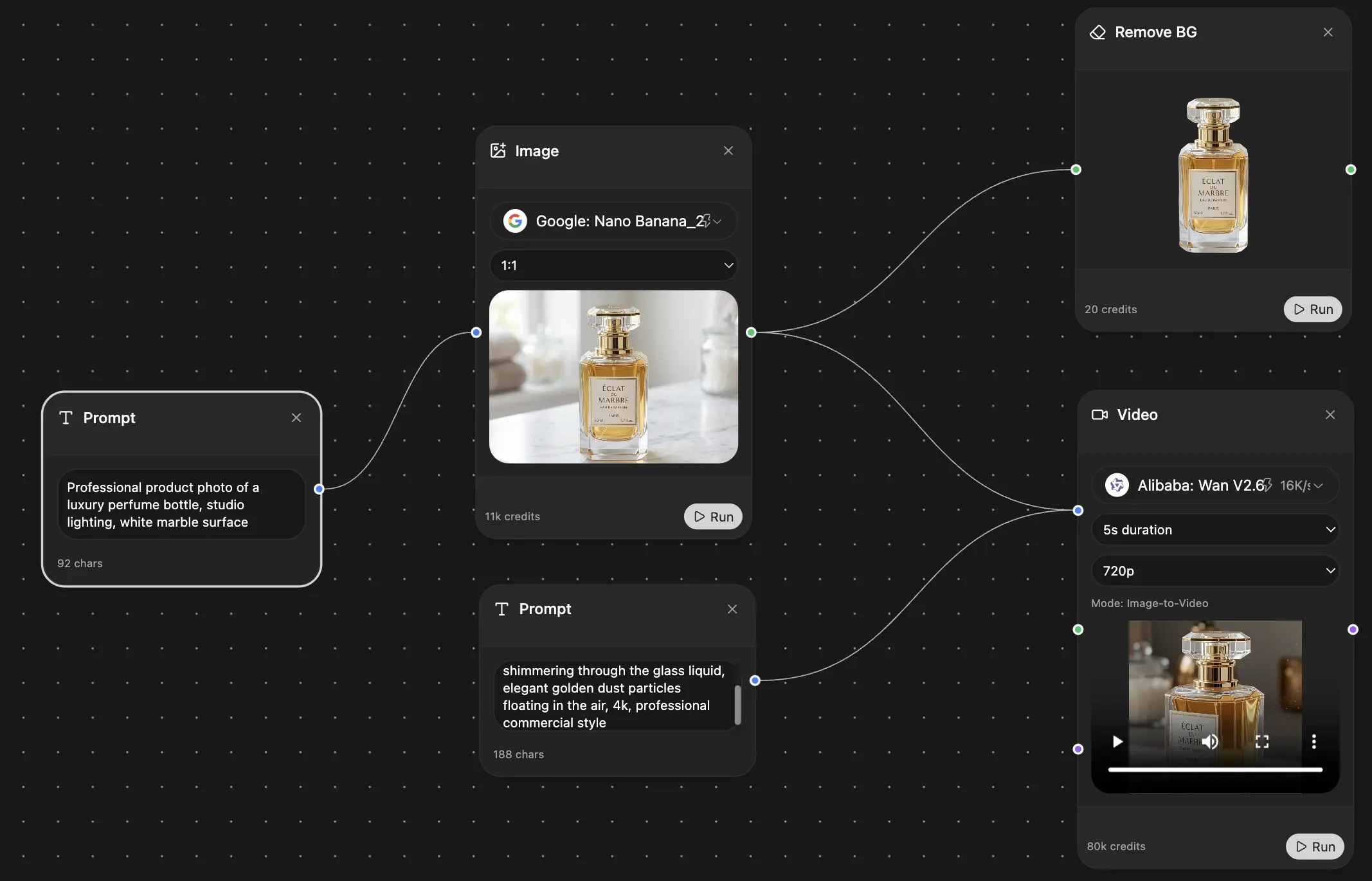
Chat, image, video & motion tools — side by side
Save hours of work and research
Transparent, High-Value Pricing
Trusted by teams at






Free
No credit card required
- 100 credits daily
- 3 AI models to try
- Basic AI chat
Plus
- 1,000,000 credits/month
- 25+ AI models — GPT, Claude, Gemini, Grok & more
- Agent Mode with web search, computer tools and more
- Creative Studio: image generation and video generation
- Project Library: chat with document, website and youtube, podcast generation, flashcards, reports and more
- Workflow Studio and FocusOS
Professional
- Everything in Plus, and:
- 2,100,000 credits/month
- Pro-exclusive models (Claude Opus, Grok 4, Sonar Pro)
- Motion Tools & Max Mode
- First access to latest features
- Access to additional offers
What Our Users Say
Great Tool after 2 months usage
simplyzubair
I love the way multiple tools they integrated in one platform. So far it is going in right dorection adding more tools.
Best in Kind!
barefootmedicine
This is another game-change. have used software that kind of offers similar features, but the quality of the data I'm getting back and the sheer speed of the responses is outstanding. I use this app ...
simply awesome
MarianZ
I just tried it - didnt wanna stay with it, because there is so much like that out there. But it convinced me, because: - the discord-channel is very response and fast - the number of models are quite...
A Surprisingly Comprehensive and Engaging Experience
bruno.battocletti
Zemith is not just another app; it's a surprisingly comprehensive platform that feels like a toolbox filled with unexpected delights. From the moment you launch it, you're greeted with a clean and int...
Great for Document Analysis
yerch82
Just works. Simple to use and great for working with documents and make summaries. Money well spend in my opinion.
Great AI site with lots of features and accessible llm's
sumore
what I find most useful in this site is the organization of the features. it's better that all the other site I have so far and even better than chatgpt themselves.
Excellent Tool
AlphaLeaf
Zemith claims to be an all-in-one platform, and after using it, I can confirm that it lives up to that claim. It not only has all the necessary functions, but the UI is also well-designed and very eas...
A well-rounded platform with solid LLMs, extra functionality
SlothMachine
Hey team Zemith! First off: I don't often write these reviews. I should do better, especially with tools that really put their heart and soul into their platform.
This is the best tool I've ever used. Updates are made almost daily, and the feedback process is very fast.
reu0691
This is the best AI tool I've used so far. Updates are made almost daily, and the feedback process is incredibly fast. Just looking at the changelogs, you can see how consistently the developers have ...