AI Model Comparison: Select Your Perfect AI for 2026
Practical AI model comparison: go beyond benchmarks. Choose the right GPT, Claude, or Gemini model for your 2026 needs & budget.
Most advice on AI model comparison is wrong in a very specific way. It tells you to pick a winner, as if one model should run your whole workflow, your whole team, and apparently your whole personality too.
That worked when the gap between models was wide enough to matter at a glance. It doesn't work now. The practical question isn't “Which model is smartest?” It's “Which model is best for this exact job, under these constraints, at this moment?”
If you write content, debug code, review contracts, summarize research, and draft customer replies, you are not doing one task. You are running a portfolio. Treating AI like a single-vendor decision usually creates friction fast. The model that shines in reasoning may be too slow for live collaboration. The one that feels great for drafting may not be the one you want touching a production bug.
That's why the most useful AI model comparison is job-based, not leaderboard-based. Think less “Who won the benchmark Olympics?” and more “Who do I trust with this assignment before lunch?”
An AI Model Comparison That Actually Helps You Choose
Many begin with a leaderboard and end with buyer's remorse. They pick the model with the highest score, then discover it's too slow, too expensive, too wordy, or oddly bad at the one task they care about.
That pattern isn't unique to AI. People do the same thing with email tools, analytics platforms, and project software. They compare headline features instead of the bottlenecks that affect daily work. If you've ever had to sort through deliverability tooling, Mailwarm's is a good example of a comparison that's more useful because it stays close to the operating problem.
The same standard should apply here. A solid AI model comparison should help you answer a few blunt questions:
- What job am I hiring this model for? Writing, coding, analysis, tutoring, search, or something else.
- What matters most? Accuracy, latency, tone, context handling, price, or consistency.
- What failure can I tolerate? Slow answers are annoying. Wrong answers in legal review are expensive.
- What's my fallback? If one model stalls, another should take over.
A practical comparison also has to reflect workflow, not just capability. If you bounce between models all day, it helps to think in terms of comparative analysis rather than one-time selection. This is the same logic behind a good . Compare outputs against your actual work, not against hype.
Practical rule: Stop asking which model is best. Start asking which model is best at the task that pays your bills.
That one shift clears up most of the confusion.
Why Standard AI Benchmarks Can Be Misleading
Benchmarks aren't useless. They're just overused.
A good benchmark can show you the frontier. It can reveal whether a model class is improving, where a vendor is strong, and how tightly packed the top tier has become. But a benchmark score is not a workflow decision. It's a clue.

Benchmarks reward broad capability, not your exact use case
The classic mistake is treating MMLU, GPQA, or a general “intelligence” ranking like a universal buying guide. That's a bit like choosing a Swiss Army knife when what you need is a torque wrench. Nice tool. Wrong job.
This problem shows up most clearly in specialized work. As points out, most AI model comparison content fails to address how scores like MMLU translate to specific, non-generic tasks. A model can post a 99% ImageNet top-1 score and still fail at detecting rare diseases if recall on the minority class is weak. That's the difference between a shiny overall score and a metric that effectively protects the user.
If you work in research, legal operations, healthcare-adjacent analysis, or compliance, this matters a lot. Aggregate accuracy can hide the exact failure mode that causes damage.
Narrow margins make the “winner” less meaningful
The top of the market is crowded now. On , multitask reasoning benchmark scores are tightly packed, with GPT-4o at 88.7%, Llama 3.1 at 88.6%, and Claude-3.5 Sonnet at 88.3%. That's not a clean separation. That's a photo finish.
When margins are that tight, benchmark choice matters almost as much as model quality. Change the test set, the prompt format, or the scoring assumptions, and your “best model” can turn into “best model for a slightly different lab setup.”
Here's the practical takeaway:
- Broad benchmarks help with screening. They can narrow your list.
- Task metrics help with selection. They decide what goes into production.
- Failure analysis matters more than bragging rights. You need to know how the model breaks.
A benchmark can tell you who's fast on test day. It can't tell you who performs well inside your messy workflow, with your documents, your naming conventions, and your deadlines.
What to check instead
If you're doing a real AI model comparison for work, add a second layer after headline benchmarks:
- Use your own prompts that reflect the actual task.
- Score for the thing that matters. That might be precision, recall, edit quality, or usable code output.
- Inspect edge cases instead of only averaging everything together.
- Evaluate the source material too. Weak inputs produce misleading outputs, which is why source quality matters as much as model quality. A quick refresher on is surprisingly relevant here.
Benchmarks are fine. Blind faith in benchmarks is where things go sideways.
The Models That Matter A 2026 AI Model Comparison
The useful question in 2026 is not which model tops a generic leaderboard. It is which model earns its keep on the job you need done.
Headline scores still have some value. The Stanford HAI AI Index reports that in January 2025, OpenAI's o3-mini (high) reached 97.9% on the MATH dataset, a notable result on a benchmark built for multi-step mathematical reasoning (). That matters if your workflow depends on formal reasoning. It matters far less if your team spends all day editing code, drafting campaigns, or reviewing contracts.
That is why I group models by working role, not by headline prestige.
Reasoning and problem solving
For technical research, advanced analytics, and thorny logic work, the shortlist is still led by the reasoning-focused frontier models.
The catch is simple. A model that looks best on an academic reasoning test may still be the wrong choice for a production workflow with latency limits, budget caps, or messy source material. I see this mistake a lot in model selection meetings. Teams buy the smartest-looking option, then discover their actual bottleneck was turnaround time or editing reliability.
For buyers comparing the current field at a category level, this is a useful starting point. It is most helpful as a shortlist builder, not as a final decision tool.
Speed and latency
Latency changes user behavior fast.
A slower model can look impressive in a demo and still drag down a real workflow once people are waiting on every follow-up, revision, or code iteration. That is especially visible in engineering, research support, and customer-facing assistants where response cadence shapes adoption.
Fast models are rarely the absolute best at deep reasoning. They do win in high-frequency loops where people need ten decent iterations in five minutes instead of one polished answer in thirty seconds.
Writing and broad mixed workloads
Writing quality remains one of the hardest areas to judge from public scoreboards.
Some models are strong at structure, summarization, and factual compression but produce flat copy. Others generate more natural prose but need tighter prompting to stay on-brand or avoid overwriting. In practice, the best model for a content team is often the one that takes editorial direction well, keeps voice drift under control, and makes fewer cleanup passes necessary.
For mixed workloads, broad capability still matters. Teams often need one model to summarize a sales call, draft a follow-up, rewrite a landing page section, and help with light SQL or regex in the same afternoon. That kind of range has real operational value, even if no single benchmark captures it cleanly.
Coding and development
Coding is where the myth of one best model breaks fastest.
Bug fixing, code review, refactoring, test generation, architecture discussion, and cross-language editing are different jobs. A model that is strong at one can be mediocre at another. That is why strong teams stop asking for the best coding model and start asking narrower questions, such as which model is best at isolating regressions in a large codebase or which one edits safely across TypeScript and Python.
My default approach is pragmatic. Use one model for diagnosis, another for edits, and a faster one for repetitive inner-loop work if that saves time overall. Multi-model setups sound more complex on paper than they feel in practice. On a platform like Zemith, they are usually the simplest way to match capability to task without forcing one model into every role.
Cost-effectiveness and open models
Procurement changed once open-weight models got close enough to matter.
For many teams, the decision is no longer frontier closed model versus weak budget alternative. It is premium quality versus acceptable quality at a much lower cost, with more control over deployment and data handling. That trade-off is especially relevant for internal tooling, high-volume automations, and workloads where slight quality differences do not justify a much larger bill.
Open models still require more hands-on evaluation. They can be less predictable across edge cases, and deployment overhead is real. But dismissing them as second-tier options is outdated. In several production scenarios, they are the financially sane choice.
That is the broader pattern across this 2026 AI model comparison. The winners that matter are the ones that fit the task, the speed requirement, the risk tolerance, and the budget. The benchmark champion is often just one candidate, not the answer.
Picking the Right AI Model For Your Job
The practical question is not which model wins the internet this month. It is which model reduces rework for the job in front of you.

A good AI model comparison should end in a routing decision. Use this model for bug isolation. Use that one for brand-safe rewrites. Use another for long-form analysis. Teams get better results once they stop asking a single model to be a universal employee.
For developers
Developers rarely need the model with the best general reputation. They need one that can read a messy codebase, respect existing patterns, and make changes without breaking adjacent files.
In practice, coding splits into different jobs:
- Debugging and root-cause analysis: Choose a model that stays patient with logs, traces, and multi-step reasoning.
- Code editing across files: Choose a model that follows instructions tightly and preserves structure.
- Inner-loop assistance: Choose a faster model for refactors, test scaffolding, and repetitive edits where latency matters.
I would not use the same model for all three unless the team has no other option. The strongest debugger is not always the safest editor. The fastest autocomplete-style assistant is often the weakest at diagnosing why a regression happened in the first place.
That is where model routing starts to pay for itself.
For marketers and content teams
Marketing work punishes sloppy model selection fast. A model can sound impressive in a first draft and still be bad for production because it ignores positioning, drifts from brand voice, or writes copy that needs heavy cleanup.
The better workflow is role-based:
- Use a model with strong ideation for angle generation and campaign exploration.
- Use a stricter model for rewrites, compression, and brand alignment.
- Use a cheaper, faster model for variants, metadata, and repetitive production tasks.
Revision quality matters more than first-draft sparkle. I care less about whether a model writes one clever headline and more about whether it can produce ten usable alternatives after clear feedback. Teams that want a more disciplined process usually benefit from an instead of choosing tools by demo appeal.
For researchers and analysts
Research workflows break weak models quickly.
The problem is not just hallucination. It is false confidence, weak source handling, and long answers that sound structured while slipping on basic distinctions. For analysis work, prefer models that can separate fact from inference, ask for missing context, and stay consistent across long prompts.
These use cases deserve stricter scrutiny:
- Literature synthesis
- Competitive analysis
- Long document comparison
- Technical question answering
- Hypothesis generation for manual verification
A polished wrong answer still wastes time. It just wastes it later.
For students and educators
Students need explanation quality. Educators need accuracy and restraint.
Those are related, but they are not identical. A conversational model may feel more helpful for tutoring, while a reasoning-oriented model may perform better on multi-step logic or quantitative work. For writing support, the useful test is whether the model improves structure and clarity without flattening everything into generic school-essay prose.
A workable setup is simple:
- Use a reasoning model for problem solving and concept explanation.
- Use a writing model for outlining, revision, and tone control.
- Use a fast model for flashcards, quiz prompts, and study aids.
For founders and general operators
Founders and operators switch contexts all day. Strategy note at 8. Sales follow-up at 10. SQL question at 1. Hiring brief at 4.
That work punishes single-model habits because the tasks are too different. The setup I recommend is boring, and boring is good here:
- One model for analysis and planning
- One model for writing and communication
- One model for technical or data-heavy tasks
- One lower-cost model for volume work
This is usually the point where a multi-model platform becomes more useful than a leaderboard. The win is not access to more models by itself. The win is choosing the right one quickly, without forcing every task through the same system just because it scored well on a benchmark.
How to Build Your Own Evaluation Framework
A useful AI evaluation framework is usually smaller than people expect. You do not need a lab setup. You need a test that reflects the work your team already ships, and a scoring method that makes trade-offs obvious.

I use one rule here. If a benchmark result would not change how you route an actual task, it does not belong in the decision.
Step 1 Define a small test set
Start with 3 to 5 real prompts pulled from production work. That keeps the exercise honest.
Good candidates include:
- a customer email that needs rewriting
- a bug report with messy reproduction steps
- a research note that needs summarizing
- a spreadsheet question with awkward context
- a document excerpt that needs structured extraction
A tiny test set is enough if the prompts are representative. Five good tasks will usually teach you more than fifty benchmark-style prompts that never appear in your workflow.
Step 2 Decide what winning looks like
Set the criteria before you compare outputs. If you skip that step, the loudest opinion wins.
Use a simple scorecard:
- Accuracy: Did it get the facts, logic, or extraction right?
- Usefulness: Could someone use the answer with minimal follow-up?
- Speed: Was the response fast enough for the job?
- Edit burden: How much cleanup did the output create?
- Consistency: Did the model behave the same way across repeat runs?
- Cost: Is the result good enough for what you are paying?
Cost belongs in the scorecard because quality alone is not the decision. A model that is slightly better but much more expensive can be the wrong choice for high-volume work. As noted earlier, the open versus closed price gap is large enough that budget-sensitive teams should test value, not just top-end output.
Step 3 Run the same tasks across multiple models
Keep the conditions fixed. Same prompt. Same context. Same output format.
Evaluations usually go off the rails. A product team gives extra clarification to the model they already like. An engineer retries one model three times and accepts the first weak output from another. Then the team calls it a fair comparison.
It is not.
Run side-by-side tests and review the outputs blind if possible. If your team wants a cleaner decision process, borrow a few principles from and force the discussion back to observable performance.
Field note: The model that feels smartest in a chat window often loses once you measure revision time, formatting reliability, or factual discipline.
Step 4 Review failures, not just winners
The winning output matters. The failure patterns matter more.
Look for recurring misses:
- Does one model over-explain simple tasks?
- Does another ignore structure or formatting instructions?
- Does one produce polished nonsense under uncertainty?
- Does a cheaper model get close enough that it should handle first-pass drafts or bulk requests?
This review is where practical routing starts to emerge. You stop asking which model is best overall and start asking which model fails in ways you can tolerate for a given job.
Step 5 Assign roles, not crowns
Do not turn the result into a beauty contest. Turn it into a routing plan.
One model can handle technical analysis. Another can own drafting and rewriting. A cheaper one can process repetitive queue work where speed and acceptable quality beat polish. That approach holds up better than chasing a single winner every time a new model posts a benchmark bump.
That is the whole point of a useful evaluation framework. It should help you choose the right model for the task in front of you, not reward whichever model looks strongest in a generic leaderboard.
The Multi-Model Advantage How to Win with Zemith
The strongest AI setup in 2026 is not a monogamous relationship with one provider. It's a working system that lets you switch tools without breaking your flow.

That's the core argument behind a multi-model workflow. Different models are better at different things. If you force one model to handle every task, you absorb the trade-offs instead of managing them.
Why one-model setups break down
The friction shows up quickly:
- Writers want one behavior.
- Developers want another.
- Researchers need a different standard entirely.
- Budget owners care about routing expensive tasks carefully.
A platform approach makes more sense than juggling separate subscriptions and endless tab-hopping. If you want a broader view of how these platforms differ, this is a helpful reference point.
The core advantage is orchestration. Keep your prompts, files, and comparisons in one place. Test the same task across models. Save the prompts that work. Reuse them without rebuilding the process from scratch every week.
A quick product walkthrough helps make that concrete:
What a better workflow looks like
In practice, a multi-model setup works best when it supports a few simple habits:
- Compare before standardizing: Test real tasks side by side before making a default choice.
- Store what works: Save proven prompts and outputs so the team isn't reinventing them.
- Organize by project: Keep documents, chats, and context grouped around the work itself.
- Route by strength: Use the writing model for writing, the coding model for coding, and the fast model for repetitive throughput work.
That's a more mature way to handle AI model comparison. Not as a one-time shopping decision, but as an operating practice.
More AI hype is unnecessary. The priority should be less switching, better routing, and fewer expensive mistakes.
If you want one place to compare top models, organize work by project, save prompts, analyze documents, write faster, and stop paying for a pile of disconnected AI tools, is worth a serious look. It's built for the way people work now, across writing, research, coding, and creative tasks, without turning your browser into a museum of open tabs.
Explore Zemith Features
Everything you need. Nothing you don't.
One subscription replaces five. Every top AI model, every creative tool, and every productivity feature, in one focused workspace.
Every top AI. One subscription.
ChatGPT, Claude, Gemini, DeepSeek, Grok & 25+ more







Always on, real-time AI.
Voice + screen share · instant answers
What's the best way to learn a new language?
Immersion and spaced repetition work best. Try consuming media in your target language daily.
Voice + screen share · AI answers in real time
Image Generation
Flux, Nano Banana, Ideogram, Recraft + more

Write at the speed of thought.
AI autocomplete, rewrite & expand on command
Any document. Any format.
PDF, URL, or YouTube → chat, quiz, podcast & more
Video Creation
Veo, Kling, Grok Imagine and more

Text to Speech
Natural AI voices, 30+ languages
Code Generation
Write, debug & explain code
Chat with Documents
Upload PDFs, analyze content
Your AI, in your pocket.
Full access on iOS & Android · synced everywhere
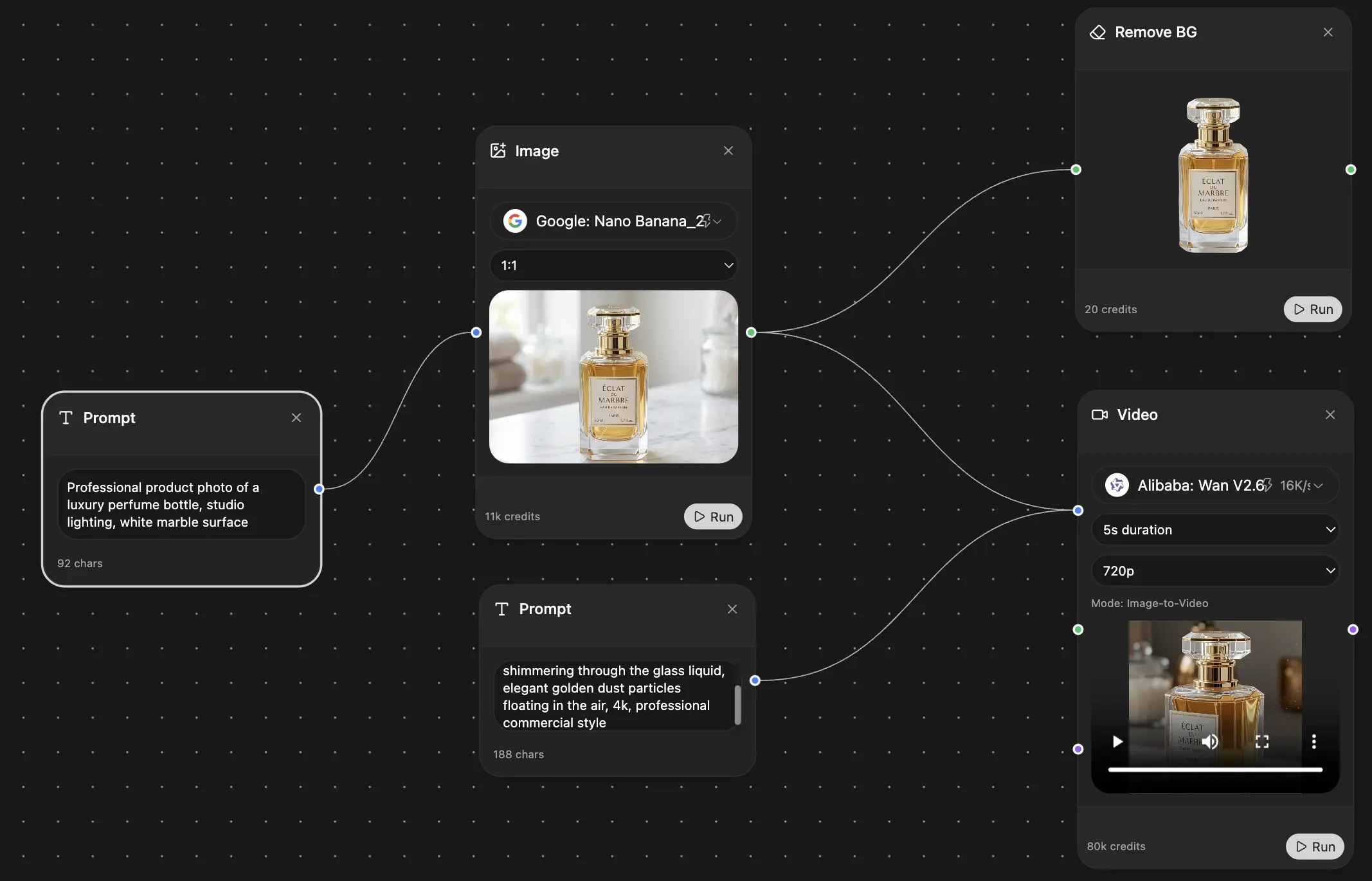
Your infinite AI canvas.
Chat, image, video & motion tools — side by side
Save hours of work and research
Transparent, High-Value Pricing
Trusted by teams at






Free
No credit card required
- 100 credits daily
- 3 AI models to try
- Basic AI chat
Plus
- 1,000,000 credits/month
- 25+ AI models — GPT, Claude, Gemini, Grok & more
- Agent Mode with web search, computer tools and more
- Creative Studio: image generation and video generation
- Project Library: chat with document, website and youtube, podcast generation, flashcards, reports and more
- Workflow Studio and FocusOS
Professional
- Everything in Plus, and:
- 2,100,000 credits/month
- Pro-exclusive models (Claude Opus, Grok 4, Sonar Pro)
- Motion Tools & Max Mode
- First access to latest features
- Access to additional offers
What Our Users Say
Great Tool after 2 months usage
simplyzubair
I love the way multiple tools they integrated in one platform. So far it is going in right dorection adding more tools.
Best in Kind!
barefootmedicine
This is another game-change. have used software that kind of offers similar features, but the quality of the data I'm getting back and the sheer speed of the responses is outstanding. I use this app ...
simply awesome
MarianZ
I just tried it - didnt wanna stay with it, because there is so much like that out there. But it convinced me, because: - the discord-channel is very response and fast - the number of models are quite...
A Surprisingly Comprehensive and Engaging Experience
bruno.battocletti
Zemith is not just another app; it's a surprisingly comprehensive platform that feels like a toolbox filled with unexpected delights. From the moment you launch it, you're greeted with a clean and int...
Great for Document Analysis
yerch82
Just works. Simple to use and great for working with documents and make summaries. Money well spend in my opinion.
Great AI site with lots of features and accessible llm's
sumore
what I find most useful in this site is the organization of the features. it's better that all the other site I have so far and even better than chatgpt themselves.
Excellent Tool
AlphaLeaf
Zemith claims to be an all-in-one platform, and after using it, I can confirm that it lives up to that claim. It not only has all the necessary functions, but the UI is also well-designed and very eas...
A well-rounded platform with solid LLMs, extra functionality
SlothMachine
Hey team Zemith! First off: I don't often write these reviews. I should do better, especially with tools that really put their heart and soul into their platform.
This is the best tool I've ever used. Updates are made almost daily, and the feedback process is very fast.
reu0691
This is the best AI tool I've used so far. Updates are made almost daily, and the feedback process is incredibly fast. Just looking at the changelogs, you can see how consistently the developers have ...