AI Image Generator from Text in 2026
Learn how an AI image generator from text works in 2026. Compare top models, master prompt engineering, and discover one platform that does it all.
You type, “editorial fashion portrait, silver jacket, rain-soaked city, cinematic lighting,” and the generator returns something gorgeous. The model has also given your subject three elbows, unreadable sunglasses, and a street sign that looks like it was designed by a sleepy alien. Welcome to the everyday reality of an AI image generator from text.
The basic promise is simple. You describe an image in ordinary language, and a generative model turns those words into pixels. The complicated part is choosing the right model, writing a prompt it can follow, checking the result for commercial risks, and repeating the process without losing your mind or your browser tabs.
Text-to-image systems have moved quickly from experimental research into mainstream products. A scholarly review records that the first system capable of generating images from text appeared in 2014, with GAN-based methods arriving soon afterward, so the field reached mass-market relevance in roughly a decade. gives useful historical context without pretending the technology appeared overnight.
From Prompt to Picture in Five Seconds Flat
The moment feels almost magical because the input is so casual. You write a sentence, press generate, and the software creates a visual interpretation rather than searching a stock library for an existing file. It isn't copying your sentence onto a canvas. It's translating language into relationships between objects, styles, colors, lighting, composition, and mood.
That distinction explains the strange results. “A cozy cabin beside a frozen lake” sounds clear to you, but the model still has to decide whether the cabin sits in the foreground, whether the lake reflects the moon, how much snow covers the roof, and what “cozy” looks like. If you don't specify those choices, the model fills the gaps with its own learned guesses.
A useful mental shift: You're not ordering a finished picture. You're giving a visual collaborator a brief.
The commercial field has also become crowded. One estimate values the global AI text-to-image generator market at USD 501.6 million in 2024, with a projection of about USD 2,528.5 million by 2034 and a 15.3% CAGR from 2025 to 2034. is one signal of why new models, interfaces, and specialized workflows keep appearing.
For a first experiment, start with a job, not a style. Try “square product image for a ceramic coffee mug, warm morning window light, pale stone surface, empty space on the left for headline text.” That prompt gives the model an object, setting, lighting direction, format, and layout requirement.
If you want more examples before writing your own, browse these . For fashion-focused visual references, can help you think in terms of wardrobe, pose, lighting, and editorial composition rather than vague instructions such as “make it cool.”
How Text to Image AI Actually Thinks
The easiest way to understand the pipeline is to imagine a sketch artist receiving a creative brief, making a rough draft, refining it, and handing you a sharpened final file.

Step one turns language into visual instructions
A text encoder reads your prompt and converts words into a machine-readable representation. It doesn't understand “red umbrella” exactly as a person does, but it maps the phrase into patterns associated with color, object identity, shape, and context.
Next, the generative model begins with visual noise, something closer to television static than a sketch. It gradually adjusts that noise so the emerging arrangement aligns with the encoded prompt. Early passes establish broad composition and color. Later passes add edges, textures, facial features, fabric, and other details.
Step two works in a compressed space
Many modern systems use latent diffusion. Instead of manipulating every individual pixel throughout the process, the model works in a compressed latent representation, then decodes that representation into an image. This is like planning a city with a simplified map before drawing every brick and window.
The original latent diffusion research reported a FID of 5.11 on CelebA-HQ and generation at least 2.7 times faster than a standard diffusion model, as documented in the . That efficiency helped make high-resolution synthesis practical enough for interactive creative tools.
Step three controls refinement and output
A sampler decides how the noisy representation moves toward a finished image. More refinement can improve coherence, but it can also cost more time or produce an image that feels overprocessed. The decoder then converts the latent representation into pixels, while an upscaler may enlarge the image and rebuild fine detail.
You don't need to memorize the equations. You do need to know that a fast model may prioritize speed, a detailed model may spend longer refining, and a model that looks beautiful may still ignore an exact instruction.
For a practical way to inspect what an image communicates and turn it back into prompt ideas, see . It's especially useful when you have a reference image but can't quite explain why its composition works.
Meet the Model Families You Will Actually Use
Models aren't interchangeable, even when their interfaces look nearly identical. One may handle typography gracefully while another produces a beautiful portrait but turns your product label into decorative soup.
Stable Diffusion gives you room to tinker
Stable Diffusion 3.5 is appealing when you want control. Its wider fine-tuned ecosystem supports specialized looks, character concepts, and repeatable experiments. The tradeoff is choice overload. You can spend an afternoon comparing checkpoints when you meant to design a poster.
Flux suits polished visual work
Flux 1.1 Pro Ultra is a natural candidate for photorealistic hero images, editorial scenes, and layouts where text needs to behave. It isn't a magic “perfect typography” button, though. If the wording matters, render the visual and add final copy in a design tool when precision is critical.
Imagen and Gemini help with meaning
Imagen 3 and Gemini's image stack are useful when your prompt involves several relationships, such as “a chef holding a plated dessert beside a menu board, with the dessert in focus and the board softly blurred.” They can be strong choices for product mockups and concepts that require the model to keep track of what belongs where.
For medical or educational visuals, specialized workflows deserve extra caution. A resource such as the is a helpful reference point when a generic art generator isn't the right fit for anatomy-heavy communication.
Claude 4 Sonnet and GPT o3-mini belong in the planning layer. Ask them to turn a rough idea into camera direction, composition, constraints, and alternate prompts. Then send the cleaned brief to an image model.
For a more detailed side-by-side decision process, use this . My opinion is simple: serious creators should compare outputs across models instead of treating a single subscription as a permanent marriage.
Prompt Engineering Tricks That Actually Move the Needle
The best prompts aren't mysterious spells. They're compact creative briefs with fewer gaps for the model to fill.

Start with the subject
Put the main subject first. “A red vintage bicycle” gives the model a clear anchor. “Beautiful vibes, nostalgic, cinematic, cool red tones” gives it a mood board with no bicycle and no reason to apologize.
Add visual facts in layers:
- Subject: A red vintage bicycle with a wicker basket
- Setting: Park path after rain, early autumn
- Composition: Three-quarter view, bicycle on the right, open space on the left
- Lighting: Soft overcast daylight, subtle reflections on wet pavement
- Finish: Editorial product photography, natural colors, realistic materials
Commas and semicolons help separate ideas. They won't create discipline by themselves, but they make a long brief easier for both you and the model to parse.
Add the details that affect the image
Lens and lighting language can change the result dramatically. Try “shallow depth of field, eye-level camera, soft window light” for a gentle portrait, or “wide-angle architectural photograph, hard afternoon shadows, centered symmetry” for a sharper structure.
Negative prompts can remove common distractions: “no watermark, no extra limbs, no distorted hands, no unreadable logo.” Treat them as guardrails, not a substitute for a clear positive description.
If your tool supports seeds, save the seed for a version you may need to reproduce. Then change one element at a time. Otherwise, you won't know whether the new background helped or whether the model just rolled a luckier visual dice.
Use a reusable formula
Prompt formula: subject + action or arrangement + environment + composition + lighting + medium or style + color direction + exclusions + output requirements
For example: “Young botanist arranging pressed flowers at a wooden desk, sunlit studio, medium shot, warm side light, documentary photography, muted green and amber palette, no extra fingers, no text, vertical portrait.”
Style references can help, but use them thoughtfully. Instead of piling on famous names, describe the properties you want: “risograph texture, limited ink palette, visible paper grain.” That gives the model a visual target without turning your prompt into a celebrity roll call.
When realism matters, compare the language used in . For faster iteration, can help turn a loose idea into a more structured brief.
Real Workflows From People Who Ship Images Every Week
A marketer rarely needs “an image.” They need a repeatable stream of images that look like they belong to the same brand.
The daily social marketer
A practical morning workflow starts with a campaign message, not a visual adjective. The marketer writes: “New oat milk launch, glass bottle on a pale blue kitchen counter, morning sunlight from the left, condensation visible, clean space above for headline, premium grocery advertising.”
Flux can handle the hero shot, while Imagen can explore product mockups and alternate arrangements. The marketer keeps the brand colors, product proportions, and negative prompts in a reusable template, then changes the seasonal setting rather than reinventing the entire prompt.
The indie fantasy author
An author building a character sheet needs identity consistency more than a single dazzling frame. A fine-tuned LoRA can help preserve a character's face, costume details, and overall visual language across scenes. The author might prompt: “Mara, silver braid, scar over left eyebrow, moss-green cloak, standing at a ruined observatory during a storm, full-body character reference, front view, side view, neutral expression.”
Fine-tuning can be more accessible than many creators assume. An SSRN study reported that fine-tuning with 20 domain-specific images using LoRA, DreamBooth, or Textual Inversion could match or exceed state-of-the-art performance in its tested setting. . The result still depends on image quality, captions, and the target task. A small, coherent set beats a messy folder of unrelated references.
The teacher making a slide deck
A teacher may begin with one lesson idea, then generate a visual sequence: “Water cycle for middle-school learners, clean illustrated diagram, evaporation, condensation, precipitation, collection, large readable labels, friendly colors, uncluttered white background.”
The teacher can create a consistent image brief for each slide, then use an image analyzer to study the visual language of a reference illustration. The is useful when the goal is to carry over composition or mood without guessing at every descriptive word.
The workflow fit matters more than the fanciest model. A marketer needs brand repeatability, an author needs character continuity, and a teacher needs clarity. Those are different jobs, so they deserve different model tests.
The Stuff Nobody Puts on the Marketing Page
The glossy demo usually shows the best frame. Commercial work requires you to inspect the boring questions too: who owns the result, what data trained the system, and whether the output treats people fairly.
Copyright isn't a simple yes or no
The U.S. Copyright Office's 2025 guidance says an AI output may receive copyright protection when a human determines sufficient expressive elements, while prompts alone aren't enough. creates a practical distinction between asking for an image and materially shaping the final expression through editing, arrangement, compositing, or other human creative choices.
That doesn't mean every edit automatically solves the problem. Keep records of the prompt, model, source assets, edits, compositing steps, and final decisions. If a client asks how the image was made, you should be able to answer without reconstructing the process from a mysterious file named final_final_7.png.
Training data remains a business question
The legality of training on copyrighted works and the possibility that outputs could become infringing derivatives remain unsettled. A 2026 review of 2025 court decisions describes this situation as unresolved, particularly around training and derivative outputs, so creators shouldn't treat a tool's availability as proof that every commercial use is risk-free.
Dataset policies matter too. A copyright-protection dataset paper says its collection includes copyrighted content from Wikipedia and other image sources, uses prompts for Stable Diffusion generation, and is available only for non-commercial or educational use. also explains that potentially infringing data may be assessed and removed when a valid issue is identified.
Bias needs testing, not good intentions
Models reflect patterns in their training data. That can affect how they depict professions, skin tones, body types, cultures, family structures, and locations. Test the prompts your organization will use, then inspect outputs across varied identities and contexts before generating a large batch.
HEIM evaluates 12 deployment-relevant aspects, including image-text alignment, aesthetics, originality, reasoning, knowledge, bias, toxicity, fairness, robustness, multilinguality, and efficiency. is a useful reminder that visual beauty is only one part of reliability.
Why a Multi-Model Workspace Changes the Game
Five browser tabs, three subscriptions, and a download folder full of nearly identical PNGs don't make you a more serious creator. They make you an unpaid account manager.
A multi-model workspace changes the workflow by putting planning, rendering, comparison, and cleanup closer together. Zemith offers access to Gemini-2.5 Pro, Claude 4 Sonnet, GPT o3-mini, Flux 1.1 Pro Ultra, Stable Diffusion 3.5, and Imagen 3 through one interface, so you can use language models for prompt development and image models for rendering without manually moving every draft between services.
A simple workflow looks like this:
- Ask Claude or GPT o3-mini to turn your rough idea into a structured visual brief.
- Render the first pass in Flux when realism or a polished hero image matters.
- Try Imagen when the scene requires more reasoning about objects, relationships, or product placement.
- Use Stable Diffusion 3.5 when you want to explore a specialized style or customization route.
- Analyze a reference image when you need to understand its composition, then remove or replace the background for a clean asset.
The point isn't that every image needs every model. The point is that comparison becomes a normal creative step rather than an annoying research project.
A practical daily sequence: Draft with Claude, render with Flux, refine with Imagen, clean the asset, then save the prompt and seed.
This shows the kind of consolidated flow that makes multi-model work easier to understand. Once you've found a reliable route for a recurring job, save the prompt as a template and change only the variables that need to change.
Your First Hour With a Text to Image Generator
Don't begin by trying to make a cinematic masterpiece. Pick one image you genuinely need this week, such as a product visual, character reference, lesson illustration, or social post.
Use this checklist:
- Choose the job: Define the audience, format, and delivery channel.
- Choose the model family: Pick Flux for a polished photographic direction, Imagen for a meaning-heavy scene, or Stable Diffusion for customization and experimentation.
- Write the brief: Use subject, arrangement, environment, composition, lighting, style, exclusions, and output requirements.
- Compare and iterate: Run the prompt through two models, keep the strongest direction, save its seed, and change one variable at a time.
Keep a prompt log. Save the exact wording, model, seed, reference images, edits, and licensing notes. Render a quick draft before spending time on high-resolution finishing, and check every commercial output for unwanted text, distorted anatomy, bias, and rights concerns.
My bet for the next stage of text-to-image isn't prettier pictures. It's more dependable control: models that understand constraints, preserve brand systems, handle multilingual prompts, and fit into production workflows without demanding a new subscription for every task. The creators who learn to compare models and document their process will have a quieter advantage than the people chasing whichever demo made the internet gasp this week.
If you want to test that workflow without juggling separate tools, visit , where you can draft prompts, compare image models, analyze references, and clean up generated assets in one workspace. Start with one real image job today, run it through two models, and keep the version that earns its place in your workflow.
Explore Zemith Features
Everything you need. Nothing you don't.
One subscription replaces five. Every top AI model, every creative tool, and every productivity feature, in one focused workspace.
Every top AI. One subscription.
ChatGPT, Claude, Gemini, DeepSeek, Grok & 25+ more







Always on, real-time AI.
Voice + screen share · instant answers
What's the best way to learn a new language?
Immersion and spaced repetition work best. Try consuming media in your target language daily.
Voice + screen share · AI answers in real time
Image Generation
Flux, Nano Banana, Ideogram, Recraft + more

Write at the speed of thought.
AI autocomplete, rewrite & expand on command
Any document. Any format.
PDF, URL, or YouTube → chat, quiz, podcast & more
Video Creation
Veo, Kling, Grok Imagine and more

Text to Speech
Natural AI voices, 30+ languages
Code Generation
Write, debug & explain code
Chat with Documents
Upload PDFs, analyze content
Your AI, in your pocket.
Full access on iOS & Android · synced everywhere
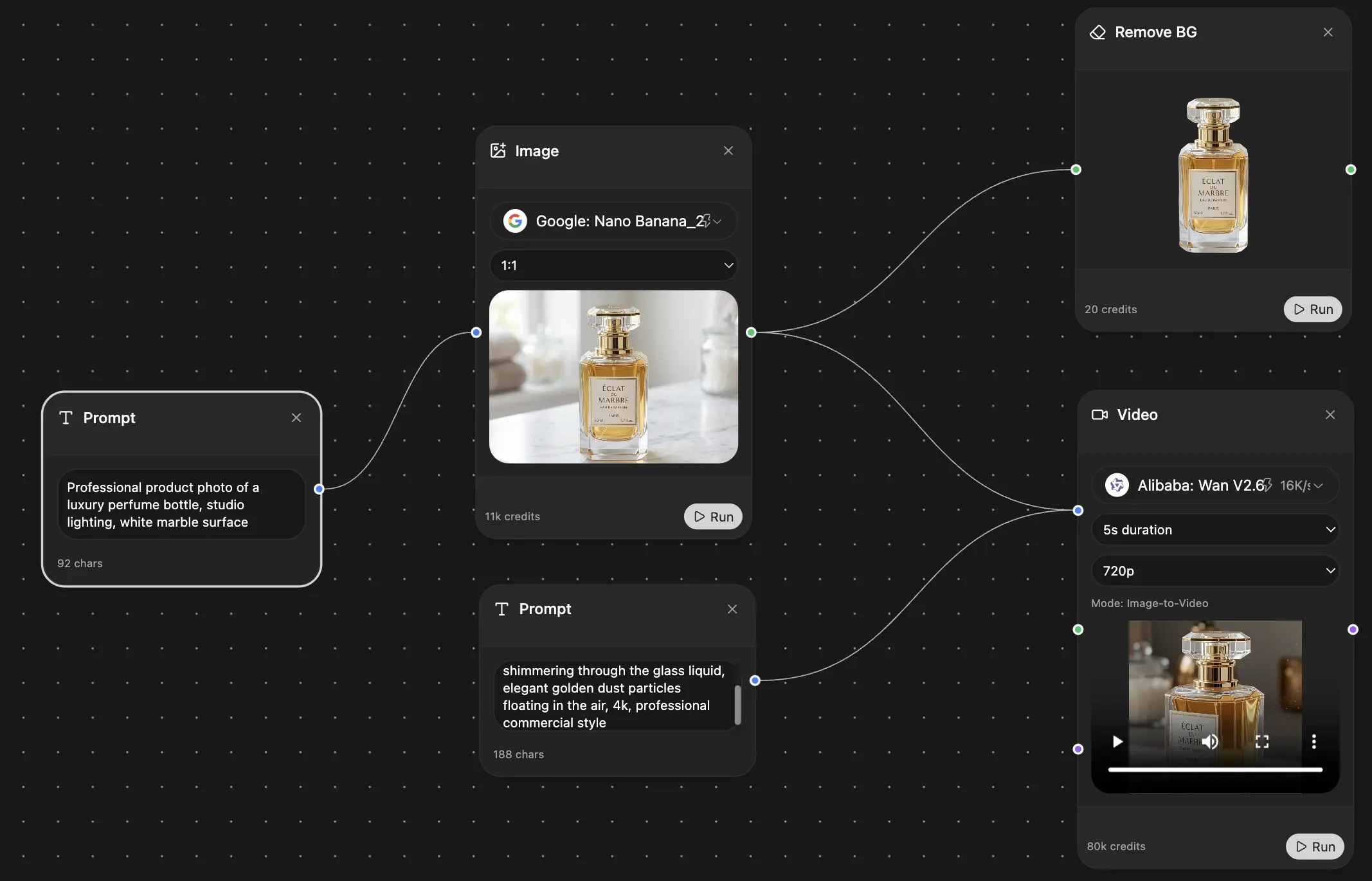
Your infinite AI canvas.
Chat, image, video & motion tools — side by side
Save hours of work and research
Transparent, High-Value Pricing
Trusted by teams at





Free
No credit card required
- 100 credits daily
- 3 AI models to try
- Basic AI chat
Plus
- 1,000,000 credits/month
- 25+ AI models — GPT, Claude, Gemini, Grok & more
- Agent Mode with web search, computer tools and more
- Creative Studio: image generation and video generation
- Project Library: chat with document, website and youtube, podcast generation, flashcards, reports and more
- Workflow Studio and FocusOS
Professional
- Everything in Plus, and:
- 2,100,000 credits/month
- Pro-exclusive models (Claude Opus, Grok 4, Sonar Pro)
- Motion Tools & Max Mode
- First access to latest features
- Access to additional offers
What Our Users Say
Great Tool after 2 months usage
simplyzubair
I love the way multiple tools they integrated in one platform. So far it is going in right dorection adding more tools.
Best in Kind!
barefootmedicine
This is another game-change. have used software that kind of offers similar features, but the quality of the data I'm getting back and the sheer speed of the responses is outstanding. I use this app ...
simply awesome
MarianZ
I just tried it - didnt wanna stay with it, because there is so much like that out there. But it convinced me, because: - the discord-channel is very response and fast - the number of models are quite...
A Surprisingly Comprehensive and Engaging Experience
bruno.battocletti
Zemith is not just another app; it's a surprisingly comprehensive platform that feels like a toolbox filled with unexpected delights. From the moment you launch it, you're greeted with a clean and int...
Great for Document Analysis
yerch82
Just works. Simple to use and great for working with documents and make summaries. Money well spend in my opinion.
Great AI site with lots of features and accessible llm's
sumore
what I find most useful in this site is the organization of the features. it's better that all the other site I have so far and even better than chatgpt themselves.
Excellent Tool
AlphaLeaf
Zemith claims to be an all-in-one platform, and after using it, I can confirm that it lives up to that claim. It not only has all the necessary functions, but the UI is also well-designed and very eas...
A well-rounded platform with solid LLMs, extra functionality
SlothMachine
Hey team Zemith! First off: I don't often write these reviews. I should do better, especially with tools that really put their heart and soul into their platform.
This is the best tool I've ever used. Updates are made almost daily, and the feedback process is very fast.
reu0691
This is the best AI tool I've used so far. Updates are made almost daily, and the feedback process is incredibly fast. Just looking at the changelogs, you can see how consistently the developers have ...