AI for Knowledge Management: A Practical Guide That Works
Learn how AI for knowledge management actually works in real teams, what to deploy first, and how to avoid the common pitfalls that derail adoption.
You probably know the scene already. A teammate pings for the latest policy doc, someone swears it was in a shared drive, three people search Slack, and the version you find is wrong anyway. Ten minutes turn into forty-five, then the meeting starts without the answer, and everyone pretends that was fine. That's the daily tax of AI for knowledge management, except the tax is already there before the AI gets involved.
The ugly part is that the tax isn't a one-off annoyance. McKinsey found employees spend 19% of the workweek, about 7.5 hours a week, searching for and gathering information that already exists internally, and that's the clean, average number, not the chaos you see in product, legal, engineering, or support teams (). If your team lives in docs, tickets, wikis, and inboxes, that number is the bill you keep paying until you change the system. For a blunt breakdown of that hidden cost, Zemith's note on is worth a look.
Why Every Team Wastes a Full Day Each Week Searching for Stuff
The first failure is usually not intelligence, it's retrieval. A person knows the answer exists somewhere, but the answer is trapped across a PDF, a thread, a deck, or a page that hasn't been touched since the last reorg. That's why the “quick search” becomes a scavenger hunt, and why people start asking the same question to three different humans instead of trusting the system.
The real cost is not just time lost
The 7.5-hour figure matters because it exposes a simple truth. Every hour spent rediscovering old information is an hour not spent shipping, selling, resolving, or deciding. In practice, the waste is worse for teams with regulated knowledge or fast-changing processes, because people don't just look for the answer, they look for the current answer.
That's the economic case for AI for knowledge management. Not “innovation.” Not “digital transformation.” It's the fact that your organization already owns the knowledge, but can't get to it fast enough. When an internal system can cut retrieval friction, the gains compound across the whole workforce instead of living inside one pilot team.
Practical rule: if your employees still ask, “Who has the latest version?”, your knowledge system is doing storage, not management.
The smart move is to treat search time like a cost center you can shrink. Once you do that, the discussion gets a lot less abstract and a lot more useful. You stop debating whether people “like AI,” and start asking whether they can find the right policy, answer, or playbook before the meeting ends.
What AI for Knowledge Management Means
AI for knowledge management is software that reads documents, organizes them, and answers questions with the source attached. A person can ask for a policy, a process, or a product answer, and the system pulls from internal material instead of sending them on a scavenger hunt through folders. The question is not whether it sounds smart, it is whether it can show its work.
A tool that only bolts a chatbot onto a dusty wiki is decoration. Real knowledge management systems ingest content continuously, classify it, summarize it, and retrieve the right chunk when someone asks a question. That is the difference between a shelf and a working library.

The one question that cuts through vendor fluff
Ask every vendor the same thing, Does it cite the source it used? If the answer is vague, the demo is selling confidence, not trust. A credible knowledge platform needs traceability, because the point is not to generate plausible text, it is to return an answer people can verify.
The architecture matters for the same reason. Recent KM literature treats RAG, retrieval-augmented generation, as the reference pattern because it combines generation with retrieval from internal sources, which helps ground answers in organizational documents (). If you want the plain-English mechanics behind the assistant layer, gives a clear breakdown without the usual jargon.
The Core Technologies Without the Jargon
The stack sounds intimidating until you translate it into jobs. Each layer has one purpose, and if a vendor can't explain that purpose without buzzwords, they probably don't understand the workflow well enough. The point is to reduce search pain and answer drift, not to build a science project with a fancy homepage.

NLP and embeddings do the reading
NLP, natural language processing, is the part that reads messy text and figures out what it's about. Think of it as the intern who can skim ten documents before lunch and tell you which ones mention the right policy, client, or feature. Its limitation is obvious, it can extract meaning, but it still needs a good knowledge base to work with.
Embeddings turn meaning into math so the system can find similar ideas even when the exact keywords don't match. That's useful when someone asks for “the holiday policy” but the file is labeled “PTO eligibility guidelines.” The downside is simple, garbage in still matters, because semantic matching won't fix bad source content.
RAG and vector databases do the answering
RAG is the part that lets the model answer using your documents instead of the open internet. It's like giving the assistant a stack of internal binders before the meeting starts, then forcing it to open the right page before speaking. That reduces hallucination risk, but it only works if the sources are current and the retrieval layer is clean.
A vector database is the storage layer that makes semantic search fast enough to be usable. It doesn't think, it indexes meaning so the system can pull the right material quickly. Zemith's guide on is useful if you want the practical difference without the academic fog.
The stack is only as good as the source library behind it. No vector database can rescue a pile of stale SOPs and duplicate decks.
Where AI Knowledge Management Pays Off Fastest
The fastest returns come from work that repeats, burns time, and depends on accurate internal knowledge. Start there. Everything else is a fancy way to delay the hard decisions about scope, governance, and source quality.
Customer support is the cleanest place to start because the payoff is easy to measure and easy to defend. If the knowledge base can deflect even part of the ticket volume, the support team feels it immediately, and finance does too. That is why serious teams start there instead of trying to AI-enable every workflow on day one, which usually turns into an expensive search box with better marketing.
Onboarding is the next obvious win because new hires ask the same questions over and over. Mature AI knowledge management has been linked to 20% to 30% faster time-to-productivity, and that matches what managers already see when ramp time drags. For the structure behind that kind of rollout, Zemith's guide maps cleanly to the same problem.
A Phased Rollout That Doesn't Blow Up
Forget the fantasy where you upload everything, press a button, and trust magically appears. Real deployments start by deciding what deserves to be machine-assisted, what needs human review, and what should stay out of scope because the risk is too high. The academic pattern is clear, workflow first, tool second ().
Build from the pain point, not the platform
The first move is a knowledge audit. Find the content people need, locate the rot, and identify the one workflow where search pain is constant. If you can't name the workflow in one sentence, you're not ready to automate it.
The next move is a narrow pilot with source citations turned on. Don't start broad, because broad pilots hide failure under volume. A good pilot is small enough that users can tell when the system is right, and annoying enough that they'll notice when it's wrong.
Pilot the messiest reliable workflow, not the prettiest one. Pretty data is how teams fool themselves.
The last move is governance, which is where most rollouts fail. Someone has to own the source of truth, define refresh rules, and resolve conflicts when two documents disagree. That's not bureaucracy, that's maintenance, and without it the system turns into a very confident liar.

Governance, Citations, and the Stuff That Breaks Later
This is the part vendors skip because it's not fun to demo. Once the system starts answering questions, the issue becomes whether those answers still make sense next month when the policy changes, the doc gets revised, or two teams publish conflicting guidance. If you don't manage that layer, the system gets faster at spreading stale knowledge.
The FINOS guidance is blunt about what trustworthy citations require, auditable links between the retrieved source chunks and the generated output, plus preserved metadata like document titles, authors, URLs, page numbers, and section headers (). That matters because a citation that can't be traced later isn't a citation, it's stage dressing. The answer has to point back to something real, and that “something” has to survive audits, updates, and context loss.
Speed is easier than judgment
The contrarian truth is that AI usually improves speed faster than it improves decision quality. It can surface answers quickly, but it can also surface contradictions, weak sources, and stale guidance if the knowledge base is sloppy. That's why confidence scoring, provenance checks, and human review gates aren't extras, they're the system.
For sensitive workflows, the hard question is which knowledge should stay human-governed because the cost of error is too high. That logic shows up in practical discussions about AI risk, including Talent Pronto's clear breakdown of . For source evaluation habits more broadly, Zemith's guide is a good match.
How Zemith Stacks Map to Each Phase
The platform choice should match the rollout stage, not the other way around. For phase-two pilots, a Document Assistant makes sense because it lets teams chat over uploaded files, generate summaries, quizzes, flashcards, and even turn long PDFs into podcasts for auditory learners. That's useful when you want people to engage directly with the source material instead of skimming another dashboard.
The curation layer comes from Library and Projects. Library gives contextual memory across multiple files, while Projects centralize chats, docs, and research around a shared knowledge base, which is exactly what KM teams need when source sets multiply. Multi-Model access helps when a hard retrieval question needs stronger reasoning and a routine summary needs speed, so you don't waste the expensive model on a boring task.
Deep Research is the audit tool, because it supports real-time web search, fact-checking, and competitor analysis when you're pressure-testing what should be in the knowledge base. Smart Notepad handles the writing side, drafts, rephrasing, and turning bullet points into clean prose. AI Live Mode is handy when a researcher wants to replay findings as a spoken walkthrough, which is a lot more useful than another dead PDF nobody opens twice.

Your 30-Day Action Plan and the Two Metrics That Matter
Days one to seven, pick one workflow, audit the sources, and delete or quarantine anything you can't trust. Days eight to fourteen, run a single-document pilot in Document Assistant and test citations against the FINOS-style traceability standard. Days fifteen to twenty-one, move that workflow into a Library or Project, enable Multi-Model access, and use Smart Notepad on three real writing tasks.
Days twenty-two to thirty, measure two things only, retrieval time saved per query and citation accuracy verified by a human reviewer on a random sample. If those don't move, the rollout isn't ready. If they do, expand carefully instead of dumping the whole company into the system and hoping governance catches up later.
Zemith gives teams a single workspace for document Q&A, research, writing, and knowledge organization, which is exactly what a sane AI for knowledge management rollout needs. If you want a practical starting point instead of another tool pile, visit and test one workflow, one source set, and one citation standard before you scale.
Explore Zemith Features
Everything you need. Nothing you don't.
One subscription replaces five. Every top AI model, every creative tool, and every productivity feature, in one focused workspace.
Every top AI. One subscription.
ChatGPT, Claude, Gemini, DeepSeek, Grok & 25+ more







Always on, real-time AI.
Voice + screen share · instant answers
What's the best way to learn a new language?
Immersion and spaced repetition work best. Try consuming media in your target language daily.
Voice + screen share · AI answers in real time
Image Generation
Flux, Nano Banana, Ideogram, Recraft + more

Write at the speed of thought.
AI autocomplete, rewrite & expand on command
Any document. Any format.
PDF, URL, or YouTube → chat, quiz, podcast & more
Video Creation
Veo, Kling, Grok Imagine and more

Text to Speech
Natural AI voices, 30+ languages
Code Generation
Write, debug & explain code
Chat with Documents
Upload PDFs, analyze content
Your AI, in your pocket.
Full access on iOS & Android · synced everywhere
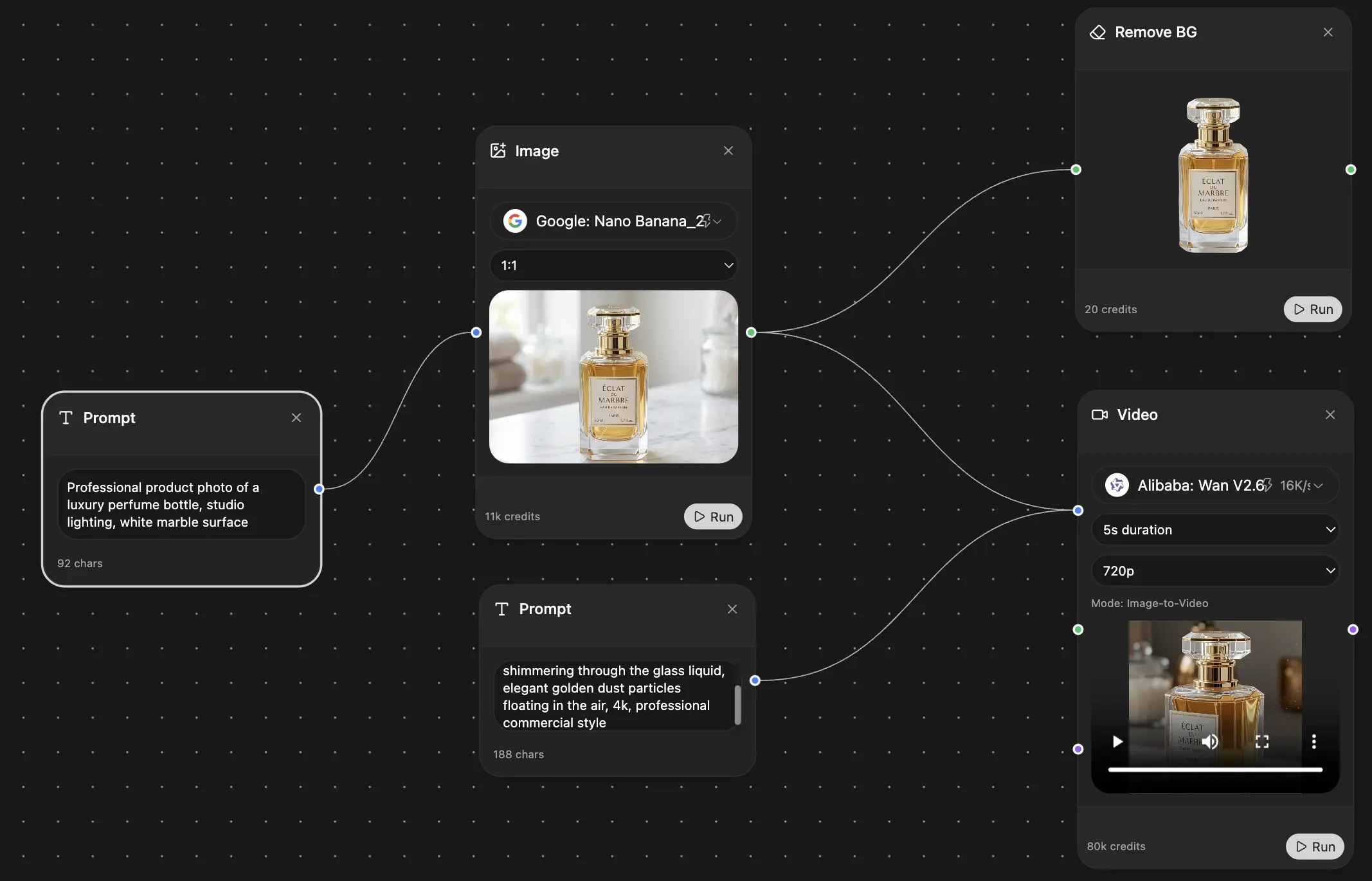
Your infinite AI canvas.
Chat, image, video & motion tools — side by side
Save hours of work and research
Transparent, High-Value Pricing
Trusted by teams at






Free
No credit card required
- 100 credits daily
- 3 AI models to try
- Basic AI chat
Plus
- 1,000,000 credits/month
- 25+ AI models — GPT, Claude, Gemini, Grok & more
- Agent Mode with web search, computer tools and more
- Creative Studio: image generation and video generation
- Project Library: chat with document, website and youtube, podcast generation, flashcards, reports and more
- Workflow Studio and FocusOS
Professional
- Everything in Plus, and:
- 2,100,000 credits/month
- Pro-exclusive models (Claude Opus, Grok 4, Sonar Pro)
- Motion Tools & Max Mode
- First access to latest features
- Access to additional offers
What Our Users Say
Great Tool after 2 months usage
simplyzubair
I love the way multiple tools they integrated in one platform. So far it is going in right dorection adding more tools.
Best in Kind!
barefootmedicine
This is another game-change. have used software that kind of offers similar features, but the quality of the data I'm getting back and the sheer speed of the responses is outstanding. I use this app ...
simply awesome
MarianZ
I just tried it - didnt wanna stay with it, because there is so much like that out there. But it convinced me, because: - the discord-channel is very response and fast - the number of models are quite...
A Surprisingly Comprehensive and Engaging Experience
bruno.battocletti
Zemith is not just another app; it's a surprisingly comprehensive platform that feels like a toolbox filled with unexpected delights. From the moment you launch it, you're greeted with a clean and int...
Great for Document Analysis
yerch82
Just works. Simple to use and great for working with documents and make summaries. Money well spend in my opinion.
Great AI site with lots of features and accessible llm's
sumore
what I find most useful in this site is the organization of the features. it's better that all the other site I have so far and even better than chatgpt themselves.
Excellent Tool
AlphaLeaf
Zemith claims to be an all-in-one platform, and after using it, I can confirm that it lives up to that claim. It not only has all the necessary functions, but the UI is also well-designed and very eas...
A well-rounded platform with solid LLMs, extra functionality
SlothMachine
Hey team Zemith! First off: I don't often write these reviews. I should do better, especially with tools that really put their heart and soul into their platform.
This is the best tool I've ever used. Updates are made almost daily, and the feedback process is very fast.
reu0691
This is the best AI tool I've used so far. Updates are made almost daily, and the feedback process is incredibly fast. Just looking at the changelogs, you can see how consistently the developers have ...