AI Flashcard Maker: How to Build Better Study Decks Fast
Use an AI flashcard maker to turn notes, PDFs, and lectures into high-retention decks. Learn prompts, workflows, and editing tips that actually stick.
The popular advice is simple: upload your notes, let an AI flashcard maker generate a complete deck, and start studying. That workflow saves time, but it also creates a dangerous illusion. A large deck isn't necessarily a useful deck, and cards that feel easy to flip through can fall apart when an exam asks you to retrieve a concept without the original paragraph sitting nearby.
The better approach is AI-assisted drafting followed by human editing. AI should handle the repetitive work of finding concepts and proposing questions. You should decide whether each card is accurate, specific, and difficult enough to strengthen recall. That distinction matters because active retrieval and spaced repetition, not the act of producing a polished-looking deck, drive durable learning. An ERIC paper reports that AI-generated learning cards can support retention and recall in large online courses when they reinforce retrieval practice and spaced review, while also warning that card structure and quality still matter ().
Why Most AI Flashcards Fail the Retention Test
One-click deck generation optimizes for speed and volume, not necessarily memory. A tool can turn a PDF into dozens of cards in seconds, but it may produce vague prompts, bloated answers, and questions that only make sense when you remember the source document. That isn't a failure of AI alone. It's a workflow failure.

The three quality traps
Over-summarization compresses a nuanced idea into a sentence that sounds correct but hides the distinctions you need to remember. A weak card might ask, “What is operant conditioning?” and answer with a broad definition. A stronger version asks, “How does negative reinforcement differ from punishment?” The second card forces you to retrieve a relationship, not repeat a glossary entry.
Context leakage creates orphan cards. “What happens next?” is useless if the question loses meaning outside the lecture slide. Rewrite it as, “What happens to enzyme activity when an inhibitor binds the active site?” A complete prompt gives your memory a fair test.
Recognition traps make studying feel productive because the answer looks familiar. “Define glycolysis” may invite a vague mental nod. “Name the main outcome of glycolysis and identify where it occurs” requires a deliberate response before you check the back.
Practical rule: If you can answer a card by recognizing a phrase, rather than producing the answer yourself, rewrite the prompt.
The market's visibility reflects how quickly these tools have gained attention. In October 2025, one directory ranked 43 AI flashcard products, with listed monthly traffic ranging from about 24.78K visits for KardsAI to 4.29M visits for the top-ranked product (). That demand doesn't prove every generated card works. It does show why learners need a quality filter, not another race to produce the biggest deck.
For a useful primer on , focus on atomic questions, precise answers, and prompts that demand retrieval. Zemith's broader guidance on fits the same principle. The generator starts the job. The learner finishes it.
Building Your First Deck with Zemith Document Assistant
Start with the source, not the flashcard request. Uploading an entire textbook chapter and asking for a giant deck encourages the model to treat every sentence as equally important. A cleaner workflow creates an intermediate layer between raw material and review cards.
Step one, extract the structure
Put your lecture slides, textbook section, or rough notes into Zemith Document Assistant. Ask it to identify:
- Core concepts: The ideas your instructor builds the lesson around.
- Definitions and distinctions: Terms that look similar but behave differently.
- Processes: Ordered steps, mechanisms, and cause-and-effect chains.
- Likely confusion points: Exceptions, competing theories, and easily swapped details.
For a long document, work in topic-sized chunks rather than generating one enormous deck. A section on renal physiology, for example, should be separated from a section on endocrine regulation if the concepts require different question styles. The intermediate summary should be short enough for you to inspect without needing a snack break and a minor change of career.
Zemith's Document Assistant can also turn documents into quizzes and flashcards, but the useful move is to review the extracted concepts before asking for cards. This is a practical starting point for that source-to-deck workflow.
Step two, annotate in Smart Notepad
Move the structured material into Smart Notepad and mark it up like a demanding editor. Flag an unfamiliar term, add the example your professor used, and label concepts by priority. A simple tagging scheme works well:
- High priority: Directly emphasized in class or central to later topics.
- Needs comparison: Concepts that are easy to confuse.
- Application: Material that should become a scenario-based question.
- Verify: Claims, dates, formulas, or definitions that need checking against your notes.
This step creates a human-curated source. AI can extract what appears important, but you know whether the professor spent half a lecture contrasting two mechanisms or merely mentioned one in passing.
Step three, generate from the annotated notes
Ask the AI to create a modest batch of cards from the revised notes, with one fact or relationship per card. Specify the card type, difficulty, and answer length. For example:
Create concise retrieval cards from the tagged notes. Split compound facts into separate cards. Prefer comparison and application questions over basic definitions. Keep each answer focused on one idea, and mark any statement that isn't directly supported by the notes.
Preview the results before sending them into a study queue. Delete duplicates, repair vague wording, and add your own examples. The finished deck should be editable and traceable to a source you trust, not a mystery pile of confident-looking sentences.
Prompt Templates That Work Across Subjects
A good prompt doesn't merely ask the model to “make flashcards.” It defines the kind of mental work each card should require. Three structures transfer well across science, history, literature, and language learning because they test different forms of retrieval.
Constraint-based questions
These questions narrow the response and prevent sprawling answers. Instead of “What is homeostasis?” ask, “Name two conditions required for a system to maintain homeostasis.” In organic chemistry, ask, “What two features must be present for this reaction pathway to proceed?” In history, ask, “Identify two economic conditions that contributed to the event.”
Comparison prompts
Comparison cards build relational memory. They make you retrieve the boundary between ideas, which is often where exam questions hide. “How does X differ from Y in terms of Z?” is a reliable frame for distinguishing constitutional isomers, historical causes, or near-synonymous vocabulary.
Application scenarios
Application cards test transfer. They ask you to use knowledge in a new setting rather than recite the wording from your notes. In anatomy, a patient's symptoms can prompt you to identify the underlying mechanism. In literature, a passage can ask which theme or rhetorical strategy is operating. For language learning, a sentence can require the correct word based on context.
The answer length should match the task. A comparison card may need a compact contrast, while an application card may need a mechanism plus a reason. Don't force every subject into definition cards. A language learner needs context, a biology student needs mechanisms, and a history student often needs causation.
You can refine the instruction further by asking the model to generate several candidate prompts, then keep only the clearest version. The can help you build reusable instructions instead of rewriting the same request before every study session.
The Human Editing Pass That Doubles Recall
The human pass is where a usable deck becomes a dependable one. Research summarized by TechLearning found that learners who created their own cards outperformed users of premade cards in five of six experiments, with one experiment showing a 25% advantage (). AI-generated cards resemble premade cards when you accept them untouched, so the practical lesson is to preserve the drafting speed while restoring your judgment.

Use a focused review pass
You don't need to rewrite every card from scratch. Scan for the errors that make practice misleading:
- Fix ambiguous phrasing. Replace “What affects blood pressure?” with a question that names the mechanism, condition, or comparison.
- Condense broad answers. If the back contains a paragraph, split it into atomic cards. One card can test the definition, another the example, and another the exception.
- Remove cue leakage. Delete wording that gives away the answer through repetition, unusual phrasing, or a partial definition.
- Repair orphan cards. Add the missing subject so the card still makes sense when shuffled away from the source.
- Verify precision. Check numbers, names, formulas, and exceptions against the original material or a trusted reference.
A card should feel slightly demanding, not impossible. If the prompt contains no useful context, add a cue such as the unit, process, or category. If it practically recites the answer, remove the giveaway.
Editing test: Read only the front. Can you state exactly what kind of answer it expects?
The strongest workflow is not “AI versus manual.” It's AI for extraction, then human refinement for meaning. That keeps the cognitive work that matters while removing the tedious formatting work. For help polishing the wording itself, use as a companion to your card review.
A quick video walkthrough can make the process easier to copy:
Exporting to Anki and Quizlet Without Breaking Formatting
A strong deck can still become useless during export if the fields aren't structured consistently. Before moving cards from Smart Notepad, decide what belongs on the front, what belongs on the back, and which details should become tags rather than answer text.

Anki format
For a basic Anki import, use a tab-separated or comma-separated file with stable fields:
- Front: One complete retrieval question.
- Back: A concise answer, plus an optional explanation.
- Tags: Subject, lecture, difficulty, or exam unit.
Tabs are often safer than commas when your answers contain punctuation. Keep each card on one line. A line break inside an answer can be interpreted as a new note, which creates the classic “why did my one card become six?” disaster.
Before importing, check the text encoding so accented characters and symbols survive the transfer. If you use cloze deletions, preserve the syntax consistently and test a small sample first. Image references and audio placeholders should also remain in predictable fields, rather than being buried in explanatory text.
Quizlet format
Quizlet bulk imports work well with term-definition pairs separated by tabs. Put the question in the first field and the answer in the second. Avoid adding tabs inside either field, and use a simple tag convention in the term or a separate note system if your workflow requires it.
For both platforms, review a small import before committing the full deck. Look for three common problems:
- Split cards: Caused by accidental line breaks.
- Merged fields: Caused by inconsistent delimiters.
- Corrupted symbols: Caused by encoding or unsupported HTML.
Exporting isn't the time to discover that every chemical formula has turned into decorative gibberish. A clean source structure, a consistent delimiter, and a sample import prevent most cleanup sessions.
Spaced Repetition Schedules That Actually Stick
Flashcards work best when you retrieve an answer, check it, and meet the card again after a delay. In a large experimental study, spacing out practice was more effective than massing it for 90% of participants, even though 72% initially believed cramming worked better (research on spacing and massed practice). A controlled medical-education study also found better recall after one week with repetitive testing using electronic flashcards than with repetitive studying, with a reported p value below 0.001 ().
Use a simple sequence for new material: initial learning, next-day retrieval, another review after a short gap, then progressively wider intervals. The exact schedule should respond to your performance. Cards you miss need an earlier return. Cards you recall cleanly can wait longer.
A practical weekly routine looks like this:
- Add a small batch of edited cards after each class or reading session.
- Review due cards before adding many new ones.
- Suspend duplicates and cards that test trivia irrelevant to your goal.
- Track whether errors come from forgetting, confusing two ideas, or misunderstanding the concept.
- Rewrite the card when the same wording repeatedly produces the same mistake.
Cramming can have a place immediately before an assessment, but it shouldn't replace the schedule. Research on digital spaced-repetition systems highlights the importance of both the scheduling algorithm and the card's design, and notes that vocabulary gains may not automatically transfer to speaking and writing without user-generated cards and complementary practice (). For a clear explanation of review timing, is a useful reference, while Zemith's can help turn the principle into a repeatable routine.
The best ai flashcard maker workflow is therefore modest and slightly fussy. Generate quickly, edit carefully, export carefully, and return to the cards before they feel comfortable.
Zemith combines a Document Assistant for extracting concepts and generating study materials with Smart Notepad for refining, tagging, and editing the cards before review. Visit to turn your notes into a cleaner, more reliable study workflow instead of trusting a one-click deck blindly.
Explore Zemith Features
Everything you need. Nothing you don't.
One subscription replaces five. Every top AI model, every creative tool, and every productivity feature, in one focused workspace.
Every top AI. One subscription.
ChatGPT, Claude, Gemini, DeepSeek, Grok & 25+ more







Always on, real-time AI.
Voice + screen share · instant answers
What's the best way to learn a new language?
Immersion and spaced repetition work best. Try consuming media in your target language daily.
Voice + screen share · AI answers in real time
Image Generation
Flux, Nano Banana, Ideogram, Recraft + more

Write at the speed of thought.
AI autocomplete, rewrite & expand on command
Any document. Any format.
PDF, URL, or YouTube → chat, quiz, podcast & more
Video Creation
Veo, Kling, Grok Imagine and more

Text to Speech
Natural AI voices, 30+ languages
Code Generation
Write, debug & explain code
Chat with Documents
Upload PDFs, analyze content
Your AI, in your pocket.
Full access on iOS & Android · synced everywhere
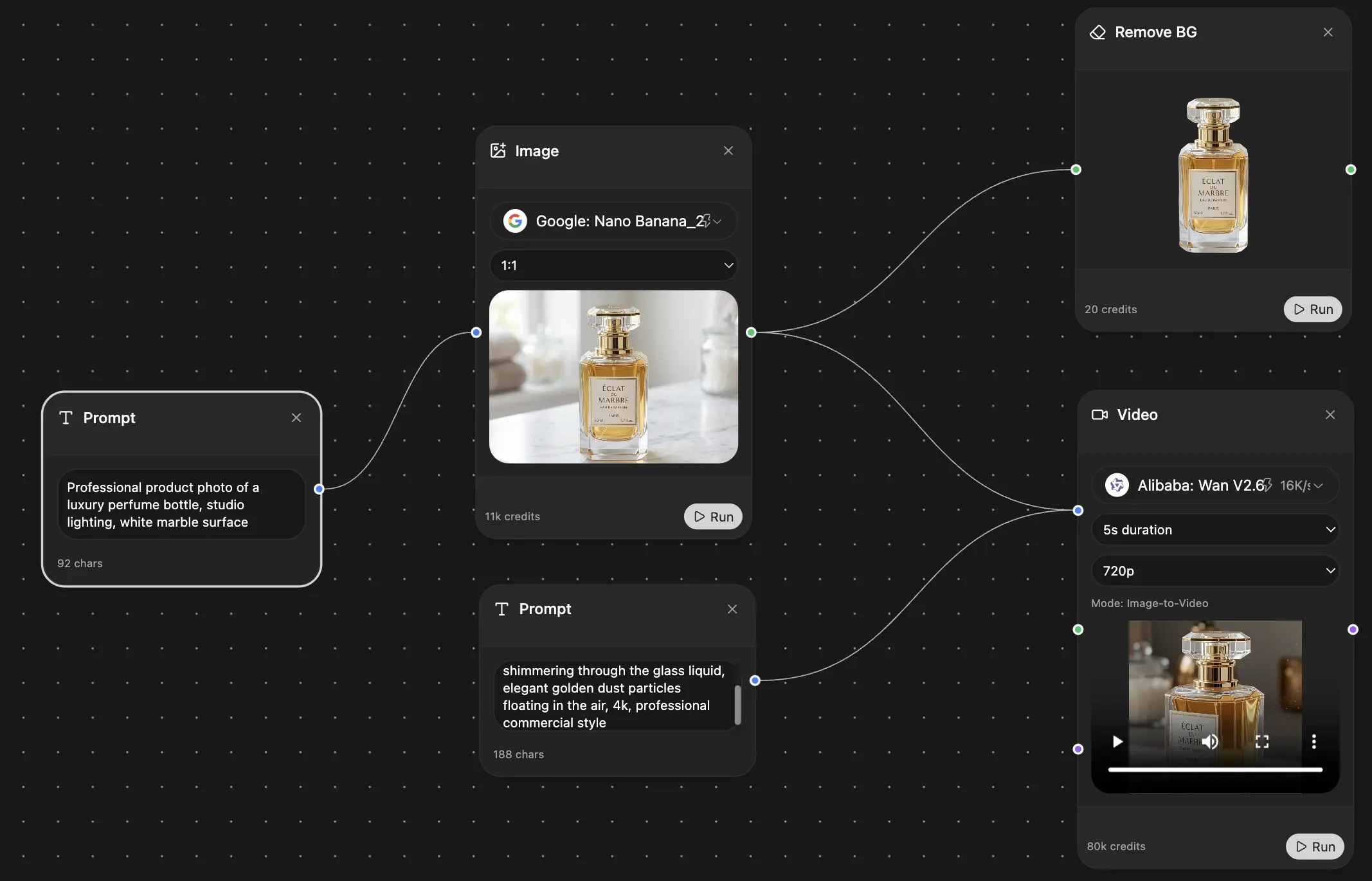
Your infinite AI canvas.
Chat, image, video & motion tools — side by side
Save hours of work and research
Transparent, High-Value Pricing
Trusted by teams at






Free
No credit card required
- 100 credits daily
- 3 AI models to try
- Basic AI chat
Plus
- 1,000,000 credits/month
- 25+ AI models — GPT, Claude, Gemini, Grok & more
- Agent Mode with web search, computer tools and more
- Creative Studio: image generation and video generation
- Project Library: chat with document, website and youtube, podcast generation, flashcards, reports and more
- Workflow Studio and FocusOS
Professional
- Everything in Plus, and:
- 2,100,000 credits/month
- Pro-exclusive models (Claude Opus, Grok 4, Sonar Pro)
- Motion Tools & Max Mode
- First access to latest features
- Access to additional offers
What Our Users Say
Great Tool after 2 months usage
simplyzubair
I love the way multiple tools they integrated in one platform. So far it is going in right dorection adding more tools.
Best in Kind!
barefootmedicine
This is another game-change. have used software that kind of offers similar features, but the quality of the data I'm getting back and the sheer speed of the responses is outstanding. I use this app ...
simply awesome
MarianZ
I just tried it - didnt wanna stay with it, because there is so much like that out there. But it convinced me, because: - the discord-channel is very response and fast - the number of models are quite...
A Surprisingly Comprehensive and Engaging Experience
bruno.battocletti
Zemith is not just another app; it's a surprisingly comprehensive platform that feels like a toolbox filled with unexpected delights. From the moment you launch it, you're greeted with a clean and int...
Great for Document Analysis
yerch82
Just works. Simple to use and great for working with documents and make summaries. Money well spend in my opinion.
Great AI site with lots of features and accessible llm's
sumore
what I find most useful in this site is the organization of the features. it's better that all the other site I have so far and even better than chatgpt themselves.
Excellent Tool
AlphaLeaf
Zemith claims to be an all-in-one platform, and after using it, I can confirm that it lives up to that claim. It not only has all the necessary functions, but the UI is also well-designed and very eas...
A well-rounded platform with solid LLMs, extra functionality
SlothMachine
Hey team Zemith! First off: I don't often write these reviews. I should do better, especially with tools that really put their heart and soul into their platform.
This is the best tool I've ever used. Updates are made almost daily, and the feedback process is very fast.
reu0691
This is the best AI tool I've used so far. Updates are made almost daily, and the feedback process is incredibly fast. Just looking at the changelogs, you can see how consistently the developers have ...