Account Creator Bot: How They Work & How to Stop Them
Learn how account creator bots automate fake signups and discover effective strategies to detect, block, and prevent them in 2026.
The popular advice says an account creator bot is just a script that fills a signup form, beats a CAPTCHA, and vanishes. That advice is stale. In practice, the serious operators build identity infrastructure, not little signup toys, and they treat creation time, phone reputation, browser fingerprints, and posting behavior as parts of one system, not isolated tricks.
That's why the fight isn't about a single checkbox defense. Platforms have spent years moving from simple rules to probabilistic detection, because no single signal proves automation by itself. Once you accept that, the whole topic changes from “how do bots register?” to “how do layered defenses still get bypassed?”
Why Account Creator Bots Are More Than Just Signup Scripts
Still picture an account creator bot as a clumsy form-filler with a CAPTCHA problem? That description was already too small years ago, and it misses how these systems are used now. The modern version looks more like a registration pipeline with parts that handle browser control, temporary identity, verification codes, proxy switching, and session capture so the operator can reuse the account later.
The practical shift is simple. A bot that only types into a form is easy to catch, but a bot that behaves like a small identity factory can spread the risk across many signals. That's why a useful way to think about it is not “bot or not,” but “how many layers does this automation control before it gets flagged?”
Practical rule: if the automation can survive only one defense, it's fragile. If it has to get past multiple identity checks, it starts looking like fraud infrastructure instead of signup automation.
The scale also matters. Independent reporting on JanitorAI describes a market where creation moved into millions of accounts and hundreds of thousands of new bot creations per month, with peaks that would've sounded absurd a few years ago, including 15,000 bot creations per day on Valentine's 2024 and 72% of total creations in 2024 being NSFW bots, according to that reporting (). That's not a hobbyist side project anymore. That's industrial throughput.
A better mental model is a machine that manufactures legitimacy. The operator isn't just trying to “make an account,” they're trying to make one that survives the platform's first look and doesn't get instantly tied to the others. If you're building legitimate automation, that distinction matters, because it tells you exactly where the abuse starts, and where compliance should stop.
For teams that still think about automation as a shortcut, start with a cleaner mental model from . The point isn't to make every workflow faster at any cost, it's to separate responsible automation from the kind that gets your app or your ops team in trouble.
The Technical Anatomy of a Modern Account Creator Bot
A modern bot usually starts with the same boring core. It fills the signup form, submits an email or phone number, handles CAPTCHA, and completes the profile setup, because that's the basic registration pipeline described in the workflow guide for Instagram-style account automation (). The trick isn't the form. The trick is making the surrounding infrastructure look ordinary enough that the platform doesn't care.

The registration stack
A GitHub example shows the usual throughput mindset clearly. It uses Selenium headless Chrome, multiple temporary email providers, OTP auto-detection, bulk creation, and a 10-second delay between accounts to reduce immediate rate-limit pressure (). That delay is not there for elegance. It's there to avoid looking like a firehose.
A factory line. Form filling is the conveyor belt, temporary email is the label printer, OTP retrieval is the barcode scan, and session export is the shipping manifest. The operator wants each machine to hand off to the next one without a human touching anything, because every human pause creates cost and a chance to get caught.
The hard part is rarely the UI. It's the trust stack underneath it.
The identity and transport layer
Operators often chain an emulator or isolated browser profile with an SMS verification API and a per-session proxy, because platforms correlate phone carrier data, IP geolocation, device fingerprints, and registration timing patterns to flag automation (). That same analysis says a multi-instance workstation can reach roughly 100-200 accounts per hour when SMS inventory and proxies are not the bottleneck.
The operator's real goal is not speed by itself. It's speed without creating a pattern the platform can score.
That's why the bottleneck usually isn't form filling. It's verification and anti-abuse detection. If a platform sees the same carrier pattern, the same proxy family, the same browser profile behavior, and a burst of registrations in a tight window, the bot stops looking like a user and starts looking like a process.
For developers who want a sane way to prototype automation, is the right kind of reference point. It keeps the discussion on controlled automation, not on building a pile of brittle signup hacks that collapse the first time a platform changes one field name.
Legitimate Automation Versus Malicious Account Farms
Automated account workflows are not all the same. QA teams need throwaway test users, product teams need sandbox accounts, and developers need repeatable setup flows so they can verify integrations without clicking through the same screen over and over. The line is intent, control, and whether the workflow stays inside an allowed environment.
Side-by-side, the difference is clearer than many operators admit
A legitimate flow uses official APIs, documented test data, and clear labeling. A malicious farm hides behind disposable identities, rotates infrastructure, and tries to make one real operator look like many separate users. That distinction matters because fake-account creation bots are described by as tools that create large numbers of fake accounts “at great speed and scale,” and the same analysis shows why single controls like CAPTCHA, email verification, and honeypots only slow the problem rather than solve it.
The risk starts the moment a workflow leaves the sandbox. A script that is acceptable in a dev environment can become a policy and legal problem if it is pointed at a real platform without permission, especially when it generates synthetic identities, manipulates engagement, or works around rate limits. Platform terms still matter, and privacy rules matter too if the workflow touches personal data.
A practical rule set keeps the boundary visible.
- Use official surfaces: If there is a sanctioned API or sandbox, use that instead of impersonating users.
- Keep identities synthetic and scoped: Test data should stay inside test systems, not become a hidden population of fake users.
- Document purpose: If you cannot explain why the automation exists in one plain sentence, it is probably not defensible.
The abuse economy is why this topic matters beyond developer convenience. Security and academic research show that fake accounts are bought to push spam, and once those accounts exist they can be reused for reputation manipulation, marketplace abuse, or coordinated inauthentic behavior. The account itself becomes inventory.
For teams that want a compliant path, the right frame is controlled automation, not volume at any cost. fits that mindset because it centers on building useful automation that stays auditable, explainable, and far less likely to turn into a policy problem later.
How Platforms Detect Bots and Why They Still Get Fooled
Detection stopped being a simple yes-or-no game a long time ago. First Draft News points to account creation date as a key indicator, says recently created accounts can be flagged as suspicious or bot-like, and gives a general automation rule of 100 tweets per day as a sign of possible bot behavior (). Botometer works the same way in spirit, using a Complete Automation Probability score rather than a binary label, because one signal almost never tells the full story.
The signals that keep showing up
The most useful thresholds are still the plain ones. The Data Journalism Handbook says the Oxford Internet Institute classifies accounts posting more than 50 times per day as showing heavy automation, while the Atlantic Council's DFRLab treats 72 tweets per day as suspicious and over 144 tweets per day as highly suspicious (). Those are not magic numbers, but they do turn intuition into something a reviewer can act on.
Platforms also look at profile shape. Sophos says a blank or generic profile image, a username with random numbers, and bios that don't logically match the profile photo are strong indicators of automation or deception, and it specifically calls a name followed by random numbers “very likely a bot” (Sophos bot-sign guide). F5 adds another useful clue, noting that similarities in detailed identity fields like addresses, phone numbers, and credit cards can expose fake-account clusters even when the profiles look individually plausible ().
I'd also read the as a practical companion if you're trying to understand how post-creation signals and profile authenticity checks are evaluated in real workflows. It's a good reminder that detection doesn't stop at signup, it keeps inspecting the account after the first login.
Useful heuristic: platforms don't need perfect proof. They just need enough weak signals pointing in the same direction to make the account expensive to keep alive.
That's why they still get fooled. Attackers adapt faster than static rules can be updated, and every new defense creates a new evasion market. If the platform only checks the signup step, the attacker shifts into post-creation behavior. If the platform only checks posting rate, the attacker slows down. If the platform only checks profiles, the attacker cleans up the bio. The game keeps moving because the model is probabilistic, not absolute.
If you're defending your own product surface, is useful as a parallel reading, because it reinforces the same basic lesson. Anything that touches public or semi-public systems needs rate awareness, identity awareness, and a bias toward low-friction compliance instead of brute-force automation.
Building Responsible Automation with Zemith AI Tools
Responsible automation starts with one question. Does the workflow use an official API, a sandbox, or a documented test surface, or is it trying to impersonate a real user flow? If the answer is unclear, stop there. That one decision usually separates maintainable automation from a policy problem waiting to happen.
A practical build checklist
Use Zemith's Coding Assistant to scaffold the boring parts of legitimate automation, like API clients, webhook handlers, validation logic, and test-account setup against official sandbox endpoints. That gives you code you can inspect and adapt, instead of ad hoc scripts that somebody's laptop owns forever.
Use the Smart Notepad to document the guardrails in plain language. I'd keep four questions in that note and answer them for every automation project:
- Official surface: Are we using a sanctioned API or sandbox?
- Rate discipline: Are we respecting limits and backoff rules?
- Transparent identity: Does the automation identify itself clearly?
- Legitimate purpose: Is this for testing, staging, or another defensible workflow?
Those questions sound basic because they are basic. Basic is good. Basic is what survives handoff, audit, and the developer who joins six months later and says, “Why is this hitting production like a raccoon with a crowbar?”
Research and controls you can actually use
Zemith's Deep Research feature can help teams review their own automation against platform policies, compare documentation, and check whether a proposed workflow crosses into abuse territory. Its multi-model access is also handy when you want to prototype different approaches to rate limiting, human-in-the-loop approval, or monitoring dashboards without locking the team into one model on day one.
If you need a concrete internal pattern, build a test-account generator that only talks to official sandbox APIs, then layer a compliance dashboard on top of it. Track whether the automation is labeled, whether it's staying inside the allowed environment, and whether any fallback path starts to resemble human impersonation.
The cleanest developer habit is simple. If a workflow can't be explained to a security reviewer without hand-waving, it's not ready.
Effective Defense Strategies Against Fake Accounts
The strongest defenses treat fake-account creation as a lifecycle, not a single event. Pre-registration controls inspect the incoming request, registration controls raise the cost of entry, and post-registration controls catch the accounts that slip through anyway. That layered approach fits how bot operators work, because they do not need every account to survive, only enough of them to justify the run.
Before signup, use device fingerprinting, IP reputation, and proxy-aware risk scoring. That does not mean blocking every unfamiliar user. It means separating a new customer from a machine that keeps arriving with the same transport fingerprints and the same low-effort patterns.
During signup, use progressive profiling and multi-step verification instead of a single brittle gate. If the attacker can predict the exact challenge every time, they will build for it. A better signup flow also starts with the right form design, so review that balances security and user experience before you harden the rest of the funnel. When the platform changes the cost curve with step-up checks, the bot operator has to spend more on SMS inventory, proxies, and session handling just to keep pace.
After signup, monitor the behaviors that CISA highlights, including coordinated activity, rapid creation patterns, irregular usernames, and hyperactive posting. That is where a lot of fake-account networks get careless, because they assume the hard part ended when the account was born. It did not.
For account-takeover adjacent risk, the is a useful reference because the same defensive mindset applies. Once an account looks real, the next problem is preserving trust across login, session, and downstream abuse.
A short operational checklist helps teams move faster.
- Layer controls: Do not bet on CAPTCHA alone.
- Watch clusters, not just singles: One weird profile is noise, many similar ones are a campaign.
- Make abuse expensive: Raise the cost of each verified account.
- Tune continuously: Static rules age badly when attackers iterate week by week.
The goal is not perfect prevention. That does not exist. The goal is to make each fake account expensive enough that the operator's return on effort breaks before the cluster becomes useful.
Where Account Automation Is Heading Next
The next round of friction is already visible. AI-generated profile photos weaken reverse-image checks, synthetic identity generation makes field clustering messier, and voice-based verification opens new attack surfaces for anyone trying to mimic a real user. At the same time, platforms are moving toward continuous authentication, which means they'll judge legitimacy throughout the session instead of only at signup.
That pushes developers in one clear direction. The workflows that last will be the ones built for transparency, documentation, and allowed surfaces, not the ones that try to dodge every check in the stack. If you're building in that lane, Zemith gives you a practical starting point with AI coding, research, and productivity tools that help you build compliant automation instead of brittle identity theater.
If you're building automated workflows and want them to stay on the right side of platform rules, try Zemith for coding assistance, research, and policy documentation in one workspace. It's a practical place to design testable automation without drifting into fake-account infrastructure. Visit and use the tools to build something your team can defend.
Explore Zemith Features
Everything you need. Nothing you don't.
One subscription replaces five. Every top AI model, every creative tool, and every productivity feature, in one focused workspace.
Every top AI. One subscription.
ChatGPT, Claude, Gemini, DeepSeek, Grok & 25+ more








Always on, real-time AI.
Voice + screen share · instant answers
What's the best way to learn a new language?
Immersion and spaced repetition work best. Try consuming media in your target language daily.
Voice + screen share · AI answers in real time
Image Generation
Flux, Nano Banana, Ideogram, Recraft + more

Write at the speed of thought.
AI autocomplete, rewrite & expand on command
Any document. Any format.
PDF, URL, or YouTube → chat, quiz, podcast & more
Video Creation
Veo, Kling, Grok Imagine and more

Text to Speech
Natural AI voices, 30+ languages
Code Generation
Write, debug & explain code
Chat with Documents
Upload PDFs, analyze content
Your AI, in your pocket.
Full access on iOS & Android · synced everywhere
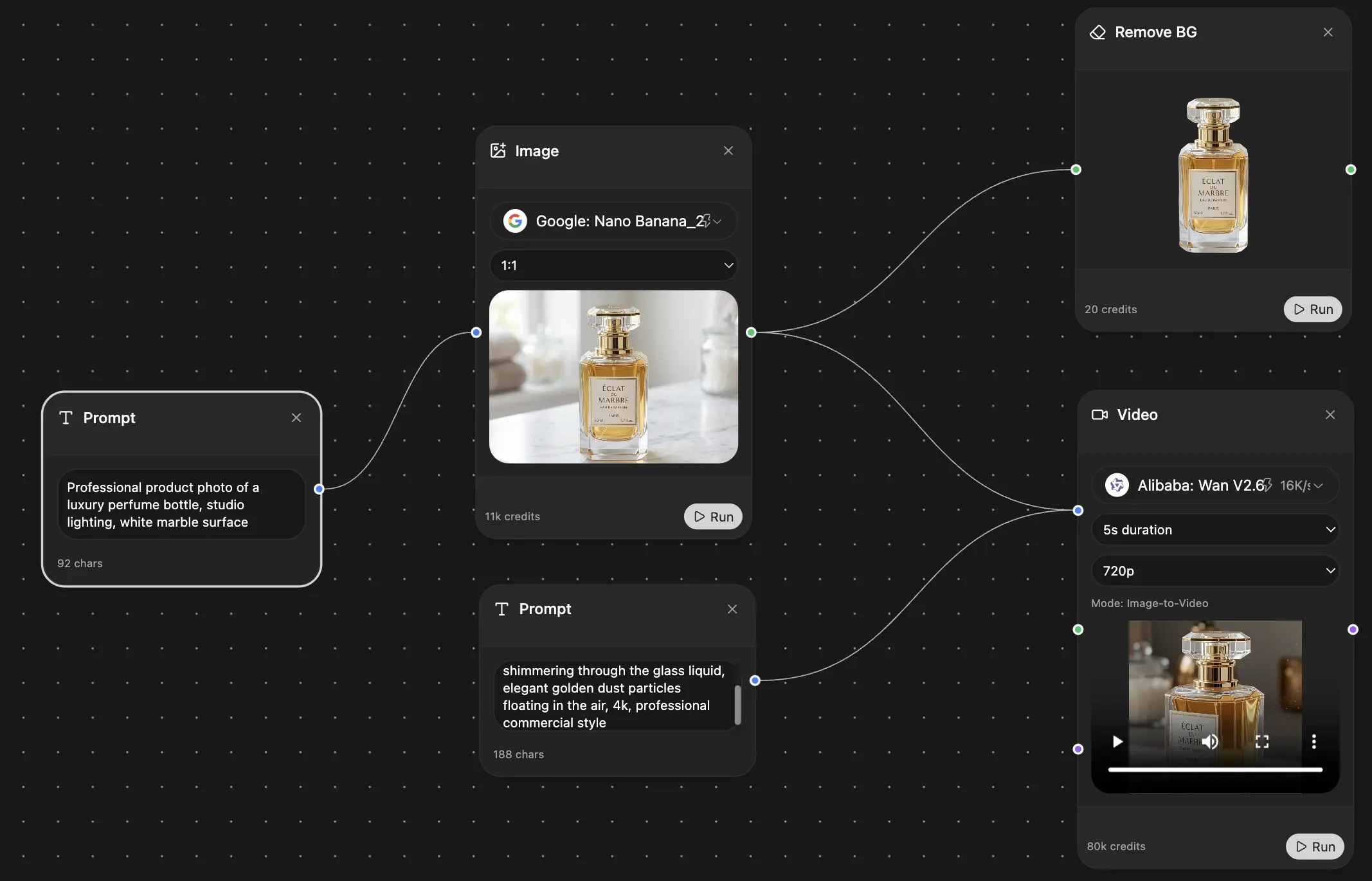
Your infinite AI canvas.
Chat, image, video & motion tools — side by side
Save hours of work and research
Transparent, High-Value Pricing
Trusted by teams at






Free
No credit card required
- 100 credits daily
- 3 AI models to try
- Basic AI chat
Plus
- 1,000,000 credits/month
- 25+ AI models — GPT, Claude, Gemini, Grok & more
- Agent Mode with web search, computer tools and more
- Creative Studio: image generation and video generation
- Project Library: chat with document, website and youtube, podcast generation, flashcards, reports and more
- Workflow Studio and FocusOS
Professional
- Everything in Plus, and:
- 2,100,000 credits/month
- Pro-exclusive models (Claude Opus, Grok 4, Sonar Pro)
- Motion Tools & Max Mode
- First access to latest features
- Access to additional offers
What Our Users Say
Great Tool after 2 months usage
simplyzubair
I love the way multiple tools they integrated in one platform. So far it is going in right dorection adding more tools.
Best in Kind!
barefootmedicine
This is another game-change. have used software that kind of offers similar features, but the quality of the data I'm getting back and the sheer speed of the responses is outstanding. I use this app ...
simply awesome
MarianZ
I just tried it - didnt wanna stay with it, because there is so much like that out there. But it convinced me, because: - the discord-channel is very response and fast - the number of models are quite...
A Surprisingly Comprehensive and Engaging Experience
bruno.battocletti
Zemith is not just another app; it's a surprisingly comprehensive platform that feels like a toolbox filled with unexpected delights. From the moment you launch it, you're greeted with a clean and int...
Great for Document Analysis
yerch82
Just works. Simple to use and great for working with documents and make summaries. Money well spend in my opinion.
Great AI site with lots of features and accessible llm's
sumore
what I find most useful in this site is the organization of the features. it's better that all the other site I have so far and even better than chatgpt themselves.
Excellent Tool
AlphaLeaf
Zemith claims to be an all-in-one platform, and after using it, I can confirm that it lives up to that claim. It not only has all the necessary functions, but the UI is also well-designed and very eas...
A well-rounded platform with solid LLMs, extra functionality
SlothMachine
Hey team Zemith! First off: I don't often write these reviews. I should do better, especially with tools that really put their heart and soul into their platform.
This is the best tool I've ever used. Updates are made almost daily, and the feedback process is very fast.
reu0691
This is the best AI tool I've used so far. Updates are made almost daily, and the feedback process is incredibly fast. Just looking at the changelogs, you can see how consistently the developers have ...