Using AI to Summarize Text: Enhance Productivity
Learn how using AI to summarize text saves hours. Discover workflows, prompt writing, & verification for accurate summaries from any document.
You've got a folder full of reports, a meeting transcript that won't quit, three articles you meant to skim yesterday, and a document titled final_final_v7 that somehow became your problem. That's exactly where using AI to summarize text stops being a novelty and starts being a survival skill. The trick is not getting a shorter version of everything, it's getting a summary you can trust enough to make a decision with.
Drowning in Words? AI Summarization Is Your Life Raft
AI summarization used to feel like a neat demo. Now it shows up inside the tools people already use, which is why it's become part of normal knowledge work instead of a side experiment. Microsoft describes summarization as a feature in Microsoft 365 Word, Outlook, and Copilot, and Azure AI Language splits it into plain text, conversations, and native documents, so teams can summarize PDFs, Word files, and transcripts without hand-editing every line. Google also treats summarization as a core generative-AI use case in Gemini and Document AI for business and research documents.
That matters because the pain isn't reading one long thing. It's reading too many long things, then trying to remember which one said what. A summarizer earns its keep when it helps you move from “I have no time” to “I know where to look next.”
What changes the game
The workflow shift is bigger than the feature itself. Instead of opening five tabs and hoping your brain cooperates, you can compress a document, check the important parts, and decide whether it deserves a full read. That's why practical tools matter more than flashy ones.
Practical rule: use the summary to locate the signal, not to replace the source.
If you already use email or document tools, it's worth comparing how different assistants handle review tasks, not just prose compression. MyMentions' guide to is a useful adjacent example because it shows how summarization sits inside broader workflow work, not just one-off reading.
For a more document-specific workflow, Zemith's own fits the practical mindset here. The point is not “press summarize and walk away.” The point is to build a repeatable habit that saves time without flattening meaning.
Extractive vs Abstractive Summarization Explained
The two main modes are easier to understand than the jargon makes them sound. Extractive summarization is basically the highlighter approach, it pulls important sentences directly from the original. Abstractive summarization works more like a sharp colleague who reads the source and explains the point in fresh wording. The survey literature groups modern methods across prompt engineering, fine-tuning, knowledge distillation, and older sentence-ranking pipelines, which is a reminder that this space includes both classic NLP and LLM-driven systems.

When each one helps
Extractive output is usually safer when wording matters and you want to see the source's own language. It can feel clunky, but it's easier to audit. Abstractive output reads better for executives, clients, or teammates who want the gist without wading through the original phrasing.
Some summaries fail because they sound polished while quietly drifting away from the source.
That's the trade-off. Better prose doesn't automatically mean better truth.
In practice, a bullet list often works well for extractive results, while a narrative paragraph fits abstractive summaries better. If you're summarizing a policy memo, contract note, or research brief, the right choice depends on whether you need fidelity or readability first. For a quick mental model, think of extractive as “show me the evidence” and abstractive as “tell me what the evidence means.”
If you want to connect this to structure and meaning, the related idea of helps because the best summaries don't just shorten text, they preserve relationships between ideas. That's where many generic tools stumble, they reduce length but lose hierarchy. A strong summarizer should make the text shorter without turning it into soup.
Choosing Your AI Summarization Sidekick
Free summarizers are fine when the task is small and the source is clean. But once you move into mixed-format documents, transcripts, or research packets, the limitations start showing up fast. QuillBot's summarizer, for example, says users can paste up to 600 words at a time and generate unlimited free summaries per day, while Grammarly lets users choose bullet-point or paragraph output and adjust tone for academic, formal, persuasive, or technical writing. Temple University also notes that some tools allow only 2 PDF uploads per day on free tiers, others create one-sentence PDF summaries, and some offer 3 flashcards per day or browser extensions for web-page summarization.
Those limits tell you something important. A summarizer isn't just a button, it's a workflow constraint. If the tool can't handle your file type, tone, or downstream use case, you'll spend more time patching the output than you saved upfront.
What serious users look for
A useful summarization tool should answer three questions cleanly.
- Can it handle the source format? PDFs, docs, transcripts, and web text behave differently.
- Can it shape the output? Bullet list, paragraph, executive summary, study notes, action items.
- Can you keep working without switching apps? That's where a workspace matters more than a single feature.
Zemith sits in that last category because it combines document chat, writing support, and organized workspaces in one place, so a summary doesn't become an orphaned note. You can summarize a file, refine the wording, and store the result in a project without bouncing between disconnected tools. Its multi-model access also matters in practice, because different documents respond better to different models, and the same summary style won't always fit every audience. For a closer look at that side of the stack, Zemith's is worth reading before you lock in a workflow.
The primary advantage here is friction removal. A single-task summarizer can compress text, but an integrated workspace helps you move from summary to action. That's the difference between “nice demo” and “something I'll use tomorrow.”
A Practical Workflow for Summarizing Any Document
Long documents break weak summarizers. That's why a one-shot prompt often falls apart on dense PDFs, mixed-format reports, and source packs with tables, headings, and transcript fragments. Cloud guidance recommends a map-reduce style design for long documents that exceed token limits, because you split the text, summarize each part in parallel, then synthesize a final summary from those partial results. It also notes that chunking should follow paragraph or section boundaries rather than arbitrary character counts, because semantic coherence matters.
The cleanest way to do this in a tool like Zemith is to treat the document like a set of linked sections, not a single blob. If the PDF is messy, first convert it into workable text. Zemith's is useful here because clean input makes better summaries, and bad OCR tends to produce bad confidence.
The workflow that holds up
- Normalize the source. Strip out headers, duplicate footers, and broken OCR artifacts before summarizing.
- Chunk by meaning. Keep sections intact where possible, especially when arguments span multiple paragraphs.
- Summarize each chunk. Ask for a constrained output, ideally with the same format every time.
- Merge and check. Build a final summary from the chunk outputs, then verify it against the original.
That sounds simple, but the discipline is in the middle step. If each chunk is summarized with a different tone or length, the final synthesis gets messy fast. If you want a second lens on workflow design, a good place to explore is through prompt structure and repeatable steps, not just model choice.
Good workflow, bad workflow: one reads like a careful editor, the other reads like a rushed intern with a caffeine problem.
The biggest win from this approach is control. You can summarize a 60-page packet without pretending the whole thing fits in one context window, and you can do it without losing the thread between sections. That's the difference between a summary that survives review and one that gets ignored.
Writing AI Prompts That Get You Better Summaries
The prompt matters because summarizers obey instructions more than people expect. If you say “summarize this,” you'll usually get a generic middle-ground answer. If you define the audience, length, format, and purpose, the output gets much easier to use. Box's best-practice guidance is blunt about this, it recommends defining the purpose, giving precise instructions including desired word count, tailoring for the audience, and combining extractive and abstractive methods depending on the content. Box on AI summarization best practices
Prompt templates that actually help
Use these as starting points.
- Executive summary: “Summarize this document in 5 bullet points for a leadership team. Focus on decisions, risks, and the business outcome.”
- Action items: “Extract every concrete next step, owner, and dependency from this text. Omit background unless it changes the action.”
- Research recap: “Summarize the methods, findings, and limitations in plain language. Keep the structure in that order.”
- Audience-specific version: “Rewrite this for a marketing team that needs the key message, not the technical detail.”
Those prompts work because they tell the model what success looks like. A summary for legal review and a summary for a product team shouldn't look the same, and a vague prompt will happily blur that distinction.
If you want to keep your reusable prompts in one place, Zemith's Prompt Gallery makes that easier by storing the versions you reuse for article drafts, research notes, and document reviews. For a deeper writing-specific angle, GitDocAI's guide on how to is a solid reminder that prompt quality and editorial cleanup usually travel together.
A small habit makes a big difference here. Keep one prompt for “short executive read,” one for “dense technical recap,” and one for “action items only.” That way you're not reinventing the prompt every time your inbox attacks.
Don't Just Trust Verify Your AI Summary
AI summaries are useful, but they're not a substitute for reading the source when accuracy matters. The easiest verification habit is simple. Read the source's introduction and conclusion yourself, ask the model for a structured summary, then spot-check the key claims against the original. The SentX guide recommends exactly this kind of quote-back and source-check workflow, which turns summarization into a QA process instead of blind trust.
A quick verification routine
- Cross-reference the summary against the source. Look for missing qualifiers, swapped emphasis, or invented transitions.
- Scan for omitted details. Important constraints, exceptions, and caveats disappear more often than people expect.
- Check readability and coherence. A summary can be accurate and still be hard to use.
The University of Calgary's handout is useful because it keeps the human in the loop. It advises comparing AI output with your own notes, validating accuracy before accepting the result, and checking whether the model is relying on training data or up-to-date web data. It also flags working links, bias, and missing important aspects as practical review points.
Treat the summary like a map, not the territory.
That line stays true in research, business, and content work. If a summary contains claims you'd put in a report, verify them before anyone else repeats them.
Zemith's Smart Notepad and Whiteboard fit that review habit nicely because you can compare the summary and the source side by side instead of juggling tabs like a frantic octopus. A source-grounded approach also lines up with broader guidance on , which is the right mindset when the summary is going to inform anything important. The better your check, the less likely you are to ship a polished mistake.
Common Pitfalls and How to Sidestep Them
The most common mistake is over-trusting a summary because it reads smoothly. Fluent prose can hide missing caveats, shifted emphasis, or a conclusion that the source never made. That's why source-grounded summaries matter most in research, legal, and business settings, where knowing what was omitted can matter as much as what was included. Google's AI summarization use-case guidance makes that gap pretty clear, especially around citation needs, section-aware chunking, and surfacing disagreements or limitations.
The traps that show up most often
- Nuance gets flattened. Conditional language and exceptions are often the first things to disappear.
- Mixed-format content gets mangled. PDFs with tables, meeting notes, and transcripts don't all compress the same way.
- A summary gets treated like authorship. If you use the output in your own work, be transparent about the source and the AI role.
Another trap is assuming every summarizer should behave the same way. Some tools are tuned for documents, some for conversations, and some for query-focused results. That's why a better workflow starts with the question, “What kind of input am I dealing with?” rather than “Which button is fastest?”
You'll get better results when you keep the source visible, use clear prompts, and review the output before it goes anywhere important. That's the boring answer, which is usually the one that works.
For people who live inside documents all day, Zemith is worth trying because it combines summarization, note refinement, and workspace organization in one place. If you're ready to stop treating long text like a nuisance and start handling it like a repeatable workflow, visit and put a more auditable summarization process to work on your next report, transcript, or research file.
Explore Zemith Features
Everything you need. Nothing you don't.
One subscription replaces five. Every top AI model, every creative tool, and every productivity feature, in one focused workspace.
Every top AI. One subscription.
ChatGPT, Claude, Gemini, DeepSeek, Grok & 25+ more







Always on, real-time AI.
Voice + screen share · instant answers
What's the best way to learn a new language?
Immersion and spaced repetition work best. Try consuming media in your target language daily.
Voice + screen share · AI answers in real time
Image Generation
Flux, Nano Banana, Ideogram, Recraft + more

Write at the speed of thought.
AI autocomplete, rewrite & expand on command
Any document. Any format.
PDF, URL, or YouTube → chat, quiz, podcast & more
Video Creation
Veo, Kling, Grok Imagine and more

Text to Speech
Natural AI voices, 30+ languages
Code Generation
Write, debug & explain code
Chat with Documents
Upload PDFs, analyze content
Your AI, in your pocket.
Full access on iOS & Android · synced everywhere
Your infinite AI canvas.
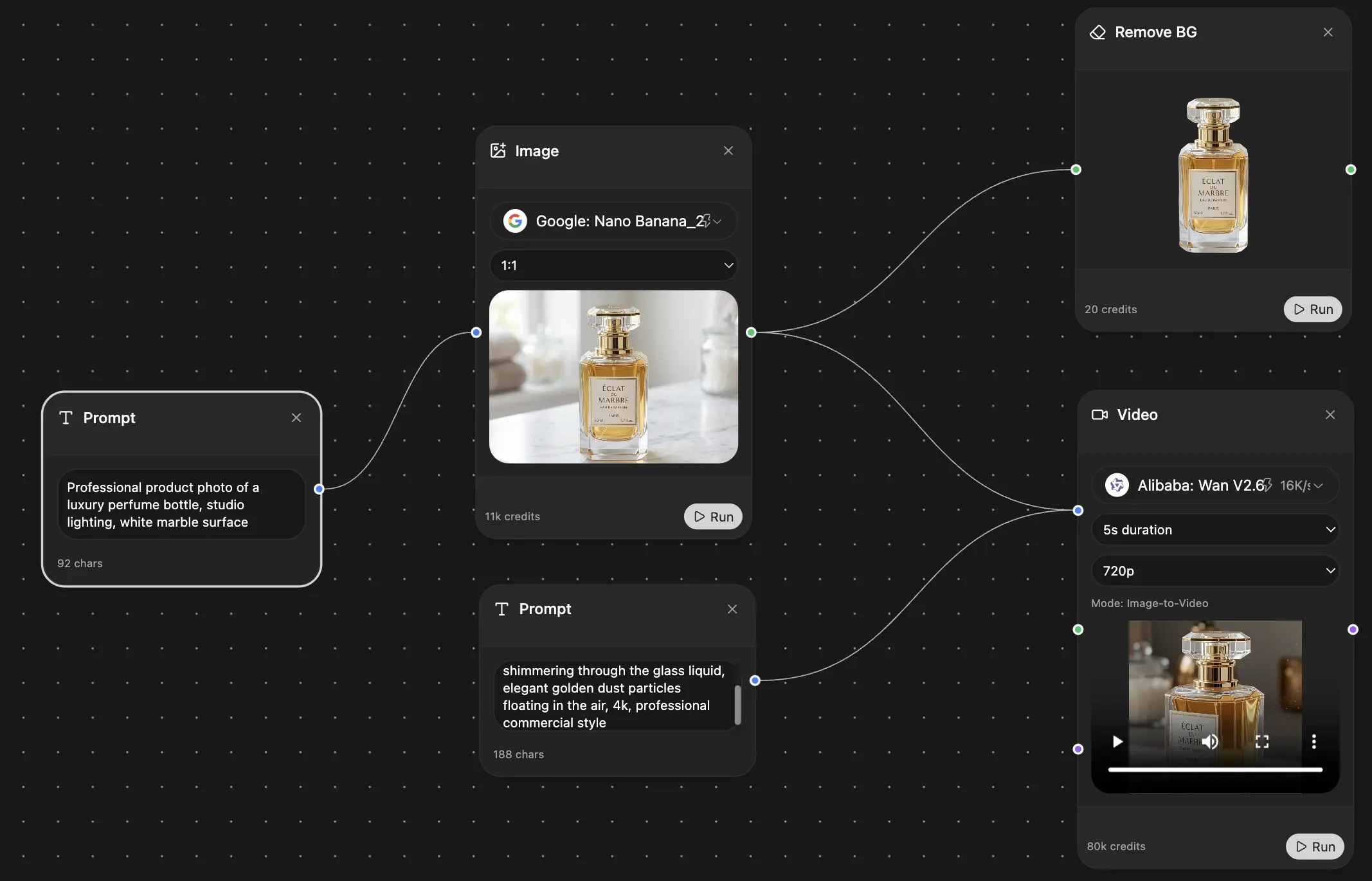
Chat, image, video & motion tools — side by side
Save hours of work and research
Transparent, High-Value Pricing
Trusted by teams at






Free
No credit card required
- 100 credits daily
- 3 AI models to try
- Basic AI chat
Plus
- 1,000,000 credits/month
- 25+ AI models — GPT, Claude, Gemini, Grok & more
- Agent Mode with web search, computer tools and more
- Creative Studio: image generation and video generation
- Project Library: chat with document, website and youtube, podcast generation, flashcards, reports and more
- Workflow Studio and FocusOS
Professional
- Everything in Plus, and:
- 2,100,000 credits/month
- Pro-exclusive models (Claude Opus, Grok 4, Sonar Pro)
- Motion Tools & Max Mode
- First access to latest features
- Access to additional offers
What Our Users Say
Great Tool after 2 months usage
simplyzubair
I love the way multiple tools they integrated in one platform. So far it is going in right dorection adding more tools.
Best in Kind!
barefootmedicine
This is another game-change. have used software that kind of offers similar features, but the quality of the data I'm getting back and the sheer speed of the responses is outstanding. I use this app ...
simply awesome
MarianZ
I just tried it - didnt wanna stay with it, because there is so much like that out there. But it convinced me, because: - the discord-channel is very response and fast - the number of models are quite...
A Surprisingly Comprehensive and Engaging Experience
bruno.battocletti
Zemith is not just another app; it's a surprisingly comprehensive platform that feels like a toolbox filled with unexpected delights. From the moment you launch it, you're greeted with a clean and int...
Great for Document Analysis
yerch82
Just works. Simple to use and great for working with documents and make summaries. Money well spend in my opinion.
Great AI site with lots of features and accessible llm's
sumore
what I find most useful in this site is the organization of the features. it's better that all the other site I have so far and even better than chatgpt themselves.
Excellent Tool
AlphaLeaf
Zemith claims to be an all-in-one platform, and after using it, I can confirm that it lives up to that claim. It not only has all the necessary functions, but the UI is also well-designed and very eas...
A well-rounded platform with solid LLMs, extra functionality
SlothMachine
Hey team Zemith! First off: I don't often write these reviews. I should do better, especially with tools that really put their heart and soul into their platform.
This is the best tool I've ever used. Updates are made almost daily, and the feedback process is very fast.
reu0691
This is the best AI tool I've used so far. Updates are made almost daily, and the feedback process is incredibly fast. Just looking at the changelogs, you can see how consistently the developers have ...