How to Write a Perfect Summary of a Website Using AI
Learn how to create an accurate summary of a website using AI tools. Step-by-step workflows, prompt templates, and verification methods for any audience.
You paste a URL into a summarizer, wait a few seconds, and get back a paragraph that sounds polished enough to be dangerous. It says almost nothing specific, misses the point of the page, and somehow feels like it was written for a stranger who has never met the business.
That's the usual pain point with a summary of a website. The good ones help a real person make a decision, a bad one just rephrases the homepage with more confidence than judgment. A useful summary should change depending on whether the reader is scanning for SEO gaps, sizing up a startup, or forwarding a quick internal update.
Why Most Website Summaries Fail and How to Fix That
The fastest way to produce a weak summary is to treat every site the same. A homepage rewrite for a coffee brand, a due-diligence note for a SaaS startup, and a competitor scan for an SEO team all need different details, different tone, and different evidence. If you flatten them into one generic paragraph, you end up with prose that sounds tidy but helps nobody.
That's where most tools stumble. They paraphrase visible text instead of deciding what matters to the audience. A useful summary should pull out the facts a reader can act on, which lines up with the plain-speaking standard Nielsen Norman Group recommends for organization overviews, purpose, years of operation, size, headquarters location, and annual revenue when relevant to the reader's task ().
Practical rule: if the reader can't use the summary to make a next move, it's not finished.
Audience first, output second
The fix is simple, but people skip it because it feels slower than clicking “summarize.” Before writing, decide whether the output is for SEO, investor diligence, executive briefing, or a quick team handoff. That one decision changes the level of detail, the evidence burden, and even which pages you need to inspect.
A useful way to sharpen the angle is to borrow the mindset behind good ad work. When you're comparing positioning, ad copy examples for inspiration can help you see how much context is needed before a message lands, especially when the same product has to speak differently to different audiences (). That's the same problem with website summaries, a generic output sounds okay, but a purpose-built one fits the reader.
For teams who want to write summaries that feel human instead of synthetic, it also helps to keep a writing reference handy, like . The point isn't to make a summary flashy. The point is to make it specific enough that someone trusts it.
A lot of “summary of a website” work fails because the writer never asks, “Who is this for, and what should they do after reading it?” Answer that first, and half the quality problem disappears.
Extracting Website Content the Right Way

A website summary is only as strong as the material you feed it. A homepage alone will usually miss pricing logic, product positioning, proof points, and the language people see after they click deeper into the site. Good extraction means choosing the right pages in the right order, not scraping everything and hoping the model figures out what matters.
Start with the page mix that matches your goal
If the summary is for a quick orientation, the homepage and About page may be enough. If it supports a buying decision, add Pricing, FAQ, case studies, and any product or docs pages that explain how the offer works. If the goal is SEO or competitor research, include the pages that show topical coverage, content depth, and the site's internal language patterns.
That extraction logic matters even more when sites resist easy capture. In practice, teams often use a proxy layer for hard-to-reach pages, rate-limited endpoints, or sites that behave differently across locations, which is where a resource like helps clarify the operational side of collection. The point is not to scrape more. It is to collect the right text without breaking the workflow, and to keep the process aligned with .
A clean internal workflow also keeps the sources organized. A structured workspace can hold the extracted pages together, preserve context across multiple files, and make it easier to revisit a source later without starting from zero. That matters because a summary gets brittle fast when the underlying pages are scattered across tabs, downloads, and half-labeled screenshots.
For teams using Zemith, the practical pattern is straightforward. Feed the URL into Document Assistant, pull in the key subpages through Research, and store the set in Library so the related pages stay connected. If a site blocks direct capture, use a fallback collection method, then bring the content into the same workspace so the summary still has one source of truth.
Practical rule: do not summarize what you have not actually assembled. Missing pages are how clean summaries become wrong summaries.
A repeatable extraction pass makes the later writing easier, but it also makes it defensible. If you know exactly which pages fed the summary, you can explain why the output says what it says.
Choosing the Right Summary Type for Your Audience
The hardest mistake to correct is choosing the wrong format. A TL;DR for Slack, an executive summary for a board packet, a bullet-point overview for internal triage, and an annotated summary for research all serve different reading jobs. Use the wrong one, and the reader gets either too little information or more detail than they asked for.
The format should follow the decision the reader needs to make. If the goal is fast orientation, a short TL;DR works. If the reader needs a recommendation or risk readout, an executive summary fits better. If they are comparing several sites or scanning for patterns, a bullet-led overview is easier to use.
If the output may be challenged later, choose an annotated summary. That format keeps each claim closer to the source text and gives you room to show where the conclusion came from. In practice, that matters for diligence work, research notes, and any report where someone will ask for the line behind the claim. Zemith's Smart Notepad can turn one extraction into multiple versions, which helps when the same source has to become a Slack note, a client update, and a longer brief. For teams that want a faster starting point for leadership-facing drafts, the gives you a direct way to shape the output around that use case.
A simple test keeps the choice grounded. If the reader is asking, “What is this?” use a TL;DR. If they are asking, “Should we act on it?” use an executive summary. If they are asking, “How does this compare?” use bullets. If they are asking, “Can I trust it?” use annotation.

Summary Types by Use Case
The same website can require a different output depending on who will read it. A SaaS pricing page often needs a tight executive summary for sales or leadership, while an eCommerce storefront usually works better as a bullet-led overview because readers want product groups, offer structure, and positioning at a glance. A research organization's About page usually benefits from an annotated format because the reader wants mission, credibility, and evidence, not polished blur.
A summary gets weaker when the format does not match the decision. It gets stronger when the format matches the task the reader is trying to finish. That is the point behind using different summary types instead of forcing one generic output onto every site. This is also where tools like can help you draft a first pass before you verify the details yourself in Zemith's workspace.
The wrong format makes accurate writing feel thin or crowded. The right format makes the same information easier to read, easier to trust, and easier to use.
Prompt Templates That Actually Produce Useful Summaries
A vague prompt produces a vague summary. If you ask an AI to “summarize this website,” it will usually give you the safest version of the page, which means it leaves out the parts people need. Better prompts tell the model what to extract, what to ignore, and how the output should be structured.

Prompt for a clean business summary
Use a prompt like this when you want a straightforward overview:
“Summarize this website for a business reader. Identify the company's purpose, main offer, target audience, and proof points. Keep the tone neutral, avoid marketing language, and use bullet points.”
That works because it sets a reading level, forces topical coverage, and blocks fluff. If you're summarizing a SaaS pricing page, add a request for plan differences, pricing structure, and any limits or add-ons. If you're summarizing an eCommerce site, ask for product categories, audience fit, and the kinds of offers the store pushes hardest.
Prompt for an annotated, evidence-heavy version
If the summary will be challenged later, ask for traceability:
“Summarize this page in a way that keeps each claim tied to the original text. Include the strongest supporting passage for each point and avoid unsupported interpretation.”
That's where a source-aware tool or workflow matters. A tool like is useful to study how structured generation is framed, but the win is in teaching the model to preserve evidence instead of just paraphrasing. For writer workflows, Zemith's Prompt Gallery lets you save prompts like these and reuse them instead of rebuilding them every time.
For polish, Smart Notepad helps clean up the rough edges. Rephrase a summary to sound more direct, shorten a padded paragraph, or shift the tone from analytical to executive without changing the underlying meaning. That's useful when the first pass is technically correct but sounds like it was dressed by committee.
A few prompt tweaks matter more than people expect.
- Ask for the page type first: homepage, pricing, About, blog post, or docs page. The model writes better when it knows the page's job.
- Name the audience: investor, SEO analyst, sales rep, or executive. Audience changes what gets foregrounded.
- Request omission control: tell the model to flag missing facts instead of inventing them. That keeps it from hallucinating completeness.
- Set a formatting rule: bullets, short paragraphs, or annotated notes. Structure makes output easier to reuse.
For a research organization's About page, ask the model to pull out mission, methods, institutional credibility, and named areas of focus. For a product landing page, ask it to separate claims, features, and proof. For a content-rich site, ask it to ignore decorative copy and focus on pages that explain the offer.
The prompt is the steering wheel. If it's loose, the summary drifts.
Verifying Your Summary and Citing Sources
An AI summary isn't useful until you can defend it. That means checking whether the key claims trace back to the original page, whether the summary missed anything important, and whether any dates or statistics are fresh enough to trust. If the summary is going into a report, an investor note, or anything else that may be challenged, verification isn't optional.
Check the source, then check the gap
The first pass is simple. Confirm that the title, headings, and main body text were captured, then compare the summary against the page to see what got compressed out. That's where a tool with real citation-backed traceability helps. Scholarly describes a workflow where the system fetches the exact page, writes a structured summary grounded in the page's text, and lets you ask follow-up questions with answers cited back to the source itself ().
A source-backed workflow is also the safer option when the output needs to survive review. Atlas makes the same point from a different angle, recommending that you check the strongest supporting passage before you save the takeaway and use citation-level evidence when the summary becomes a report claim or something another person may challenge ().
If you can't point to the passage that supports a claim, it doesn't belong in the summary.
Separate orientation from evidence
Not every use case needs the same level of rigor. A quick URL summary is fine when you're just orienting yourself or deciding whether to read more. A citation-backed summary is the right choice when the output will be shared, challenged, or reused in work that has consequences.
That distinction matters because summaries tend to fail in the same few ways. They overstate what the page says, they miss a qualifier, or they fail to notice that the page's most important detail sits in a subheading rather than the first paragraph. A reliable workflow checks for all three.
Zemith's Research feature fits this kind of validation work because it combines real-time web search with fact-checking. Used properly, it turns the summary into a checked artifact instead of a black box output, which is the difference between “sounds right” and “I'd sign my name under this.”
For practical review, I use a short checklist.
- Trace claims back: every important point should map to a visible passage.
- Check for omissions: ask what the summary left out that a reader would care about.
- Refresh dated facts: if a page mentions time-sensitive material, verify that it still holds.
- Flag uncertainty: if the source is thin, say so instead of smoothing it over.
For a deeper source-evaluation habit, the principles in are useful because they push the same discipline you need here, source quality, recency, and fit for purpose. A summary that can't survive basic source scrutiny isn't a summary you should reuse.
Building Your Repeatable Website Summary Workflow
The best website summarizers don't work from memory. They use the same sequence every time, so the output stays consistent even when the sites change. A repeatable workflow also makes it easier to compare competitors, hand off work, and revisit a summary later without guessing what happened in the first pass.
The simplest setup is a dedicated project with a clean source bucket. Keep the extracted pages in one place, store the summary versions together, and use the same checklist every time you review a new site. That's where a shared workspace matters, because the context stays attached to the project instead of disappearing into a random download folder like a lost sock.
A workflow that holds up in real work
Start by collecting the right pages, then choose the summary type, then prompt for the format you need, and then verify the claims. If the task repeats often, save the prompt in a library and reuse it instead of rewriting from scratch. If you're working across devices, the mobile app makes it easier to review a draft on the move, which is handy when you notice a weird sentence on the train and don't want to pretend you didn't.
Zemith's Projects and Library are useful here because they keep the source pages, notes, and summary drafts linked together with contextual memory across files. That makes it easier to batch similar website summaries, convert them into Markdown when needed, and keep one process across content, research, and competitor review.
Practical rule: consistency beats cleverness when the summary is part of a business workflow.
Different roles will use the same framework differently. A content creator might summarize competitor homepages and product pages. An entrepreneur might use the same process to evaluate partner sites or acquisition targets. A researcher might store annotated summaries for later comparison. The underlying habit stays the same, which is exactly why it scales.
A good website summary isn't a one-off trick. It's a controlled process that starts with source capture, respects the audience, and ends with a defensible output.
If you want a cleaner way to extract, reformat, and verify a summary of a website without bouncing between tools, try Zemith for the parts that usually slow people down. Its Document Assistant, Research, Smart Notepad, Projects, and Library are built for the kind of workflow that turns one-page summaries into something you can reuse. Visit and test it on a site you need to understand today.
Explore Zemith Features
Everything you need. Nothing you don't.
One subscription replaces five. Every top AI model, every creative tool, and every productivity feature, in one focused workspace.
Every top AI. One subscription.
ChatGPT, Claude, Gemini, DeepSeek, Grok & 25+ more








Always on, real-time AI.
Voice + screen share · instant answers
What's the best way to learn a new language?
Immersion and spaced repetition work best. Try consuming media in your target language daily.
Voice + screen share · AI answers in real time
Image Generation
Flux, Nano Banana, Ideogram, Recraft + more

Write at the speed of thought.
AI autocomplete, rewrite & expand on command
Any document. Any format.
PDF, URL, or YouTube → chat, quiz, podcast & more
Video Creation
Veo, Kling, Grok Imagine and more

Text to Speech
Natural AI voices, 30+ languages
Code Generation
Write, debug & explain code
Chat with Documents
Upload PDFs, analyze content
Your AI, in your pocket.
Full access on iOS & Android · synced everywhere
Your infinite AI canvas.
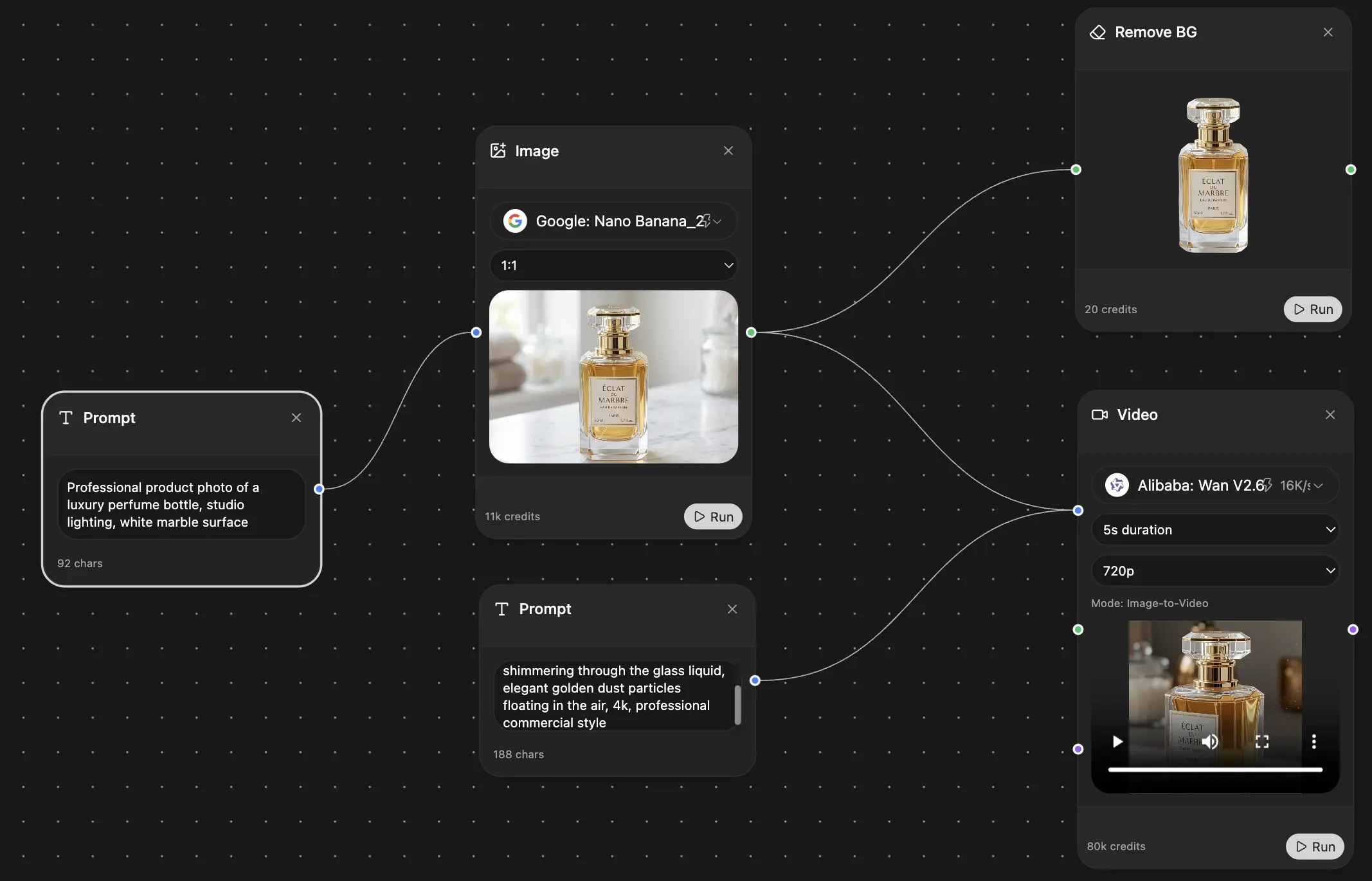
Chat, image, video & motion tools — side by side
Save hours of work and research
Transparent, High-Value Pricing
Trusted by teams at






Free
No credit card required
- 100 credits daily
- 3 AI models to try
- Basic AI chat
Plus
- 1,000,000 credits/month
- 25+ AI models — GPT, Claude, Gemini, Grok & more
- Agent Mode with web search, computer tools and more
- Creative Studio: image generation and video generation
- Project Library: chat with document, website and youtube, podcast generation, flashcards, reports and more
- Workflow Studio and FocusOS
Professional
- Everything in Plus, and:
- 2,100,000 credits/month
- Pro-exclusive models (Claude Opus, Grok 4, Sonar Pro)
- Motion Tools & Max Mode
- First access to latest features
- Access to additional offers
What Our Users Say
Great Tool after 2 months usage
simplyzubair
I love the way multiple tools they integrated in one platform. So far it is going in right dorection adding more tools.
Best in Kind!
barefootmedicine
This is another game-change. have used software that kind of offers similar features, but the quality of the data I'm getting back and the sheer speed of the responses is outstanding. I use this app ...
simply awesome
MarianZ
I just tried it - didnt wanna stay with it, because there is so much like that out there. But it convinced me, because: - the discord-channel is very response and fast - the number of models are quite...
A Surprisingly Comprehensive and Engaging Experience
bruno.battocletti
Zemith is not just another app; it's a surprisingly comprehensive platform that feels like a toolbox filled with unexpected delights. From the moment you launch it, you're greeted with a clean and int...
Great for Document Analysis
yerch82
Just works. Simple to use and great for working with documents and make summaries. Money well spend in my opinion.
Great AI site with lots of features and accessible llm's
sumore
what I find most useful in this site is the organization of the features. it's better that all the other site I have so far and even better than chatgpt themselves.
Excellent Tool
AlphaLeaf
Zemith claims to be an all-in-one platform, and after using it, I can confirm that it lives up to that claim. It not only has all the necessary functions, but the UI is also well-designed and very eas...
A well-rounded platform with solid LLMs, extra functionality
SlothMachine
Hey team Zemith! First off: I don't often write these reviews. I should do better, especially with tools that really put their heart and soul into their platform.
This is the best tool I've ever used. Updates are made almost daily, and the feedback process is very fast.
reu0691
This is the best AI tool I've used so far. Updates are made almost daily, and the feedback process is incredibly fast. Just looking at the changelogs, you can see how consistently the developers have ...