Smart Notepad Explained: What It Is and How It Works in 2026
Discover what a smart notepad is, how AI features reshape writing, and practical tips to get more from Zemith's Smart Notepad in 2026.
You open a notes app to capture one useful idea. The cursor blinks. You type a fragment, delete it, add three bullets, rearrange them, and somehow twenty minutes vanish. The problem usually isn't motivation. A blank text box gives you nowhere to go.
That's where a smart notepad earns its place. Instead of acting like a digital sheet of paper, it can help complete, reshape, organize, and develop what you've already started. Think of it as a thinking partner inside the writing surface, one that handles the mechanical work while you keep control of the idea.
The distinction matters for students, developers, writers, and researchers. A plain notes app stores your thoughts. A smart notepad can help turn those thoughts into something you can search, share, study, publish, or use in a real project.
That Blinking Cursor Is Not Your Problem
Maya is preparing a research presentation. Her notes contain half-sentences, arrows, highlighted phrases, and one mysterious word she wrote at 2 a.m. that now looks like “penguin.” She knows the argument is somewhere in the mess, but the blank document asks her to produce polished prose immediately.
That's a terrible bargain. Good thinking often starts as fragments, not paragraphs. The tool shouldn't punish you for beginning roughly.
A developer faces the same friction after a long debugging session. They might have the useful material already:
- Fixed login redirect
- Cache issue only happened after refresh
- Need to document environment variable
- Add test before release
Those bullets are enough for the developer, but not yet enough for a changelog, an internal update, or a customer-facing explanation. A regular text box leaves the conversion to you. A smart notepad can help bridge the gap.
Practical rule: Capture the thought in its easiest form first. Improve the presentation after the idea exists.
This approach also helps with writer's block, which often feels like a creativity problem but behaves more like a starting problem. A short phrase, question, or rough outline gives an AI writing surface something to work with. The offers another useful way to approach that first stubborn sentence.
The shift is simple: you're no longer asking, “How do I write a perfect paragraph from nothing?” You're asking, “What can I give the notepad so we can develop this together?”
That change makes the cursor less intimidating. You supply the intent. The smart notepad helps with the next move.
What a Smart Notepad Actually Does
A smart notepad is a writing environment that uses AI to interpret your text and assist with the work around it. It isn't just a notes app with a flashy button. It can help you continue a sentence, rewrite an awkward passage, change the tone, expand a compressed thought, or turn scattered bullets into readable prose.
A useful analogy is a thoughtful editor sitting beside you. The editor doesn't decide what you believe. They notice that your paragraph is unclear, suggest a cleaner version, and ask whether you want it casual, concise, persuasive, or more formal.

Autocomplete helps you keep moving
You begin with:
The main reason students lose track of research notes is
A smart notepad might suggest:
that they capture information without recording why it matters to their argument.
You can accept it, edit it, or ignore it. The value isn't that the suggestion is always right. The value is that it removes some of the friction between an unfinished thought and the next useful phrase.
Rephrasing gives rough ideas a cleaner shape
Start with:
This feature is good because it makes notes less messy and helps people find stuff.
A rephrase could become:
This feature makes notes easier to navigate and retrieve.
The shorter version may suit a product brief. A longer version might work better in an educational explanation. The point is to create options without forcing you to copy the first output.
Style adjustments change the audience
Your original message might say:
We need to fix the onboarding flow because new users keep getting confused.
For an executive update:
The onboarding flow requires revision to reduce user confusion during initial setup.
For a friendly team message:
New users are getting stuck during onboarding, so we should simplify the first steps.
The facts stay the same, while the delivery changes. That's especially handy when one idea needs to move from a private note into an email, report, proposal, or presentation.
Bullet-to-paragraph turns fragments into usable content
Your rough notes might read:
- Remote work improves flexibility
- Communication needs clearer routines
- Documentation prevents repeated questions
A paragraph transformation could produce:
Remote work gives people more flexibility, but it also requires clearer communication routines. Strong documentation helps teams preserve decisions and avoid answering the same questions repeatedly.
You still need to check the meaning and add evidence where appropriate. AI can organize your material, but it can't automatically know whether your point is accurate, complete, or appropriate for the audience.
For a deeper look at how an AI workspace can support note capture and development, explore Zemith's . In under thirty seconds, the explanation is this: a smart notepad captures your rough thinking, understands the direction, and helps turn it into a more useful form.
Smart Notepad vs Smart Notebooks and Notes Apps
The category gets confusing because several tools use the word “smart.” A physical digital notebook may capture handwriting. A traditional notes app may sync text across devices. An AI-powered notepad may actively transform what you write.
These tools overlap, but they solve different problems.
SMART Technologies provides a useful historical reference. The company introduced the first SMART Board in 1991, branded the SmartBoard in 1992, and introduced SMART Notebook for education in 1997, according to this . That progression moved from interactive hardware toward software for storing, editing, and sharing content.
Here's the practical comparison:
A physical smart notebook can feel closer to paper, which matters if handwriting helps you slow down and notice what you're thinking. Longhand note-taking has also been associated with deeper processing in a three-study paper, where laptop users performed worse on conceptual questions and tended to transcribe lectures more directly than students writing by hand. .
Traditional apps remain perfectly sensible when you only need a reliable place to put information. Not every grocery list needs an AI editor. Sometimes “buy coffee” is already the ideal final draft.
AI smart notepads become more useful when the note is only the beginning. If you need to turn a meeting fragment into an update, a research outline into a draft, or a list of ideas into a structured plan, the transformation layer matters. Zemith's can help you evaluate that workflow alongside your existing tools.
Cross-platform access also matters when notes support collaborative work, especially for students moving between devices or preparing complex projects. A practical is useful for thinking through how documents, formats, and shared workflows behave beyond one app ecosystem.
Real Workflows for Developers Writers Researchers and Students
Features sound abstract until they produce something you can use. The following workflows show where a smart notepad fits without requiring you to hand over your entire brain to a robot intern.
The developer with four rough bullets
A developer finishes a release and writes:
- Fixed login redirect
- Refresh caused cache issue
- Added environment variable documentation
- Test still needed
They use bullet-to-paragraph to create an internal release note, then apply a more formal style for a changelog:
Improved the login redirect flow and resolved a cache issue triggered by page refreshes. Added documentation for the required environment variable. A follow-up test is still needed before the release is considered complete.
The concrete output is a clean draft that still preserves the unfinished task. That last detail matters. A smart notepad should improve clarity, not transform “needs testing” into “fully tested.”
The writer testing an opening
A writer has a promising hook:
Most productivity advice fails before the work begins.
Instead of polishing one sentence for an hour, they ask for three alternatives with different energies: direct, playful, and reflective. One version may suit a newsletter, another a personal essay, and another a professional article.
The output isn't the finished piece. It's a small set of doors. The writer chooses the one that sounds closest to their voice, then continues manually.
The researcher facing a highlight avalanche
A researcher has copied passages from several papers into one note. The material is valuable, but it mixes definitions, findings, caveats, and personal reactions.
They first ask the notepad to separate the content into themes. Then they request a literature-review paragraph that distinguishes source claims from their own interpretation. The result becomes a working draft, not a final citation-ready paper. The researcher still checks every reference and verifies that the paragraph hasn't blended separate arguments.
The student with an impossible class outline
A student's notes look like this:
- Working memory
- Attention changes with multitasking
- Example from lecture
- Ask about exam
- Review chapter diagram
The smart notepad can convert the outline into a study summary, then create quiz questions from the same material. A document assistant can extend that workflow by generating flashcards or a podcast from a larger document, while the student uses the original notes to check whether the generated study material stayed faithful.
The repeatable pattern is clear: capture quickly, define the desired output, review the transformation, and save the useful version where you can find it again.
Getting More Out of Zemith's Smart Notepad
The most useful results come from treating the notepad like a workspace, not a vending machine. You put in context, choose a specific operation, and inspect what comes out.
Start with autocomplete when your idea is already moving but your fingers are lagging behind. Write a few words, then ask for a continuation that preserves your point.
Continue this paragraph in a practical tone. Keep the focus on how students can retrieve notes before an exam.
That prompt gives the system a subject, audience, tone, and purpose. “Continue this” alone may produce something grammatically smooth and completely unhelpful, like a motivational poster wearing glasses.

Use rewriting for decisions, not decoration
Rephrasing works best when you know what feels wrong. Try:
Rewrite this paragraph for a technical reader. Keep every factual detail, remove repetition, and make the final sentence state the practical implication.
For a softer version:
Rewrite this message so it sounds clear and collaborative, not defensive.
You can also request shorter sentences, a more executive tone, or a version suitable for a student handout. Predictive text can influence the way people express ideas. A Harvard SEAS study found that captions written with suggestions were shorter and used fewer unexpected words, including fewer adjectives and color words such as “green” or “blue,” than captions written without suggestions. .
That's a reason to compare alternatives rather than accepting the first polished sentence. Convenience can subtly narrow your expression.
Turn fragments into a deliberate output
For custom paragraph generation, include the raw material and the destination:
Turn these bullets into a concise project update for a cross-functional team. Explain the progress, identify the open risk, and end with the next action.
For bullet-to-paragraph conversion:
Convert these notes into one coherent paragraph. Keep the order of ideas, preserve uncertainty, and don't add facts that aren't present.
The instruction about uncertainty is essential. If your note says “possible cause,” the generated paragraph shouldn't upgrade it to “confirmed cause.”
Connect the notepad to larger work
A note becomes more valuable when it can travel. Move a finished fragment into a Zemith Project when it belongs to a continuing topic, or place source material in the Library so related documents and conversations remain easier to retrieve. Zemith also combines notepad work with a Document Assistant that can summarize documents, create quizzes, produce flashcards, and convert documents into podcasts.
For better question design, the is a useful companion. The same principle applies here: tell the tool what you have, what you need, who it's for, and what it must not change.
Keep a human review step for private drafts, client material, research notes, and proprietary code. Privacy and governance deserve direct attention because note-taking tools may involve cloud processing, retention, access permissions, or model-training policies. Before uploading sensitive content, check the service's controls and decide what belongs in a local or restricted workflow.
Do Smart Notepads Actually Save You Time
A tidy paragraph can create the illusion of progress. You format a heading, smooth three sentences, and feel productive while the actual research question remains untouched. A smart notepad can make that illusion more attractive because polished text arrives quickly.
The better test is not, “Do my notes look nicer?” Ask whether you can retrieve the right idea, connect it to related material, and turn it into a completed task.

Longhand and typing also serve different cognitive purposes. One comparative study found that computer note-takers performed better on reproduction tasks, while handwriting supported better free recall, with 77.3% of students correctly classified by the experimental condition. . Another neuroscience study reported differences in brain activity during pen-based and keyboard note-taking, but found no significant difference in immediate post-test performance across ink pens, digital pens, and keyboards. .
That mixed picture points to a practical conclusion: the best input method depends on the task, and the best AI feature depends on the output.
Measure the workflow, not the polish
Try a small personal audit:
- Retrieval: Can you find the needed idea without rereading the whole note?
- Reuse: Can the note become a brief, study guide, email, or task?
- Accuracy: Did the transformation preserve your meaning?
- Completion: Did the session help finish the actual assignment?
Use the Library and Projects workspace to connect notes across documents instead of allowing every useful idea to disappear inside one isolated page. A summary can be a starting point, but it only saves meaningful time when it leads to action. Zemith's is most useful when you define what you'll do with the summary afterward.
The real productivity win is not prettier notes. It's fewer dead ends between an idea and its next use.
For a closer look at how handwriting recognition depends on the underlying OCR and ink pipeline, discusses practical variation in recognition quality and input latency. The lesson is broader than device shopping: responsive capture and accurate conversion both matter, but neither replaces judgment.
A Simple Checklist Before Your Next Writing Session
Before you open a smart notepad, run this quick checklist:
- Choose the input: Start with handwriting, bullets, fragments, or full sentences, whichever gets the idea out fastest.
- Name the outcome: Ask for a paragraph, study summary, changelog, outline, email, or another specific result.
- Set the boundaries: Tell the tool what tone to use and what it must preserve.
- Review the meaning: Accept useful wording, but check facts, uncertainty, citations, and your own voice.
- Store the result: Move worthwhile material into a searchable Library or relevant Project so it can support future work.
A smart notepad should reduce friction without taking over the thinking. Let it handle the reshaping, while you remain responsible for the direction.
Zemith brings AI writing assistance, document tools, research workflows, and organized workspaces into one platform, including autocomplete, rephrasing, style adjustments, paragraph generation, and bullet-to-paragraph conversion. Visit and try turning one rough note from your next writing session into something you can use.
Explore Zemith Features
Everything you need. Nothing you don't.
One subscription replaces five. Every top AI model, every creative tool, and every productivity feature, in one focused workspace.
Every top AI. One subscription.
ChatGPT, Claude, Gemini, DeepSeek, Grok & 25+ more







Always on, real-time AI.
Voice + screen share · instant answers
What's the best way to learn a new language?
Immersion and spaced repetition work best. Try consuming media in your target language daily.
Voice + screen share · AI answers in real time
Image Generation
Flux, Nano Banana, Ideogram, Recraft + more

Write at the speed of thought.
AI autocomplete, rewrite & expand on command
Any document. Any format.
PDF, URL, or YouTube → chat, quiz, podcast & more
Video Creation
Veo, Kling, Grok Imagine and more

Text to Speech
Natural AI voices, 30+ languages
Code Generation
Write, debug & explain code
Chat with Documents
Upload PDFs, analyze content
Your AI, in your pocket.
Full access on iOS & Android · synced everywhere
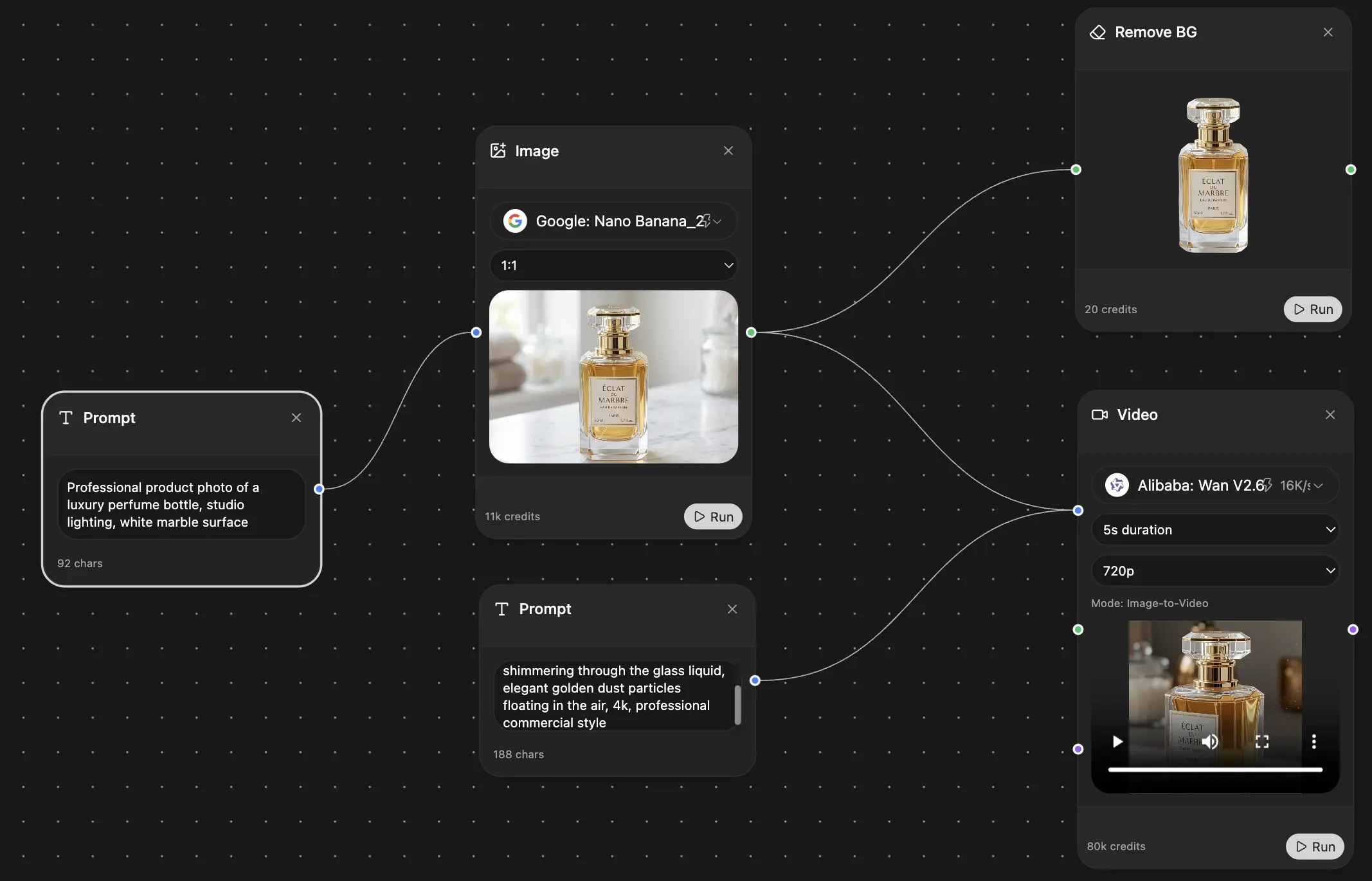
Your infinite AI canvas.
Chat, image, video & motion tools — side by side
Save hours of work and research
Transparent, High-Value Pricing
Trusted by teams at






Free
No credit card required
- 100 credits daily
- 3 AI models to try
- Basic AI chat
Plus
- 1,000,000 credits/month
- 25+ AI models — GPT, Claude, Gemini, Grok & more
- Agent Mode with web search, computer tools and more
- Creative Studio: image generation and video generation
- Project Library: chat with document, website and youtube, podcast generation, flashcards, reports and more
- Workflow Studio and FocusOS
Professional
- Everything in Plus, and:
- 2,100,000 credits/month
- Pro-exclusive models (Claude Opus, Grok 4, Sonar Pro)
- Motion Tools & Max Mode
- First access to latest features
- Access to additional offers
What Our Users Say
Great Tool after 2 months usage
simplyzubair
I love the way multiple tools they integrated in one platform. So far it is going in right dorection adding more tools.
Best in Kind!
barefootmedicine
This is another game-change. have used software that kind of offers similar features, but the quality of the data I'm getting back and the sheer speed of the responses is outstanding. I use this app ...
simply awesome
MarianZ
I just tried it - didnt wanna stay with it, because there is so much like that out there. But it convinced me, because: - the discord-channel is very response and fast - the number of models are quite...
A Surprisingly Comprehensive and Engaging Experience
bruno.battocletti
Zemith is not just another app; it's a surprisingly comprehensive platform that feels like a toolbox filled with unexpected delights. From the moment you launch it, you're greeted with a clean and int...
Great for Document Analysis
yerch82
Just works. Simple to use and great for working with documents and make summaries. Money well spend in my opinion.
Great AI site with lots of features and accessible llm's
sumore
what I find most useful in this site is the organization of the features. it's better that all the other site I have so far and even better than chatgpt themselves.
Excellent Tool
AlphaLeaf
Zemith claims to be an all-in-one platform, and after using it, I can confirm that it lives up to that claim. It not only has all the necessary functions, but the UI is also well-designed and very eas...
A well-rounded platform with solid LLMs, extra functionality
SlothMachine
Hey team Zemith! First off: I don't often write these reviews. I should do better, especially with tools that really put their heart and soul into their platform.
This is the best tool I've ever used. Updates are made almost daily, and the feedback process is very fast.
reu0691
This is the best AI tool I've used so far. Updates are made almost daily, and the feedback process is incredibly fast. Just looking at the changelogs, you can see how consistently the developers have ...