8 Prompt Engineering Tips That Actually Work
Master prompt engineering tips for better AI results with practical templates, model testing, validation, and Zemith-powered workflows.
Most prompt engineering advice starts in the wrong place. It treats success as finding one clever sentence, adding “act as an expert,” and hoping the model suddenly develops perfect judgment. That's closer to wishing than engineering. Reliable AI work starts before you type: define the context, constraints, examples, output format, test process, and review step.
The difference shows up in everyday requests. Ask AI to “make it better,” and you may receive something that's merely longer, which is a generous interpretation of better. Effective prompting gives the model enough information to make useful decisions without forcing it to guess what you meant.
The following prompt engineering tips turn prompting into a repeatable production workflow. You'll see how to assign a useful role, frame context, select examples, control output, test across models, validate results, and save what works. Zemith's , multi-model access, Document Assistant, Smart Notepad, Projects, and Library can help turn those techniques into a workflow you can reuse instead of rebuilding from scratch every morning.
1. The Art of Role-Playing Gives Your AI a Job Description
“Write a security review” is a task. “You're a senior application security engineer reviewing a fintech API for authentication flaws, then explaining the findings to a mixed engineering team” is a job description. The second prompt gives the model a perspective, expertise level, audience, and communication style to work from.
A role won't magically make an AI accurate, but it can make the response more relevant and consistent. A software developer might ask Claude to act as a security expert during a vulnerability review. A marketing professional could ask Gemini to think like a brand strategist before generating campaign ideas. A student researcher might ask GPT to respond as a PhD advisor who gives rigorous but constructive thesis feedback.
Build a role with useful boundaries
Specificity matters inside the role itself. “Senior” suggests a different level of judgment than “junior,” while industry context changes the recommendations. Try stacking roles when the task needs both perspectives:
Practical rule: Give the model a role, audience, domain, and responsibility. Don't pile on impressive-sounding titles that have nothing to do with the work.
Try this adaptable prompt:
You're a senior cybersecurity engineer and technical writer at a fintech startup. Review the code below for authentication, authorization, injection, and data-exposure risks. Explain each issue in plain language, show the affected code, suggest a safer revision, and separate confirmed findings from questions that require more context.
That same pattern works in Zemith's Coding Assistant for code review and debugging. The Document Assistant can use a role such as “regulatory compliance analyst” when you need technical documents examined from a specific professional perspective. Smart Notepad can also use a “professional copywriter” persona to guide rephrasing and writing suggestions.
For more practical guidance on designing useful questions, see . Then test the same role prompt across available models. If one model gives sharp security findings while another explains them more clearly, you can assign each model the part it handles best.

2. The Specificity Spectrum Stops Vague Prompts
AI isn't a mind reader, and “write something good” is not a specification. The more relevant detail you provide, the less the model has to invent about your audience, purpose, format, tone, and boundaries. Think of ordering coffee. “Coffee” leaves plenty of room for disappointment. “Oat milk latte, extra shot” gives the barista a fighting chance.
OpenAI recommends placing instructions at the beginning and separating them from context with delimiters such as ### or triple quotation marks. Its guidance also emphasizes specifying the desired outcome, context, length, format, and style in the prompt. The are a useful baseline, especially when a prompt keeps producing technically plausible but unusable answers.
Put the decision-making details in writing
A strong request answers the Five W's and H, Who, What, When, Where, Why, and How. It also states what the output must include and what it must avoid.
Instead of “write code,” ask:
Write a React component that fetches user data from a REST API. Include loading and error states, TypeScript interfaces, functional components, and hooks. Explain the expected response shape, handle an empty result, and keep the code compatible with our existing project conventions.
For research, try:
Summarize the attached academic paper in five bullet points for a product manager who doesn't have a PhD in statistics. Focus on practical applications, limitations, and decisions the findings can inform. Avoid unexplained statistical terminology.
For image generation through Zemith's creative tools, specify the model, resolution, subject, style, mood, and exclusions:
Using Black Forest Labs Flux model, generate a 1920x1080 product photography image of a minimalist workspace with a MacBook Pro, coffee, and notebook. Use modern, well-lit, professional styling. Include no people, logos, or clutter.
Use Zemith's Projects feature when a task requires multiple related prompts. A project can hold the shared background while each request handles one specific deliverable. More examples are available in .

3. Contextual Framing Sets the Stage Before the Ask
A model can't tailor its answer to information you haven't supplied. Before asking for a marketing strategy, explain the business, audience, current position, previous attempts, resources, and constraints. Before requesting code, explain the stack, existing architecture, performance needs, and compatibility requirements. Context turns a generic answer into a response that has somewhere useful to land.
Start with a labeled block so the model can distinguish background from the actual assignment:
Background
We're a B2B SaaS company in cybersecurity, serving mid-market buyers. Our main advantage is ease of implementation. We've tried content marketing and need a strategy that fits our current team and budget.
Task
Recommend a marketing strategy that prioritizes channels, explains the reasoning behind each recommendation, identifies risks, and ends with a practical first-month action plan.
This structure prevents the final question from disappearing inside a paragraph of background. It also makes the prompt easier to update when the project changes.
Create a context template once
A reusable context template should capture:
- Business situation: Who you serve, what you sell, and where the work happens.
- Current state: What you've tried, what worked, and what failed.
- Constraints: Scope, sources, policy, budget, technical limits, and deadlines.
- Success criteria: What a useful answer must help someone decide or produce.
- Available material: Documents, research, code, brand guidelines, or previous outputs.
The can help you think about how much project material to keep available, but more context isn't automatically better. Irrelevant background creates noise. Give the model the facts that change the answer, not the entire history of your company's group chat.
Zemith Projects can hold ongoing project context, while Library can organize documents and chats across related work. For source-based tasks, load relevant files into the Document Assistant and refer to those materials directly. In a long-running project, establish the context once, then update only what has changed.
4. Few-Shot Learning Shows the Pattern
Instructions describe what you want. Examples demonstrate what “good” looks like. That difference matters when style, structure, naming conventions, or editorial judgment is hard to explain in abstract terms.
Few-shot prompting means placing input and output examples directly in the prompt. A content team might provide two LinkedIn posts they like, then ask for three more that match the rhythm, level of specificity, and audience. A developer can show two functions from an existing codebase and ask the Coding Assistant to follow the same naming and comment style.
A practical prompt might look like this:
Example 1
Input: Product update about faster document search
Output: Short LinkedIn post with a clear opening, one concrete benefit, and a practical closing question.Example 2
Input: Product update about team workspaces
Output: Short LinkedIn post with a conversational tone, no exaggerated claims, and one sentence explaining who benefits.New task: Write three posts about our new document collaboration feature. Match the tone and structure, but don't copy phrases from the examples.
Choose examples for signal, not decoration
OpenAI's guidance recommends starting with zero-shot prompting, then trying few-shot examples before considering more advanced customization. A recommends clear separators and notes that three to five good examples can improve consistency for advanced prompting tasks. The important word is good. A pile of inconsistent examples teaches the model inconsistency with impressive efficiency.
Choose examples that:
- Show the desired pattern: Include both the input and the finished output.
- Cover useful variation: Use different topics while keeping the style consistent.
- Start simply: Order examples from straightforward to more complex.
- Stay current: Remove examples that no longer reflect your brand or codebase.
- Use clear labels: Mark each example so the model can distinguish them from instructions.
Save strong few-shot prompts in Zemith's Prompt Gallery. Smart Notepad can hold template documents with examples built in, which is useful for recurring product descriptions, social posts, research summaries, and editorial rewrites. You can also adapt these techniques for , then test whether the output matches your brand instead of trusting a pleasing first draft.
5. Output Format Specification Makes Results Usable
A response can be intelligent and still waste your time if you have to restructure every line before using it. Tell the model exactly how the result should be formatted. JSON, CSV, Markdown tables, bullet lists, HTML, and structured prose each serve different workflows.
For competitor research, ask for a JSON object with fields such as company_name, unique_value_prop, pricing_strategy, weaknesses, and strengths. For product planning, request a JSON array of milestones with names, dates, deliverables, resources, and dependencies. For code documentation, ask for a Markdown table with columns for parameter, type, description, and example.
Try this:
Analyze the three competitor pages below. Return valid JSON only, using this structure:
{ "company_name": "", "positioning": "", "target_audience": "", "strengths": [], "weaknesses": [], "evidence": [] }
Use empty arrays when the source doesn't support a claim. Don't estimate missing information.
Design for the next tool, not the current screen
The best format is the one your next step can consume. If you're pasting findings into a spreadsheet, CSV may be more useful than polished prose. If a developer needs an API response, define the schema and validation rules. If a human needs to make a decision, a concise list with evidence may beat a dense object full of punctuation.
Be explicit about:
- Schema: Name every field and state which values are strings, numbers, arrays, or objects.
- Required content: Say which fields must always appear.
- Missing data: Tell the model whether to use an empty value, flag uncertainty, or decline.
- Validation: Ask for valid JSON, consistent headings, or a specific standard.
- Immediate use: Parse or paste the result into its intended destination right away.
Don't ask for “a table” when you need columns with specific meanings. Don't ask for “professional formatting” when a downstream system requires a defined schema. Zemith's Prompt Gallery is a practical place to save format templates, and a offers another example of how explicit output instructions can reduce cleanup.
6. Control and Iterate Instead of Chasing a Perfect Prompt
Prompt refinement works better as testing than as mysticism. Change one variable, compare the output, and keep notes. If you rewrite the role, context, format, and examples all at once, you won't know which change helped. You'll have a better prompt, perhaps, but no reliable method for reproducing it.
Model settings also involve trade-offs. Lower creativity settings generally suit repeatable code, extraction, and factual workflows. Higher settings can help brainstorming and creative variation. The exact control available depends on the model and tool, so don't treat a temperature number as a universal recipe.
Use a small experiment loop
For a coding task, begin with a focused request that prioritizes tested patterns and minimal commentary. For brainstorming, ask for several distinct directions and evaluate them for usefulness rather than novelty alone. For research, narrow the scope, state the evidence requirements, and ask the model to identify assumptions before expanding the work.
A practical refinement sequence looks like this:
- Baseline: Ask for the task with a clear goal and output.
- Role adjustment: Add the relevant professional perspective.
- Constraint adjustment: Add audience, scope, exclusions, and success criteria.
- Example adjustment: Include a strong input and output pair if style remains inconsistent.
- Model comparison: Run the same version across multiple models and compare editing effort.
Microsoft Foundry's emphasize that order matters, interpretation should be minimized, repeated instructions can help, and a model should have an “out” when it can't complete a task safely or accurately. That last point prevents confident nonsense from becoming a workflow feature.
In Zemith Projects, record the prompt version, model, settings, output quality, and edits required. The winning prompt isn't the one that sounds clever. It's the one that consistently produces a result you can use.
7. Chain of Thought Helps Complex Work, With a Caveat
Complex tasks benefit from visible structure. Ask the AI to identify assumptions, separate steps, compare alternatives, and explain why a recommendation follows from the available evidence. This makes the work easier to inspect than a polished conclusion with no supporting trail.
For debugging, ask:
Walk through the likely causes of this error in a numbered diagnostic sequence. For each cause, identify the evidence in the code, propose a test, and show the smallest safe fix. Separate confirmed problems from hypotheses.
For research, use:
Identify the information needed to answer this question. List the assumptions, explain which evidence supports each conclusion, and mark any conclusion that depends on missing or weak evidence.
For content strategy, ask the model to map each stage of a B2B SaaS customer journey, including customer needs, likely objections, and a matching message. The structure matters more than a theatrical request to “think harder.”
Ask for an audit trail
You can request intermediate artifacts without asking for private internal reasoning. Useful artifacts include:
- Assumption list: What must be true for the answer to hold?
- Evidence map: Which supplied source supports each conclusion?
- Decision tree: What changes if a condition is true or false?
- Alternative comparison: What other approaches were considered?
- Uncertainty flags: Which parts require human review?
Microsoft's guidance recommends leaving an “out” so the model can decline when it cannot complete a task safely or accurately. That pairs well with structured analysis. A model that says “the provided document doesn't establish this” is more useful than one that fills the gap with a confident paragraph.
Zemith's Coding Assistant can apply this approach to debugging and code review. The Document Assistant can organize analysis of complex documents into findings, assumptions, evidence, and open questions. Save that trail in Projects when teammates need to review how a recommendation was produced.
Keep the prompt focused. “Show every thought you have” isn't a quality strategy, and it can create a long performance instead of a useful answer. Ask for the reasoning artifacts you need to make or review the decision.
8. Error Correction and Validation Ask the AI to Check Its Work
Generation and validation should be separate passes. When you ask an AI to write and approve its own answer in one breath, it may repeat the same mistake with better formatting. A dedicated review prompt creates a different task and gives you a clearer audit trail.
After research, ask:
List every factual claim in the draft. For each claim, provide the supporting source or mark it as unsupported. Flag uncertain wording, outdated information, missing context, and claims that should be removed.
After analysis, ask:
What assumptions does this recommendation make? Which assumptions are supported by the supplied material? What evidence would change the conclusion?
After code generation, ask:
Review this code for security, correctness, maintainability, and edge cases. Identify how it could fail in production, then propose fixes. Don't claim a test passed unless test output is provided.
Make validation a release gate
Validation is especially important for generated software. A security-oriented prompt prefix reduced vulnerabilities by up to 56% in a benchmark involving GPT-4o and GPT-4o-mini, while iterative prompting helped models detect and repair 41.9% to 68.7% of vulnerabilities in previously generated code, according to the . Those findings support a practical habit: state security constraints before generation, then run a separate repair and review loop.
For important work, use multiple checks:
- Source check: Does each factual claim have evidence?
- Assumption check: Which inputs did the answer infer?
- Edge-case check: What happens with missing, unusual, or contradictory data?
- Instruction check: Did the response follow the requested format and exclusions?
- Human check: What still requires expert judgment?
The can help shape a repeatable review process. Document what was validated and what wasn't. A clean-looking answer isn't proof of correctness, and a citation isn't proof that the citation supports the claim.
One newer prompting insight deserves attention: sometimes the right move is not to improve the wording, but to ask for clarification. The EMNLP 2025 argues that agents should pause when instructions are unclear. Add that behavior directly:
If the request is missing information that could materially change the answer, ask up to three focused clarification questions before proceeding. If the missing detail is not material, state your assumption and continue.
8-Point Prompt Engineering Comparison
Turn Good Prompts Into a Reusable System
The useful unit of prompt engineering isn't the prompt. It's the workflow around the prompt.
Start by framing the context. Give the model the situation, audience, available evidence, previous attempts, and constraints. Assign a role that matches the work, but don't confuse a job title with expertise. Add specific requirements, examples, exclusions, and success criteria. Define the output format so the answer can move into the next tool without a long cleanup session.
Then test. Run the prompt against more than one model when the task matters, because models differ in how they follow instructions, handle context, format outputs, and explain uncertainty. A 2025 survey-based study found that 83.7% of 243 respondents agreed or strongly agreed that clearer, more specific prompts lead to better AI results, as reported in the . That supports the basic discipline, but clarity alone doesn't tell you whether a prompt works for your particular task.
Evaluate the result against a simple rubric. Did it use the supplied sources? Did it meet the requested format? Did it make unsupported assumptions? How much editing did a human need to do? Did the answer remain useful when the input changed? The last question matters because a prompt that succeeds once may still be a fragile demo.
Pay attention to placement and hierarchy, too. Recent work on system and user prompts argues that stable instructions, examples, and structure often belong in the system layer, while the actual question belongs in the user message. The broader lesson is that prompt length isn't the same as prompt quality. A shorter, well-structured prompt can outperform a sprawling instruction dump, especially when examples and context are selected carefully.
Zemith can support each stage of this loop:
- Prompt Gallery stores reusable role, format, few-shot, and validation templates.
- Smart Notepad helps refine wording, rephrase drafts, and turn rough notes into polished instructions.
- Document Assistant grounds summaries, questions, quizzes, and analysis in supplied documents.
- Projects and Library preserve durable context for recurring work and organize related conversations.
- Multi-model access lets you compare outputs across models without constantly switching applications.
- Coding Assistant and creative tools let you apply the same structured approach to code, images, and other deliverables.
The practical starting point is small. Choose one recurring task, such as turning research notes into a brief, reviewing pull requests, or drafting product descriptions. Create a template with context, role, constraints, examples, output format, and validation instructions. Test it in Zemith, compare the editing time and result quality, then save the version that makes the work easier.
Good prompt engineering doesn't remove judgment. It gives judgment a repeatable place in the process.
If you want to turn these prompt engineering tips into a working system, visit to test prompts across models, refine them in Smart Notepad, and save reliable versions in Prompt Gallery and Projects. Start with one recurring task today, build the template, and keep the version that saves real editing time.
Explore Zemith Features
Everything you need. Nothing you don't.
One subscription replaces five. Every top AI model, every creative tool, and every productivity feature, in one focused workspace.
Every top AI. One subscription.
ChatGPT, Claude, Gemini, DeepSeek, Grok & 25+ more








Always on, real-time AI.
Voice + screen share · instant answers
What's the best way to learn a new language?
Immersion and spaced repetition work best. Try consuming media in your target language daily.
Voice + screen share · AI answers in real time
Image Generation
Flux, Nano Banana, Ideogram, Recraft + more

Write at the speed of thought.
AI autocomplete, rewrite & expand on command
Any document. Any format.
PDF, URL, or YouTube → chat, quiz, podcast & more
Video Creation
Veo, Kling, Grok Imagine and more

Text to Speech
Natural AI voices, 30+ languages
Code Generation
Write, debug & explain code
Chat with Documents
Upload PDFs, analyze content
Your AI, in your pocket.
Full access on iOS & Android · synced everywhere
Your infinite AI canvas.
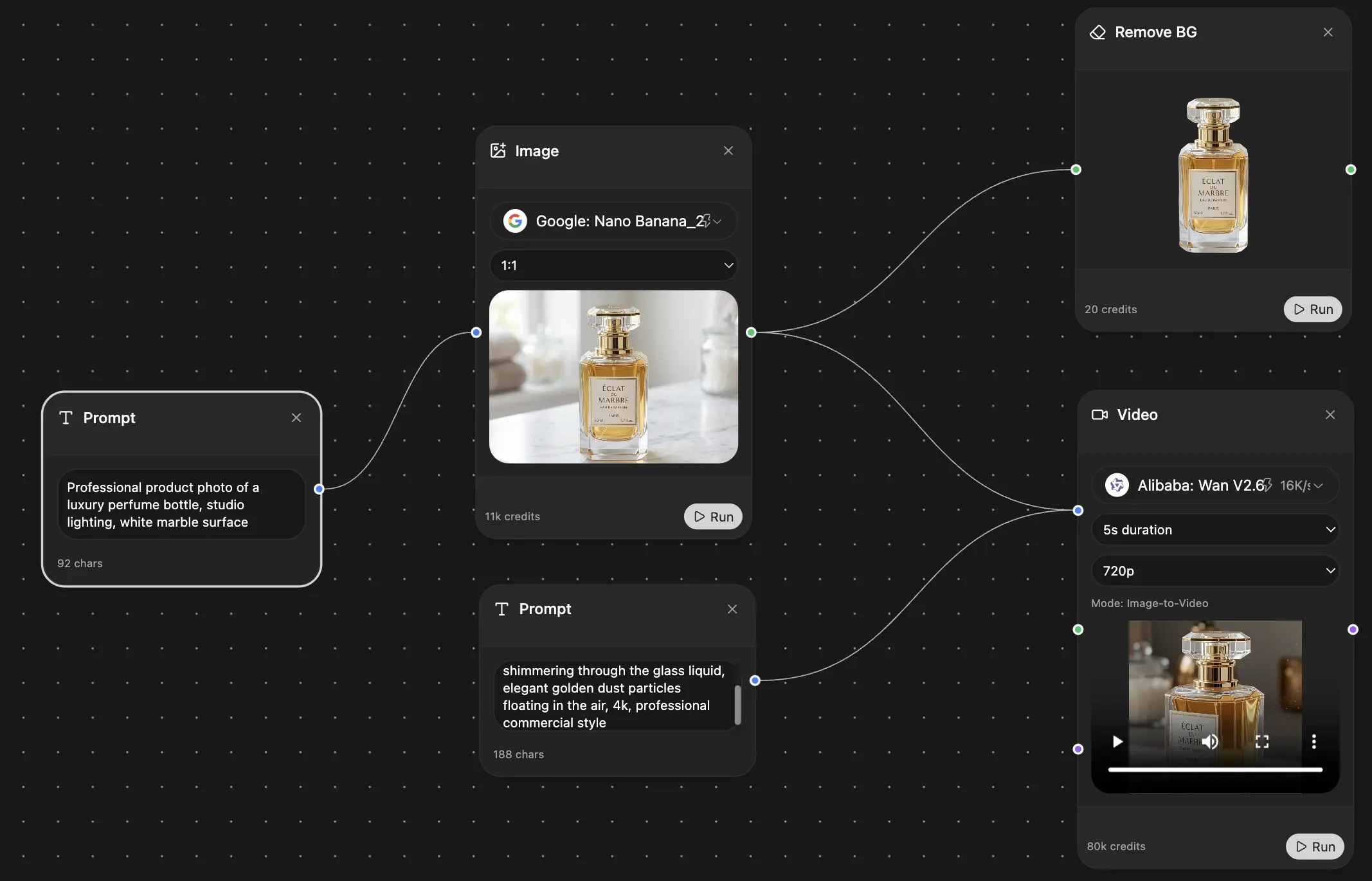
Chat, image, video & motion tools — side by side
Save hours of work and research
Transparent, High-Value Pricing
Trusted by teams at






Free
No credit card required
- 100 credits daily
- 3 AI models to try
- Basic AI chat
Plus
- 1,000,000 credits/month
- 25+ AI models — GPT, Claude, Gemini, Grok & more
- Agent Mode with web search, computer tools and more
- Creative Studio: image generation and video generation
- Project Library: chat with document, website and youtube, podcast generation, flashcards, reports and more
- Workflow Studio and FocusOS
Professional
- Everything in Plus, and:
- 2,100,000 credits/month
- Pro-exclusive models (Claude Opus, Grok 4, Sonar Pro)
- Motion Tools & Max Mode
- First access to latest features
- Access to additional offers
What Our Users Say
Great Tool after 2 months usage
simplyzubair
I love the way multiple tools they integrated in one platform. So far it is going in right dorection adding more tools.
Best in Kind!
barefootmedicine
This is another game-change. have used software that kind of offers similar features, but the quality of the data I'm getting back and the sheer speed of the responses is outstanding. I use this app ...
simply awesome
MarianZ
I just tried it - didnt wanna stay with it, because there is so much like that out there. But it convinced me, because: - the discord-channel is very response and fast - the number of models are quite...
A Surprisingly Comprehensive and Engaging Experience
bruno.battocletti
Zemith is not just another app; it's a surprisingly comprehensive platform that feels like a toolbox filled with unexpected delights. From the moment you launch it, you're greeted with a clean and int...
Great for Document Analysis
yerch82
Just works. Simple to use and great for working with documents and make summaries. Money well spend in my opinion.
Great AI site with lots of features and accessible llm's
sumore
what I find most useful in this site is the organization of the features. it's better that all the other site I have so far and even better than chatgpt themselves.
Excellent Tool
AlphaLeaf
Zemith claims to be an all-in-one platform, and after using it, I can confirm that it lives up to that claim. It not only has all the necessary functions, but the UI is also well-designed and very eas...
A well-rounded platform with solid LLMs, extra functionality
SlothMachine
Hey team Zemith! First off: I don't often write these reviews. I should do better, especially with tools that really put their heart and soul into their platform.
This is the best tool I've ever used. Updates are made almost daily, and the feedback process is very fast.
reu0691
This is the best AI tool I've used so far. Updates are made almost daily, and the feedback process is incredibly fast. Just looking at the changelogs, you can see how consistently the developers have ...