Office Productivity That Actually Works Without the Burnout
Boost office productivity with proven workflows, metrics and AI tricks that cut busywork and help you focus on real work.
You open your laptop on Monday morning with a clear plan. Then Slack starts blinking, three emails request “quick thoughts,” a calendar reminder announces a meeting you forgot existed, and your browser starts accumulating tabs like a squirrel storing acorns. By lunch, you've been busy all morning and can't point to much that moved forward.
That experience doesn't mean you lack discipline. It often means your workflow is carrying too much coordination debt, the hidden cost of searching for context, answering interruptions, repeating decisions, and moving work between disconnected tools. Traditional advice says to work harder, wake earlier, or squeeze more tasks into the day. None of that fixes a system that keeps pulling your attention apart.
Office productivity works better when you treat it as a design problem. You need to understand what productive work is, measure outcomes instead of activity, identify the interruptions draining your focus, and build workflows around the kind of work you do. A developer, writer, researcher, and manager shouldn't use the same productivity playbook.
You'll also see where AI helps and where it only creates the pleasant sensation of progress. Used carefully, an integrated workspace such as Zemith can help reduce drafting, searching, summarizing, and tool-switching friction. Used carelessly, AI merely gives your chaos a faster keyboard.
By the end, you'll be able to spot your biggest time drains, choose a useful metric for your role, and test one quick improvement today. If context switching is already eating your attention, this guide to the will help you recognize the pattern in your own work.
Introduction Why Office Productivity Feels Broken Right Now
The classic office productivity story is simple. More hours, more tasks, more output. That model works reasonably well when the work is repetitive and visible, but knowledge work behaves differently. A thoughtful product decision, a clean explanation, or a reliable piece of code may take less visible time than a full inbox, yet create far more value.
The problem is that offices still reward activity because activity is easy to see. A green status dot looks productive. A packed calendar looks important. A team member who responds instantly appears helpful, even when those responses prevent them from completing the work everyone is waiting for.
Busywork hides inside coordination
A project can stall without anyone being lazy. The brief lives in one document, feedback sits in email, the latest decision is buried in chat, and the person doing the work spends the afternoon reconstructing what happened. The core task might be straightforward. The surrounding information flow turns it into detective work.
That's why a better office productivity question isn't “How can we make people work faster?” It's “How can we help people spend more of their working time on valuable work?”
Practical rule: If a task repeatedly requires searching, clarifying, copying, or reformatting, improve the workflow before blaming the worker.
Try a quick audit today. Write down every interruption and every moment you search for information, wait for approval, or recreate something that already exists. You don't need fancy software. A note beside your keyboard is enough. Circle the two drains that appeared most often.
Those circles give you a starting point. Maybe your biggest problem is notification overload. Maybe it's unclear ownership. Maybe every decision requires a meeting because nobody trusts the shared documentation. The fix depends on the leak, but you can't repair a leak you haven't named.
What Office Productivity Really Means Beyond Busywork
A developer can spend an afternoon solving a difficult systems problem and produce only a few lines of code. A writer may read, question, and revise for hours before delivering one strong page. Their visible activity is limited, yet the work can create substantial value. Office productivity needs a better scoreboard than hours logged or tasks checked off.
Peter Drucker's 1999 framing of “knowledge-worker productivity” as the biggest management challenge of the era helped establish office productivity as a distinct economic problem rather than a slogan about efficiency. His idea remains useful because it directs attention toward the conditions that help people create value, not just the movements that make work look busy.

A busy kitchen offers the right comparison
During dinner service, a kitchen succeeds when ingredients are ready, orders are clear, stations are organized, and handoffs happen without confusion. Fast movement alone proves little. A cook who keeps searching for a missing ingredient may look active while the restaurant serves fewer meals.
Knowledge work follows the same pattern. Information flow, supervision quality, workplace design, team cohesion, psychological safety, and well-being influence whether effort becomes useful output. A writer needs a clear brief and accessible sources. A developer needs reliable requirements and uninterrupted build time. A researcher needs traceable evidence and room to test assumptions. A manager needs clear ownership, timely decisions, and early visibility into risks.
Coordination debt is the hidden queue created when those conditions are missing. People repeat questions, reconcile conflicting documents, wait for approval, or explain the same context across several tools. AI can reduce some of that debt by finding relevant information, summarizing decisions, and preparing first drafts, but only when the underlying sources and responsibilities are clear. Zemith can serve as a helpful sidekick in that workflow, while people still make the judgment calls.
Separate office work into four layers:
- Activity: Messages sent, meetings attended, documents opened, and tasks touched.
- Progress: Decisions made, risks removed, drafts improved, or problems narrowed.
- Output: The completed article, feature, analysis, or plan.
- Outcome: The business, customer, or team result created by that output.
A team may generate constant activity while progress barely moves. Another team may show modest activity and still deliver an excellent outcome. Productive workplaces examine the latter layers without forcing every contribution into a neat score.
The kitchen analogy also sets a practical boundary for personal effort. Unclear priorities and scattered context create bottlenecks that faster typing cannot fix. Improve the workflow, reduce coordination debt, and give each role the information and focus its work requires.
How to Measure Office Productivity Without Guessing
A packed calendar can hide a stalled project. Perceived productivity is how busy the day felt, while real productivity is what changed because of the work. A full inbox may create a satisfying sense of progress, yet the key decision, draft, or customer problem can remain untouched.
A 2021 APQC survey of 982 full-time knowledge workers found that the average worker spent 30 of 40 weekly hours on productive work. The remaining time included 3.6 hours managing internal communication, 2.8 hours looking for information, and 2.2 hours in unnecessary meetings. . Treat those figures as a prompt for investigation, not a universal scorecard. Your own workflow may lose time in different places.

Track the work behind the work
For one week, record three signals:
- Protected focus time: How much time went to work requiring sustained attention?
- Coordination load: How much time went to meetings, searching, status updates, clarification, and internal messages?
- Valuable completion: What meaningful deliverable, decision, or improvement existed that did not exist before?
Use the notes to inspect workflow conditions, not to rank colleagues. Two teams may work the same hours, while the team with a clear source of truth and faster decisions moves with less coordination debt. Zemith can help collect context and surface the information needed for the next decision, but people still judge quality and priority.
Choose one north-star metric per role. A developer might track completed, reviewed work that meets acceptance criteria. A writer might track approved pieces serving a defined audience need. A researcher could track decision-ready findings with traceable sources. A manager might track decisions unblocked and commitments delivered.
Avoid vanity metrics such as message volume or online presence. They measure visibility, not value. A heroic message count can still leave the project spinning like a loading icon.
Run a one-week self-audit
At the end of each day, answer three questions:
- What did I finish or materially improve?
- What interrupted the work?
- What information or decision would have made the task easier?
Repeated obstacles deserve attention before another personal productivity trick. A shared project brief, a dedicated focus block, or a decision log may reduce more coordination debt than faster typing. For a practical framework for evaluating choices with evidence rather than instinct, see .
The Biggest Office Productivity Killers Hiding in Plain Sight
A developer opens a ticket, a manager sends a “quick question,” and a meeting reminder appears before the first task is finished. None of these events seems expensive alone. Together, they create coordination debt, the extra time spent recovering context, clarifying ownership, and restarting work.
Microsoft's Work Trend Index reports that employees using Microsoft 365 are interrupted every 2 minutes during core work hours, adding up to 275 pings per day across meetings, email, and chats. .

Fragmentation makes simple work expensive
A workplace multitasking study found that the median duration of online focus in information work was 40 seconds, while workplace activities shifted every 3 minutes on average. .
The point is not that every employee loses focus on a fixed schedule. Digital work keeps changing shape: open a report, check a message, answer a question, return to the report, search for a file, and wonder why the paragraph remains unfinished. The task has not become harder, yet its surrounding coordination has.
The interruption is short. The restart is the expensive part.
The University of California, Berkeley cites research showing that people spent an average of 12 minutes 40 seconds on a task before interruption and needed 25 minutes 26 seconds to return to the same task. For difficult work, regaining intense concentration could take another 15 minutes. .
Email creates a similar restart cost. Research found that reading and managing incoming email took an average of 64 seconds to resume work afterward, potentially creating about 96 micro-interruptions in an eight-hour day and roughly an hour and a half of unproductive time. .
Make the first repair small
Turn off nonessential notifications during a protected work block. Batch routine communication, and replace a status meeting with an async update when no live decision is needed. If planning feels difficult because your mind is already crowded, this guide to offers a useful starting point.
AI can reduce repetitive coordination, especially for routine email, but a draft still needs human judgment. Review every message before sending, and explore a practical for that kind of task.
Name your top two killers before choosing a fix. If the answer is “constant pings” and “unclear requests,” a timer will not solve the core problem. Set communication boundaries, improve intake, and let Zemith help gather context when the next decision needs it. Willpower can support the repair, but it should not have to carry the whole office.
Role Specific Workflows That Make Productivity Click
A developer, writer, researcher, and manager can sit in the same office yet lose time for completely different reasons. Developers need uninterrupted reasoning. Writers need orderly sources and controlled revisions. Researchers need synthesis that preserves provenance. Managers need visibility without turning every update into another meeting.
Productivity improves when each role gets a workflow matched to its coordination debt, the hidden work created by unclear requests, scattered context, and repeated status checks. Zemith can serve as a sidekick for gathering context, preparing drafts, and keeping decisions attached to the work. The aim is fewer avoidable handoffs, not heroic concentration.
For developers
A fragmented developer workflow may begin with a ticket, jump to an old chat, move into the codebase, pause for a review comment, and return to discover that the requirement was unclear. Each interruption is like closing a map halfway through a route. The developer must spend time rebuilding the mental model before making a reliable change.
Try a tighter sequence:
- Clarify first: Write acceptance criteria and unresolved questions before opening the editor.
- Protect the build block: Keep chat closed while implementing or debugging.
- Use AI for acceleration: Ask a coding assistant to generate a small snippet, explain unfamiliar code, or suggest debugging paths. Test and review every result yourself.
- Batch review: Handle pull requests during a defined window instead of treating each notification as an emergency.
The goal is dependable reasoning, not faster typing.
For writers
Writers often open a blank document while too many research tabs compete for attention. Separate the work into stages: collect sources, build an outline, draft without polishing, then edit for clarity and evidence.
Create a short source brief for each article. Record the claim, supporting material, audience need, and open question. That brief acts like a trail of breadcrumbs, so research does not become an endless search for one more useful tab. Zemith can help turn organized notes into a starting draft, while the writer remains responsible for accuracy, voice, and judgment.
For researchers
Researchers need traceability from source to conclusion. Store related files together, summarize each document in plain language, and distinguish clearly between what the source says and what you infer.
A practical rhythm is source review first, synthesis second, and decision notes last. Ask AI to compare themes, identify contradictions, and point back to relevant passages. Do not ask it to produce a confident conclusion from a pile of unmarked documents. Provenance is the handrail that keeps speed from becoming guesswork.
For managers
Managers can reduce coordination debt by replacing recurring status questions with a shared update format. Ask each person to report progress, next action, risk, and decision needed. Read the updates before scheduling a meeting, and reserve live time for choices, blockers, or sensitive discussion.
A manager's productivity is visible in the team's clarity. People should understand priorities, make appropriate decisions, and know when to escalate. That quieter form of influence scales better than acting as the office help desk.
How Integrated AI Workspaces Supercharge Daily Office Work
AI helps most when it removes a specific bottleneck. Drafting a first version, finding a detail in a long report, comparing documents, or explaining unfamiliar code can all consume attention without representing the most valuable part of the job.
An integrated workspace reduces the switching required to perform those steps. Instead of copying context between a chatbot, document tool, research app, image generator, and code assistant, you can keep related work together. That matters because every handoff creates another chance to lose the instruction, source, file, or decision that gives the task meaning.
A 2024 MIT working paper found that consultants using AI completed 12.2% more tasks on average, finished tasks 25.1% faster, and produced results more than 40% higher in quality than a control group. . The lesson isn't that AI automatically makes everyone productive. It shows that the right assistance can reduce cognitive overhead while leaving humans responsible for judgment.
Put AI beside the work
For a writer, Zemith's Smart Notepad can turn bullet points into a polished draft, rephrase awkward passages, and adjust style without forcing a trip to another application. For a researcher, the Document Assistant can summarize a report, generate questions, and create quizzes that reveal whether the key ideas stuck.
A developer can use the Coding Assistant to generate snippets, explain code, create live previews for React components and HTML, and support debugging. Library and Projects can keep documents, chats, and related context organized around a topic instead of scattering the project across browser tabs.
If you regularly receive long reports, a guide to choosing the can help you compare approaches before building summarization into your routine. The important question is always the same: does the tool help you reach a decision or deliverable, or does it merely produce another summary to read?
Subscription fatigue is real. Nobody wants a separate monthly bill for every task they perform before breakfast. An all-in-one workspace can make the workflow simpler, but only when the team defines where it fits, what information it can use, and how people verify its output.
For more practical examples, explore this guide to an .
Your Roadmap to More Productive Weeks Starting Tomorrow
Don't rebuild your entire work life on a Tuesday afternoon. Start with one visible leak and make the repair easy to repeat.

In the next 24 hours
Choose tomorrow's most important deliverable before you finish today. Reserve one protected focus block, silence nonessential notifications during it, and write down the information you'll need before starting. At the end of the block, record what moved and what interrupted you.
Over the next 30 days
Add one repeatable habit at a time. Create a shared project brief, batch email, use async updates for routine status, or keep research sources in one organized workspace. Review the habit weekly and remove anything that creates more administration than value.
AI adoption also needs management, not just access. EY found that companies could miss up to 40% of potential AI productivity gains when talent strategy is weak. Another EY survey found that 92% of workers at organizations with clear AI-agent communication said team productivity improved, compared with much lower levels where communication was unclear. .
That means teams should explain approved uses, verification expectations, privacy boundaries, and the kinds of work AI should not handle. Track early signals such as fewer repeated questions, faster document review, clearer handoffs, and stronger output quality. Retrospectives should ask what helped people finish meaningful work, not who appeared online the longest.
Use these as experiments, not commandments. Tonight, write tomorrow's top task, choose one focus block, prepare the required context, and decide how you'll know the work mattered.
Zemith brings document assistance, Smart Notepad drafting, research support, coding help, creative tools, and organized project context into one AI workspace, so you can spend less time switching tools and more time completing meaningful office work. Visit and try shaping tomorrow's workflow around one clear deliverable.
Explore Zemith Features
Everything you need. Nothing you don't.
One subscription replaces five. Every top AI model, every creative tool, and every productivity feature, in one focused workspace.
Every top AI. One subscription.
ChatGPT, Claude, Gemini, DeepSeek, Grok & 25+ more







Always on, real-time AI.
Voice + screen share · instant answers
What's the best way to learn a new language?
Immersion and spaced repetition work best. Try consuming media in your target language daily.
Voice + screen share · AI answers in real time
Image Generation
Flux, Nano Banana, Ideogram, Recraft + more

Write at the speed of thought.
AI autocomplete, rewrite & expand on command
Any document. Any format.
PDF, URL, or YouTube → chat, quiz, podcast & more
Video Creation
Veo, Kling, Grok Imagine and more

Text to Speech
Natural AI voices, 30+ languages
Code Generation
Write, debug & explain code
Chat with Documents
Upload PDFs, analyze content
Your AI, in your pocket.
Full access on iOS & Android · synced everywhere
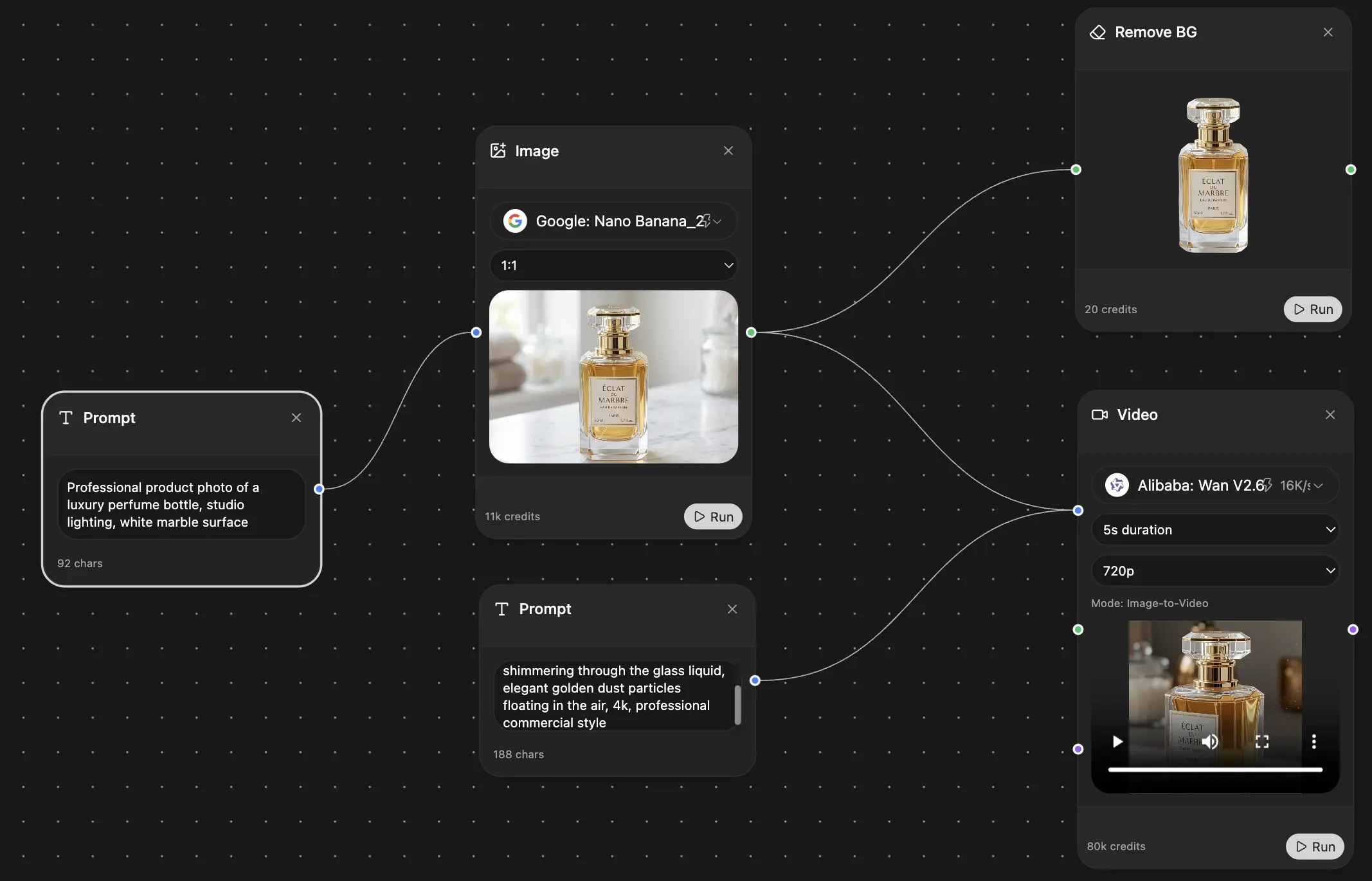
Your infinite AI canvas.
Chat, image, video & motion tools — side by side
Save hours of work and research
Transparent, High-Value Pricing
Trusted by teams at






Free
No credit card required
- 100 credits daily
- 3 AI models to try
- Basic AI chat
Plus
- 1,000,000 credits/month
- 25+ AI models — GPT, Claude, Gemini, Grok & more
- Agent Mode with web search, computer tools and more
- Creative Studio: image generation and video generation
- Project Library: chat with document, website and youtube, podcast generation, flashcards, reports and more
- Workflow Studio and FocusOS
Professional
- Everything in Plus, and:
- 2,100,000 credits/month
- Pro-exclusive models (Claude Opus, Grok 4, Sonar Pro)
- Motion Tools & Max Mode
- First access to latest features
- Access to additional offers
What Our Users Say
Great Tool after 2 months usage
simplyzubair
I love the way multiple tools they integrated in one platform. So far it is going in right dorection adding more tools.
Best in Kind!
barefootmedicine
This is another game-change. have used software that kind of offers similar features, but the quality of the data I'm getting back and the sheer speed of the responses is outstanding. I use this app ...
simply awesome
MarianZ
I just tried it - didnt wanna stay with it, because there is so much like that out there. But it convinced me, because: - the discord-channel is very response and fast - the number of models are quite...
A Surprisingly Comprehensive and Engaging Experience
bruno.battocletti
Zemith is not just another app; it's a surprisingly comprehensive platform that feels like a toolbox filled with unexpected delights. From the moment you launch it, you're greeted with a clean and int...
Great for Document Analysis
yerch82
Just works. Simple to use and great for working with documents and make summaries. Money well spend in my opinion.
Great AI site with lots of features and accessible llm's
sumore
what I find most useful in this site is the organization of the features. it's better that all the other site I have so far and even better than chatgpt themselves.
Excellent Tool
AlphaLeaf
Zemith claims to be an all-in-one platform, and after using it, I can confirm that it lives up to that claim. It not only has all the necessary functions, but the UI is also well-designed and very eas...
A well-rounded platform with solid LLMs, extra functionality
SlothMachine
Hey team Zemith! First off: I don't often write these reviews. I should do better, especially with tools that really put their heart and soul into their platform.
This is the best tool I've ever used. Updates are made almost daily, and the feedback process is very fast.
reu0691
This is the best AI tool I've used so far. Updates are made almost daily, and the feedback process is incredibly fast. Just looking at the changelogs, you can see how consistently the developers have ...