Multimodal AI Agent: Architectures, Apps & Build Guide
Explore multimodal AI agents: architectures, real-world applications, and how to build them faster with Zemith. Your complete 2026 guide.
Your browser probably has the usual AI survival kit open right now. One tab for a chatbot. One for a PDF reader. One for image analysis. One for voice notes. One for code help. Then a sad little spreadsheet tab sitting in the corner, wondering when you'll come back.
That mess is exactly why people keep searching for a practical guide to the multimodal AI agent. Not because the term sounds futuristic, but because juggling tools is annoying, slow, and weirdly expensive in attention. If an AI can read your docs, look at your screenshots, listen to your audio, and help you act on all of it in one flow, work stops feeling like app-speed dating.
The good news is this shift is already here. The category grew fast enough to stop being a niche curiosity and start being infrastructure. The multimodal AI market reached $14.3 billion in 2025, up from $3.7 billion in 2024, and organizations using multimodal AI report 42% faster issue resolution with an average 287% Year 1 ROI according to .
That's the big picture. The useful question is simpler. What can you do with this stuff today, and how do you avoid turning your workflow into a science fair project with too many cables?
So Your AI Can Read but Can It See
A text-only AI is like a very smart friend who refuses to look up from their notebook. You describe the bug in your app, paste a support ticket, summarize the chart from a PDF, and explain what the voice memo said. It helps, sure. But you're still doing the messy translation work.
A multimodal AI agent changes that dynamic. You can drop in the screenshot, the error log, the product brief, and the meeting audio, then ask one system to understand the whole situation. Less “let me retype what's on page 17,” more “here, look at this and help.”
The tab chaos problem
A common workday looks like this:
A developer has a broken UI screenshot in one window, code in another, and a chatbot in a third.
A marketer has product photos, rough copy, and a call transcript scattered across tools.
A researcher has a long PDF open, plus notes, plus a chart they need explained in plain English.
None of those tasks are purely text problems. They're context problems.
You don't need an AI that's only good at answering prompts. You need one that can understand the same messy bundle of inputs you're looking at.
That's why visual understanding matters so much in everyday work. If you want a solid grounding in how machines interpret images before layering in agents, this walkthrough on is worth a read.
Why this matters in practice
When people hear “multimodal,” they often think shiny demo. Talking avatar. Fancy camera trick. A robot that probably wants your job and maybe your lunch.
In reality, the first win is boring in the best way. You stop context-switching so much. The agent becomes a single place to ask questions across formats. That means fewer copy-paste loops, fewer lost details, and fewer moments where you mutter, “I know I saw that somewhere.”
That's the true promise here. Not sci-fi theater. Practical relief.
What Makes an AI Agent Multimodal Anyway
Think of a regular text model as a chef who can only taste. Useful skill. Limited kitchen. A multimodal system is the chef who can taste, see the ingredients, smell what's burning, and hear the pan screaming for mercy.
That richer input changes the quality of the output.

By April 2026, every major frontier model, including GPT-5.4, Claude Opus 4.6, and Gemini 2.5, natively handles text, images, and audio, and Claude Opus 4.5 reached 80.7% on MMMU, a benchmark for expert-level multimodal understanding, as summarized in .
Perception is the input layer
Perception is how the agent takes in the world. Text. Images. Audio. Sometimes video.
If you upload a product photo and ask for ad copy, the visual side identifies what's in the image. If you attach a voice note, the audio side handles speech. If you add a written brief, the language side pulls out intent, constraints, and tone.
A text-only model sees one slice. A multimodal one sees the whole sandwich.
Reasoning is where the pieces meet
Many people get confused, because “multimodal” doesn't just mean “can accept multiple file types.” A real multimodal AI agent connects those inputs into one understanding.
If a customer says “the page is broken,” uploads a screenshot, and mentions a mobile device in a voice message, the agent shouldn't treat those as three separate mini-problems. It should combine them into one conclusion.
That's where semantic interpretation matters. If you want a cleaner mental model for how machines extract meaning from language before mixing it with visuals and audio, this explainer on fills in that gap nicely.
Practical rule: If a tool can accept image, audio, and text inputs but can't reason across them in one answer, it's a multimodal interface, not a strong multimodal agent.
Action is what makes it an agent
A model can understand inputs and still just sit there like a very educated houseplant. An agent goes one step further. It does something useful with that understanding.
That action might be:
Writing code after inspecting a UI screenshot
Drafting a summary after reading a long report and chart
Generating content from product images and notes
Responding in voice during live assistance flows
For voice-heavy experiences, design details matter more than many expect. If you're thinking through conversation flow and user trust, are a valuable companion read.
The simplest test is this. Can the system perceive, reason, and act in one flow without making you play interpreter between tools? If yes, you're getting close to a fully capable agent.
How Agents Fuse Senses Without Getting Confused
The hard part isn't collecting text, images, and audio. The hard part is combining them without turning meaning into soup.
A meme is the easiest example. Read only the caption and you miss the joke. See only the image and you miss the setup. The meaning lives in the combination.
That same problem shows up in every serious multimodal workflow.

Early fusion
Early fusion mixes inputs near the start. Think smoothie. Fruit, yogurt, ice, protein powder. Into the blender they go.
In AI terms, this means the system combines low-level signals early, which can help the model spot relationships fast. Useful when different inputs are tightly connected, like spoken commentary over a screen recording.
The tradeoff is messiness. If one input is noisy, it can pollute the whole mix.
Late fusion
Late fusion keeps each modality separate longer. Think burger and fries on the same plate. Still one meal, different cooking paths.
The system processes text, images, or audio independently, then merges the conclusions later. This can be easier to manage and sometimes more reliable, especially when inputs vary in quality.
The downside is that some cross-modal clues arrive too late. You may get a tidy answer that misses the deeper connection between modalities.
Hybrid fusion
Hybrid fusion is the practical winner for many real tasks. Some signals combine early, some later, and the model keeps updating its understanding as more context appears.
That matters a lot for live interactions. Native omnimodal APIs that process voice, text, and visual inputs in a single turn reduce latency overhead to 50 to 100ms, which makes them faster than stacked sequential pipelines, according to this architecture note on multimodal pipelines.
For anything real-time, a slow handoff between separate tools feels broken even when the answer is technically correct.
Why builders should care
Fusion sounds academic until you have to ship something. Then it becomes painfully practical.
Here's the rule of thumb:
If you're designing these systems, the plumbing matters as much as the model. In this context, good can save you from building a brittle Rube Goldberg machine with a chatbot glued to a vision API.
The funny part is that users never ask which fusion strategy you chose. They just notice when the AI misunderstands the screenshot, talks over the audio cue, or responds a beat too late. That's fusion quality showing up as user experience.
Multimodal AI Agents in the Wild
The theory gets interesting only when it saves somebody a nasty afternoon.

The developer with a broken interface
A frontend developer gets a screenshot from QA. The navbar overlaps the hero section on mobile, but only on one state, and the bug report says the issue appears “after opening the menu twice.” Classic. Annoying enough to ruin coffee.
A multimodal AI agent can inspect the screenshot, read the bug notes, compare the visible layout issue against the provided component code, and propose a fix in one pass. That's why this category matters so much for engineering workflows. On SWE-bench Verified, AI agent performance rose from approximately 60% in 2024 to nearly 100% in 2025, according to .
That doesn't mean you should merge whatever the model writes while whistling casually into production. It means the assistant can now handle a much larger chunk of the debugging grind.
The creator with too many assets
A content creator has a product photo, a few feature bullets, and a rough audio note recorded while walking to lunch. Instead of opening a writing tool, an image tool, and a separate transcription app, they use one agent workflow.
A practical example is video production, where creators often work with mixed inputs: scripts, reference videos, footage, images, production notes, and brand documents. Tools like are designed to understand these different formats together, allowing creators to maintain project context instead of translating every idea into a separate prompt.
For filmmakers and creative teams, this means references, character decisions, visual rules, and production notes can continue guiding future generations throughout the project.
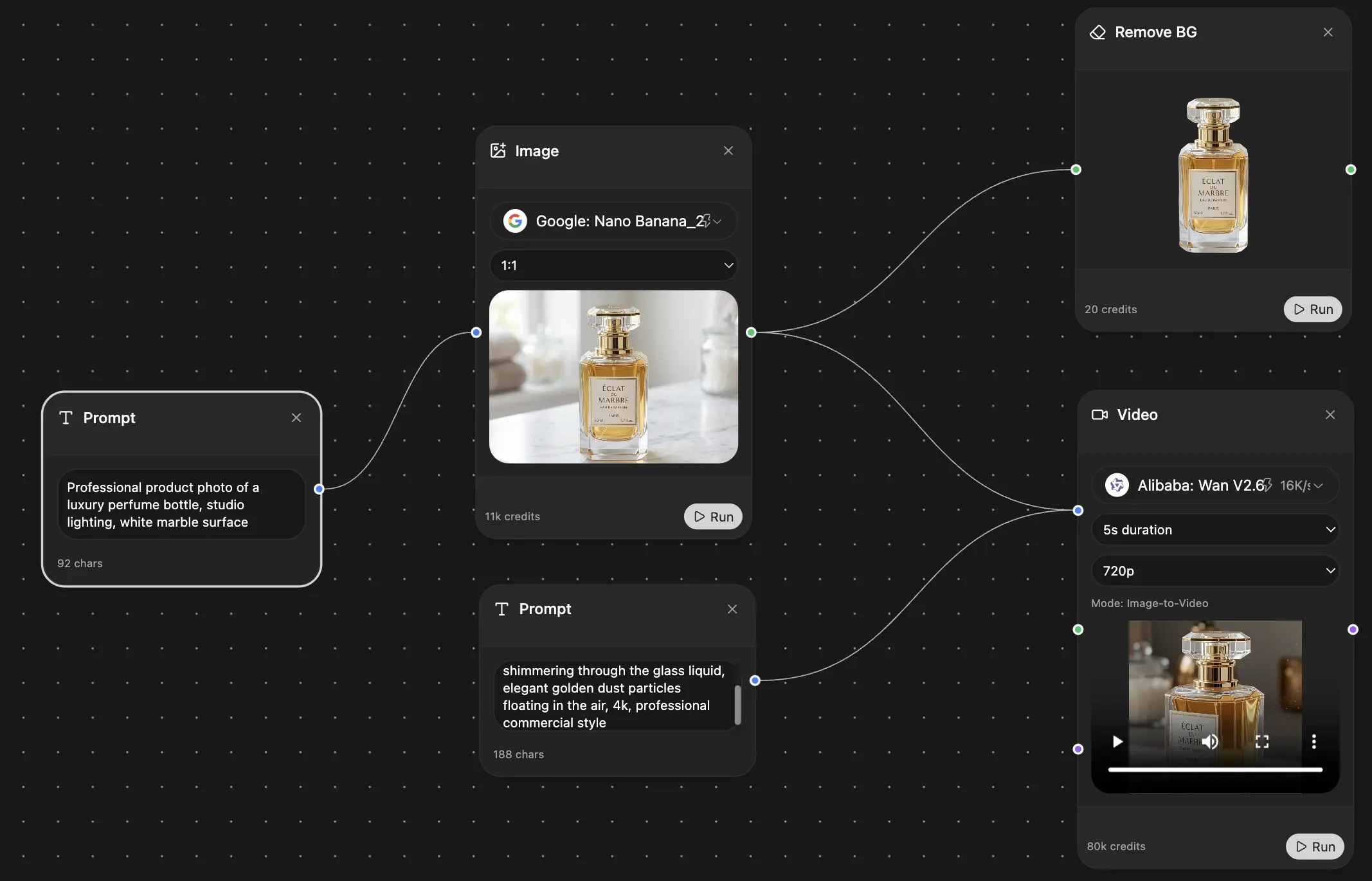
Here's a quick look at how these cross-format workflows feel in practice:
The researcher buried in PDFs
A researcher drops in a long paper and asks, “Explain the chart halfway through in plain English. Then tell me whether the conclusion follows from the figure.”
That's a very human request. It mixes document parsing, visual interpretation, summarization, and reasoning. A plain chatbot often stumbles because it wants the chart described to it first. A multimodal agent can inspect the chart directly and answer in context.
The best use cases aren't flashy. They're the ones where you stop manually translating files into prompts.
Three practical patterns worth stealing
Debug from evidence: Start with screenshots, logs, and code together instead of pasting text summaries.
Create from raw materials: Feed images, notes, and voice memos into one content workflow.
Ask questions across formats: Don't summarize the PDF for the AI. Let the system inspect the source.
That's the “so what.” A multimodal AI agent is useful because work itself is multimodal.
The Good The Bad and The Benchmark
Hype makes every new model sound like a genius intern who never sleeps. Benchmarks are where the mood gets more honest.
A strong multimodal AI agent can be excellent at narrow tasks and still struggle when a problem gets messy, social, or open-ended. That matters because many real workflows aren't just “what's in this image?” They're more like “look at this, read that, infer intent, track context, and decide the next move.”
Where the cracks show
In the COMMA benchmark, GPT-4o scored 41.74%, while the human solver scored 69.01%, as shown in . That gap is the useful reality check.
The best systems can outperform peers and still fall well short of expert humans on complex communicative tasks. So if your workflow involves ambiguity, multi-step judgment, or high stakes decisions, full autonomy is still a bad bet.
That's not disappointing. It's clarifying.
What to evaluate besides “it answered”
Here's a smarter way to judge tools:
Resilience: Does it handle noisy screenshots, awkward phrasing, and incomplete context?
Speed: Does the answer arrive fast enough to fit the workflow?
Grounding: Can you trace the response back to the actual document, image, or transcript?
Recovery: If it misunderstands one modality, can you steer it back without starting over?
If you're comparing model families for image-heavy work, this creator-focused guide on is a good example of the kind of nuance people miss when they only look at marketing pages.
Use benchmarks as a filter, not a religion
Benchmarks help you narrow options. They don't choose your workflow for you.
A simple comparison framework helps:
For readers sorting through that model-selection mess, this is useful because it focuses on choosing for the job, not choosing a winner in the abstract.
The punchline is simple. Multimodal systems are powerful. They are not magical. Treat them like talented coworkers who still need review on difficult assignments.
Building Your First Multimodal Agent The Smart Way
There are two ways to build your first multimodal workflow.
The first is the hero route. You stitch together separate APIs for text, speech, image analysis, storage, orchestration, file handling, and memory. Then you spend your week debugging serialization issues and wondering why your “simple prototype” now resembles a plate of spaghetti that learned YAML.
The second is the sane route. Use an integrated platform and spend your time on the workflow itself.

The hard way creates hidden work
From-scratch builds look flexible at first. Then the hidden list appears:
Model juggling: One provider for vision, another for text, maybe a third for speech.
Context wrangling: You have to decide what gets passed from one step to the next.
File plumbing: Images, PDFs, audio, extracted text, and metadata all need clean handoffs.
State management: Long-running tasks need memory, rollback logic, and a way to resume.
That last one bites teams constantly. Surveys show that 80% of deployed multimodal agent systems fail to maintain coherent state or rollback mechanisms over extended task chains, based on this research summary on memory and intent preservation.
The smart way starts with workflow design
A better build path is boring on purpose. Start with one narrow job and one clear success condition.
For example:
Input bundle: A screenshot, a bug description, and a code file.
Reasoning step: Ask the agent to identify the likely UI issue and explain its confidence.
Action step: Generate a patch, then summarize the change in plain English.
Review loop: Let a human approve or edit before shipping.
That's already enough to test whether your multimodal AI agent is helping or just producing polished guesses.
“Build the smallest workflow that saves real time, then add complexity only when it earns its keep.”
What beginners should optimize for
Don't optimize for maximum autonomy on day one. Optimize for reliability and reduced friction.
A practical checklist:
Choose one repeated pain point: debugging, document analysis, content repurposing, or research synthesis
Keep a human in the loop: especially for code, claims, and customer-facing output
Store context cleanly: files, prior prompts, decisions, and approved outputs should persist
Use tools that reduce setup tax: fewer moving parts means fewer weird failures
If you want a lower-friction path before touching code, this guide to using a is a smart place to start.
The big win isn't “I built an autonomous agent.” The big win is “I stopped rebuilding context every single time I needed help.”
Conclusion The Future Is See and Do
The useful shift isn't that AI got better at chatting. It's that AI can now work with the same kinds of inputs you do. Text. Images. Audio. Documents. Screens. Mixed together, as they usually are in real jobs.
That's why the multimodal AI agent matters. It fits the shape of actual work better than single-purpose tools do. Developers can debug from screenshots and code together. Creators can turn raw assets into finished drafts faster. Researchers can question documents and visuals directly instead of translating everything into text first.
The caveat matters too. Benchmarks show real progress, but they also show real limits. The strongest systems still need review on difficult tasks. That's not a flaw in the idea. It's the right operating model for now. Use agents as force multipliers, not as unsupervised authority.
There's also a larger signal here. Capital keeps flowing toward tools that collapse fragmented workflows into one place. If you follow the business side of the category, offer a useful look at where attention and funding are concentrating.
The practical takeaway is simple. Stop asking whether multimodal AI is real. Ask which of your daily tasks are still broken because your tools can't see, hear, and reason together. That's where the immediate gains live.
If you're tired of juggling separate tools for chat, documents, images, coding, and research, try . It gives you one workspace for multimodal AI workflows, so you can spend less time switching tabs and more time finishing things.
Explore Zemith Features
Everything you need. Nothing you don't.
One subscription replaces five. Every top AI model, every creative tool, and every productivity feature, in one focused workspace.
Every top AI. One subscription.
ChatGPT, Claude, Gemini, DeepSeek, Grok & 25+ more







Always on, real-time AI.
Voice + screen share · instant answers
What's the best way to learn a new language?
Immersion and spaced repetition work best. Try consuming media in your target language daily.
Voice + screen share · AI answers in real time
Image Generation
Flux, Nano Banana, Ideogram, Recraft + more

Write at the speed of thought.
AI autocomplete, rewrite & expand on command
Any document. Any format.
PDF, URL, or YouTube → chat, quiz, podcast & more
Video Creation
Veo, Kling, Grok Imagine and more

Text to Speech
Natural AI voices, 30+ languages
Code Generation
Write, debug & explain code
Chat with Documents
Upload PDFs, analyze content
Your AI, in your pocket.
Full access on iOS & Android · synced everywhere
Your infinite AI canvas.
Chat, image, video & motion tools — side by side
Save hours of work and research
Transparent, High-Value Pricing
Trusted by teams at






Free
No credit card required
- 100 credits daily
- 3 AI models to try
- Basic AI chat
Plus
- 1,000,000 credits/month
- 25+ AI models — GPT, Claude, Gemini, Grok & more
- Agent Mode with web search, computer tools and more
- Creative Studio: image generation and video generation
- Project Library: chat with document, website and youtube, podcast generation, flashcards, reports and more
- Workflow Studio and FocusOS
Professional
- Everything in Plus, and:
- 2,100,000 credits/month
- Pro-exclusive models (Claude Opus, Grok 4, Sonar Pro)
- Motion Tools & Max Mode
- First access to latest features
- Access to additional offers
What Our Users Say
Great Tool after 2 months usage
simplyzubair
I love the way multiple tools they integrated in one platform. So far it is going in right dorection adding more tools.
Best in Kind!
barefootmedicine
This is another game-change. have used software that kind of offers similar features, but the quality of the data I'm getting back and the sheer speed of the responses is outstanding. I use this app ...
simply awesome
MarianZ
I just tried it - didnt wanna stay with it, because there is so much like that out there. But it convinced me, because: - the discord-channel is very response and fast - the number of models are quite...
A Surprisingly Comprehensive and Engaging Experience
bruno.battocletti
Zemith is not just another app; it's a surprisingly comprehensive platform that feels like a toolbox filled with unexpected delights. From the moment you launch it, you're greeted with a clean and int...
Great for Document Analysis
yerch82
Just works. Simple to use and great for working with documents and make summaries. Money well spend in my opinion.
Great AI site with lots of features and accessible llm's
sumore
what I find most useful in this site is the organization of the features. it's better that all the other site I have so far and even better than chatgpt themselves.
Excellent Tool
AlphaLeaf
Zemith claims to be an all-in-one platform, and after using it, I can confirm that it lives up to that claim. It not only has all the necessary functions, but the UI is also well-designed and very eas...
A well-rounded platform with solid LLMs, extra functionality
SlothMachine
Hey team Zemith! First off: I don't often write these reviews. I should do better, especially with tools that really put their heart and soul into their platform.
This is the best tool I've ever used. Updates are made almost daily, and the feedback process is very fast.
reu0691
This is the best AI tool I've used so far. Updates are made almost daily, and the feedback process is incredibly fast. Just looking at the changelogs, you can see how consistently the developers have ...