How to Write Clearly: Actionable Techniques for 2026
Learn how to write clearly with actionable techniques and before-and-after examples. A step-by-step workflow for better writing.
Most advice about how to write clearly starts in the wrong place. It tells you to cut words, shorten sentences, and “keep it simple,” as if clarity were just a diet plan for nouns. That's how people end up with writing that's technically shorter and emotionally empty, or worse, so stripped down that readers have no idea what matters.
Clear writing is really about reader control. The UK Government Analysis Function says writers should use plain language, put statistics into context, and present the main messages clearly and concisely, while the UNC Writing Center warns that numbers need context, reliable sourcing, and careful interpretation (). In practice, that means you're not trying to sound “simple.” You're trying to make the reader's next step obvious, whether that's understanding a policy memo, approving a draft, or not rage-clicking away from your paragraph halfway through.

A useful way to think about it is this. Clarity is not the same as simplicity. Public-sector and academic guidance consistently pushes writers to define terms, use concrete language, and test text with unfamiliar readers, but the trade-off is real, because over-simplifying can distort meaning for expert, mixed, or multilingual audiences. If you've ever read a “plain English” document that felt like it had been airbrushed into oblivion, you already know the problem.
Practical rule: make the reader's job easier, not your prose flatter.
That's the standard I use when I'm editing anything from a policy note to a product brief. The question isn't “How do I remove complexity?” It's “What does this reader need to understand, trust, and do next?” If you want a useful starting point for idea generation before drafting, the internal guide on is a good companion to the clarity mindset, because a messy idea stage usually becomes a messy first draft.
The Clarity Myth Nobody Talks About
The myth is comforting, which is why it hangs around. People like to believe that if they strip away enough detail, the writing will become clear by default. In real documents, that often does the opposite, because the reader loses the logic, the stakes, and the boundaries of the claim.
Context beats simplification
The better guidance from plain-language and statistics-writing sources does not ask writers to say less and hope for the best. Purdue OWL advises writers to give enough quantitative detail for readers to interpret the data, identify where a statistic came from, and understand the population it applies to, while UCLA's statistical writing guidance emphasizes a cohesive, concise story and the UNC Writing Center points readers back to margin of error, confidence intervals, and whether a reported change is a real change (). That is not minimalism. It is disciplined clarity.
The same logic applies outside data writing. If a reader needs to approve a proposal, the right level of detail lets them judge risk. If they need to execute a task, the right level of detail prevents guesswork. If they need to compare options, the right level of detail makes the trade-offs visible instead of hiding them under a tidy summary.
Precision is part of clarity
MIT's teaching note is blunt about this. Each unit of discourse should make a single point, subjects should be followed by verbs as soon as possible, and writers should put context before new material so readers can process information in the expected order (). That shifts the argument away from short versus long and toward organized versus chaotic.
A clear sentence can still be fairly detailed. A muddy sentence can be short enough to fit on a sticky note and still leave the reader lost. The job is to choose the amount of information that helps the reader make sense of the thing in front of them, not the amount that makes the writer feel neat and tidy. Writing like a robot is not the goal, even if some drafts sound like they were assembled by a very polite vending machine.
A practical test helps here. Before you draft, sketch the core idea in a few rough lines, then compare that sketch with a working if you need to hear how the information unfolds in order. The point is not to script everything. The point is to see whether the structure gives the reader enough context to follow the reasoning without being dragged through unnecessary explanation.
For brainstorming before drafting, the process gets easier if you use a simple prompt list instead of waiting for a clean first sentence. A short guide like fits that stage well because it helps you gather material before you start deciding what the reader needs. That separation matters. Ideas can be messy. The draft should not be.
Plan Your Writing Before You Start Drafting
Clear writing usually fails before the first sentence lands. The problem is often a fuzzy audience, an unclear purpose, or a document that tries to serve three readers at once. Once that happens, the draft starts carrying work it was never set up to do.
Map the reader first
Start with three questions.
- Who is reading this? A client, a manager, a regulator, a teammate, or someone outside your field.
- What do they already know? Enough to follow shorthand, or enough detail to need definitions.
- What should they do after reading? Decide, approve, share, fix, or understand.
That small map changes the draft before you write it. A technical audience can handle precise terminology if the terms are defined well. A mixed audience needs the path marked out more carefully. A reader under pressure, especially in an email or operating note, needs the point up front because nobody has time to sift through throat-clearing.
Write the document's end state in one sentence before you draft. If that sentence is hard to write, the document probably is not ready yet. I have seen more weak documents come from unclear purpose than from bad grammar, and grammar gets blamed too often because it is easier to spot than intent.
Choose the right amount of detail
Different documents need different levels of detail. A podcast script needs a different balance of precision and flow than a compliance memo, and an helps you think through structure without flattening the voice. Flexwork Podcast Studios has a useful framework that shows how format changes what clarity looks like in practice.
If you are planning a draft now, use this quick exercise.
- Write the reader's role.
- Write the action you want.
- Write the one thing they must understand.
- Write the detail you are tempted to add, then ask whether it helps the reader act.
If a detail does not help the reader decide, it is decoration.
Brainstorming helps before drafting, but only if you separate gathering from judging. A guide on fits that stage well because it helps you collect material before you decide what the reader needs. That separation matters. Ideas can be messy. The draft should not be.

Sentence and Paragraph Techniques That Deliver
Clarity at the sentence level is mostly about sequence. Readers want the point first, then the support, then the texture. If you bury the point under three clauses, a parenthetical aside, and a hedge that sounds unsure of itself, the reader starts working too hard.
Put the main point early
A sentence gets clearer when the subject and verb arrive quickly. Put context before new material, and keep each unit of thought to one point. That keeps the reader from guessing where the sentence is going. They can follow the line instead of reconstructing it.
Before: “Because the committee, after reviewing the late submissions that arrived during the final week of the period, decided that the report would need further revision before approval, the final version was delayed.”
After: “The committee delayed approval because the report still needed revision.”
The second version is not just shorter. It gives the reader the event, the reason, and the outcome in the order they are likely to care about them.
One idea per paragraph
A paragraph should do one job. That does not mean one sentence, and it definitely does not mean every paragraph has to be tiny. It means the reader should be able to name the paragraph's purpose after finishing it without having to build a theory of the text.
Before: “The project was delayed because the vendor missed the deadline. The team also discovered that the requirements were vague. The client wanted a new launch date, and the finance team needed updated cost estimates, but the legal review was still incomplete.”
After: “The project was delayed because the vendor missed the deadline and the requirements were vague. The client now needs a new launch date, while finance and legal still need updated inputs.”
The edited version groups related ideas, which makes the relationships visible. That is the difference between a paragraph and a pile of sentences pretending to be one. A useful makes the same point from another angle, because paragraph order does more work than many writers expect.
Preserve technical precision when it matters
Sometimes the right move is not simplification, it is exactness. A method description, a compliance note, or a research summary can't survive over-editing. The language has to stay specific enough to be reproduced, checked, or defended. If you flatten that kind of writing too hard, you lose the part the reader needs.
I'm wary of writing advice that treats every long sentence as a crime. Some sentences need to carry relationships that cannot be split without damage. The question is whether the complexity belongs to the subject or to the writer's habits. If your draft sounds like it was assembled by a toaster wearing a blazer, the problem is usually the sentence architecture, not the field.
Edit for Clarity with a Practical Checklist
Drafting creates material. Editing creates meaning. A lot of writers stop after the first part because the second one feels like lifting a sofa up the stairs while holding a cup of coffee. Still, that's where unclear writing gets fixed.
Use a checklist that separates clarity from taste
Here's the checklist I'd use on almost any draft.
- Check pronouns: Is it obvious what “this,” “that,” or “they” refers to?
- Restore missing context: Has the reader been told who, when, where, or why?
- Cut overloaded sentences: Is one sentence trying to carry too many actions?
- Define jargon once: If a technical term appears, has it been explained in plain English?
- Test the flow: Does each sentence lead naturally to the next one?
That last item matters more than people admit. Microsoft's style guidance on step-by-step instructions says each step should contain a single action, use an imperative verb, and include explicit starting context when needed, because overloaded steps are harder to execute correctly (). The same principle applies to prose. If the reader has to pause and reconstruct the logic, the text isn't clear enough yet.
Practical rule: if you need to reread a sentence to understand who did what, the sentence is already too expensive.
Before and after a dense paragraph
Before: “The implementation of the revised workflow, which had been discussed in previous meetings and was intended to improve consistency across teams, required that all stakeholders update their documentation, although some teams were still using older templates that had not yet been deprecated.”
After: “The revised workflow required every stakeholder to update documentation. Some teams were still using older templates, so the rollout needed a clear cutoff date.”
The revised version keeps the substance but removes the fog. It tells the reader what changed, who has to act, and what obstacle remains. That's clarity doing actual work instead of looking neat in a vacuum.
Test with someone who did not write it
One of the most reliable ways to catch ambiguity is to hand the draft to an unfamiliar reader. If they hesitate, ask the wrong question, or summarize the point differently from you, the draft needs another pass. That's not a sign of failure. It's data.
If you want a companion workflow for revision, the internal guide on is a solid pairing with this checklist, because editing is much easier when you know what kind of problem you're looking for.
For a quick self-check, try this on a sentence from your own draft:
- What is the main verb?
- Who is acting?
- What context is missing?
- Would a new reader know what to do next?
If those answers aren't immediate, the sentence still needs work.
Use AI Tools to Speed Up Your Clarity Workflow
AI is useful for clarity work when it behaves like a sharp junior editor, not a loud roommate who rearranges your apartment and swears it “improved the vibe.” The point isn't to surrender judgment. The point is to shorten the slog between a rough draft and a readable one.
Use AI for pressure, not authorship
A good AI pass should surface friction. It should flag vague phrasing, trim dead weight, and offer cleaner alternatives without flattening meaning. Zemith's Smart Notepad can help with autocomplete, rephrasing, style adjustments, and custom paragraph generation, while its sentence-shortening tools are designed to condense text without changing the original idea. Its Document Assistant can also review longer drafts and generate structured feedback, which is useful when a document has too many moving parts for manual line editing.
If you want a focused prompt, use something like this:
“Rewrite this paragraph for clarity without removing technical nuance. Keep the original meaning, make the main point come first, and flag any terms that need definition.”
For longer drafts, try:
“Review this document for ambiguity, weak transitions, and overloaded sentences. Return the three highest-priority fixes first.”
That kind of prompt gives the tool a job instead of a mood board.
Before and after with a targeted AI pass
Before: “The team's approach to the launch, which involved a number of moving pieces across product, support, and operations, may need to be adjusted depending on how the customer feedback is interpreted during the next review cycle.”
After: “The launch plan may need adjustment after the next feedback review. Product, support, and operations should each confirm their next step.”
The useful part of AI here isn't that it writes for you. It's that it makes the sentence easier to inspect. You still have to decide whether the revised version says enough, too much, or something slightly off. That's where the human editor earns their keep.
Know when to accept and when to push back
Accept AI suggestions when they improve order, remove repetition, or reveal missing context. Push back when they erase a useful distinction, oversimplify a technical term, or flatten your tone into corporate wallpaper. If a suggestion makes the text easier to read but harder to trust, it's not a win.
For a deeper workflow on rewriting, the internal guide on fits this part of the process well. It's especially handy when you want clarity without losing the shape of the original draft.

Here's the rule I use: if the AI suggestion makes me nod without thinking, I read it again. Clarity is not automatic agreement, it's informed control.
Your Repeatable Clear-Writing Workflow
The cleanest writing process is simple enough to repeat under pressure. Plan for the reader, draft without polishing every sentence, edit with a checklist, then use AI for targeted cleanup instead of wholesale rewriting. That sequence works for emails, reports, scripts, and the awkwardly long message you promised would be “just a quick note.”
A four-phase version that holds up
- Plan, about ten minutes. Name the reader, the action, and the one thing they need to understand.
- Draft, as fast as the idea allows. Get the content out before you start second-guessing every line.
- Edit, one pass at a time. Fix ambiguity, context gaps, and overloaded sentences.
- Refine with AI, only where it helps. Use a tool for sentence shortening, rephrasing, or structural feedback, then decide what stays.
If you need a reusable format for your next project, the internal can help you standardize the parts that tend to drift from draft to draft. That's especially useful for teams that want consistency without sounding like they were all trained by the same cursed spreadsheet.
Clarity is a skill, not a personality trait. The good news is that the skill is learnable, and the payoff is immediate: fewer follow-up questions, less reader frustration, and more documents that do the job they were written for.
If you want a faster way to make drafts cleaner without sanding off the nuance, try . It brings writing, rephrasing, sentence shortening, and document review into one workspace, which makes clarity work a lot less messy.
Explore Zemith Features
Everything you need. Nothing you don't.
One subscription replaces five. Every top AI model, every creative tool, and every productivity feature, in one focused workspace.
Every top AI. One subscription.
ChatGPT, Claude, Gemini, DeepSeek, Grok & 25+ more







Always on, real-time AI.
Voice + screen share · instant answers
What's the best way to learn a new language?
Immersion and spaced repetition work best. Try consuming media in your target language daily.
Voice + screen share · AI answers in real time
Image Generation
Flux, Nano Banana, Ideogram, Recraft + more

Write at the speed of thought.
AI autocomplete, rewrite & expand on command
Any document. Any format.
PDF, URL, or YouTube → chat, quiz, podcast & more
Video Creation
Veo, Kling, Grok Imagine and more

Text to Speech
Natural AI voices, 30+ languages
Code Generation
Write, debug & explain code
Chat with Documents
Upload PDFs, analyze content
Your AI, in your pocket.
Full access on iOS & Android · synced everywhere
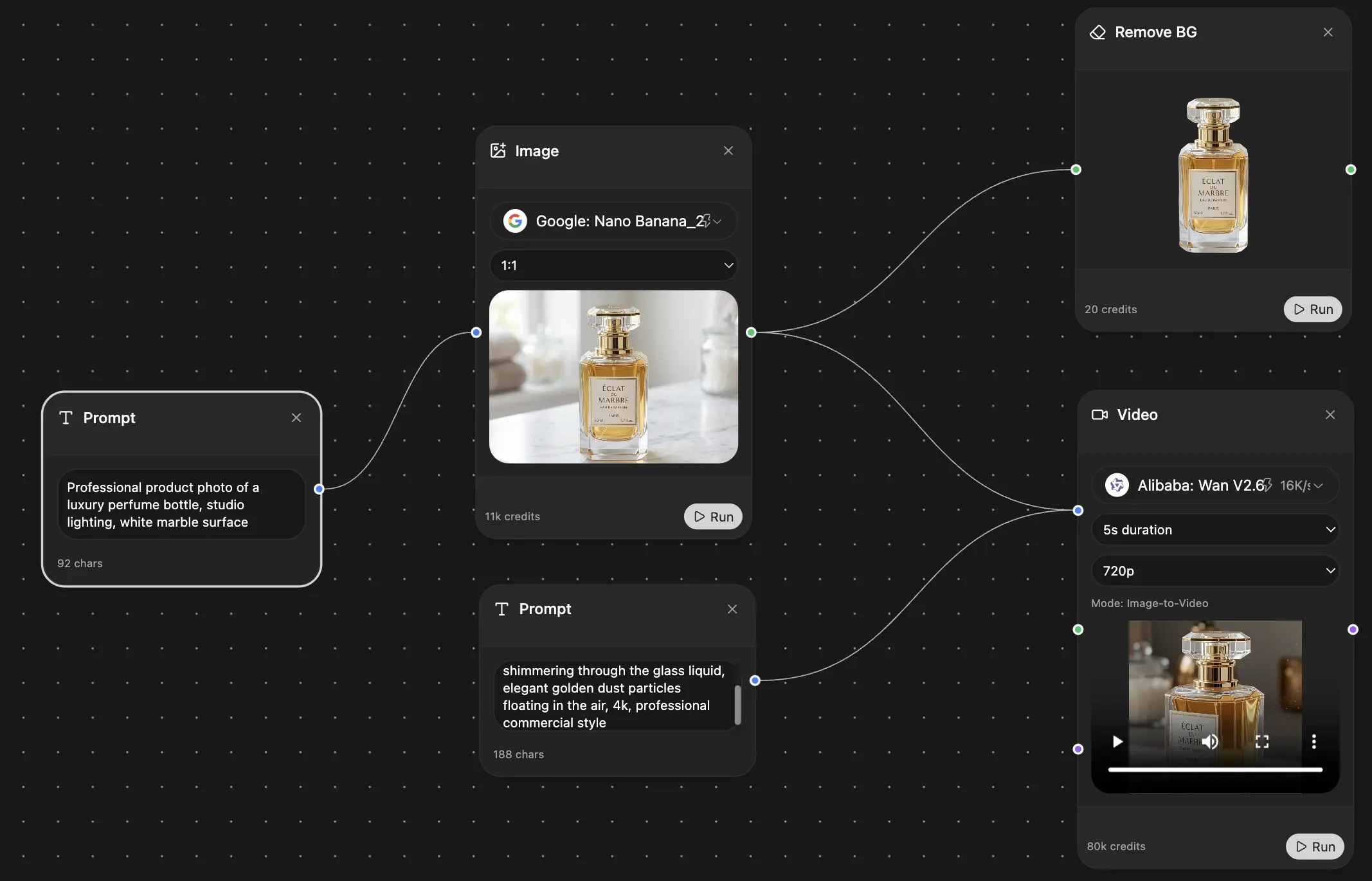
Your infinite AI canvas.
Chat, image, video & motion tools — side by side
Save hours of work and research
Transparent, High-Value Pricing
Trusted by teams at






Free
No credit card required
- 100 credits daily
- 3 AI models to try
- Basic AI chat
Plus
- 1,000,000 credits/month
- 25+ AI models — GPT, Claude, Gemini, Grok & more
- Agent Mode with web search, computer tools and more
- Creative Studio: image generation and video generation
- Project Library: chat with document, website and youtube, podcast generation, flashcards, reports and more
- Workflow Studio and FocusOS
Professional
- Everything in Plus, and:
- 2,100,000 credits/month
- Pro-exclusive models (Claude Opus, Grok 4, Sonar Pro)
- Motion Tools & Max Mode
- First access to latest features
- Access to additional offers
What Our Users Say
Great Tool after 2 months usage
simplyzubair
I love the way multiple tools they integrated in one platform. So far it is going in right dorection adding more tools.
Best in Kind!
barefootmedicine
This is another game-change. have used software that kind of offers similar features, but the quality of the data I'm getting back and the sheer speed of the responses is outstanding. I use this app ...
simply awesome
MarianZ
I just tried it - didnt wanna stay with it, because there is so much like that out there. But it convinced me, because: - the discord-channel is very response and fast - the number of models are quite...
A Surprisingly Comprehensive and Engaging Experience
bruno.battocletti
Zemith is not just another app; it's a surprisingly comprehensive platform that feels like a toolbox filled with unexpected delights. From the moment you launch it, you're greeted with a clean and int...
Great for Document Analysis
yerch82
Just works. Simple to use and great for working with documents and make summaries. Money well spend in my opinion.
Great AI site with lots of features and accessible llm's
sumore
what I find most useful in this site is the organization of the features. it's better that all the other site I have so far and even better than chatgpt themselves.
Excellent Tool
AlphaLeaf
Zemith claims to be an all-in-one platform, and after using it, I can confirm that it lives up to that claim. It not only has all the necessary functions, but the UI is also well-designed and very eas...
A well-rounded platform with solid LLMs, extra functionality
SlothMachine
Hey team Zemith! First off: I don't often write these reviews. I should do better, especially with tools that really put their heart and soul into their platform.
This is the best tool I've ever used. Updates are made almost daily, and the feedback process is very fast.
reu0691
This is the best AI tool I've used so far. Updates are made almost daily, and the feedback process is incredibly fast. Just looking at the changelogs, you can see how consistently the developers have ...