How to Improve Team Collaboration with Zemith's AI Workspace
Learn how to improve team collaboration with Zemith’s AI workspace. Get actionable steps for communication, workflows, remote practices & measurement.
Your team's in three places at once. One person is waiting on a reply in email, two people are debating a decision in chat, and somebody else already built the “final” version because nobody agreed on who owned the draft. That's not collaboration, that's a scavenger hunt with meetings.
How to improve team collaboration starts with fewer assumptions and more structure. The good news is that you don't need a heroic culture reboot or a six-hour offsite with suspiciously strong coffee. You need clear norms, tighter workflows, better rituals, and a way to see what's happening without dragging everyone into yet another call. If you want a fun way to loosen people up before they go back to work, can help teams build trust outside the usual status-update routine.
The fix is simple. Make it easier for people to speak up, assign work cleanly, keep decisions visible, and measure whether the handoffs work. A solid knowledge base also matters, because collaboration falls apart fast when everyone is guessing where the latest version lives, so keep your documentation anchored in a system like .
Introduction to Team Collaboration Foundations
Team collaboration usually fails for boring reasons. Someone didn't get the memo, someone else assumed the role was obvious, and the third person was too polite to say they were confused. That's how you end up with duplicate work, slow decisions, and “quick check-ins” that somehow eat the whole afternoon.
The fix isn't more chatter. It's a better operating rhythm. Teams work better when people know how to communicate, where decisions live, what good handoffs look like, and when a meeting is worth their time. That's why the most useful collaboration advice is rarely flashy. It's mostly about reducing friction before it turns into drama.
A good team also needs a place where people can work from the same source of truth without jumping between five tabs and a prayer. That's where structured documentation, shared workspaces, and clear ownership stop being nice-to-haves and start saving real time. If your current setup feels like a mix of inbox archaeology and calendar Tetris, you're in the right place.
Establish Communication Norms
Psychological safety is the foundation, not the garnish. Google's Project Aristotle, launched in 2012, looked at 180 teams and found that the strongest predictor of effective collaboration was whether people felt safe speaking up, taking risks, and admitting mistakes, not who had the flashiest résumé or the most senior title. Gallup's collaboration guidance and SHRM's reporting both push the same practical point, open communication, regular check-ins, and treating mistakes as learning opportunities make it easier for people to contribute ideas and surface problems early, which is the whole game.
Make speaking up feel normal
If someone only talks when they're 100% certain, your team is already losing. Set the expectation that half-baked ideas are welcome, then improve them in the open. A team that never hears uncertainty usually isn't calm, it's hiding.
Practical rule: If a teammate flags a risk, treat it like useful data, not a personal attack.
That means asking quieter people directly for their take, not waiting for the loudest voice to dominate the room like it owns the Wi-Fi. It also means ending the “oops-free zone” fantasy. Teams don't become more competent by pretending mistakes never happen, they become more competent by talking about them without making it weird.
Write the charter before the chaos
Your communication charter should be short enough for people to read it. Define which channel gets what, how quickly people should respond, and what counts as an urgent issue. If you need help writing cleaner messages that don't sound like a passive-aggressive riddle, is a useful reference point.
Use simple norms like these:
- Channel purpose: Keep decisions in one place, status updates in another, and side chatter out of the decision thread.
- Response times: Publish what “same day” and “next day” mean for your team so nobody has to decode vibes.
- Feedback rules: Use direct language, not code words. “I'm not aligned” is clearer than “circling back on synergy.”
- Low-friction reactions: A +1 reaction beats four separate “sounds good” replies when you just need acknowledgment.
The point is to reduce ambiguity. When people know how to participate, they participate more. When they don't, they lurk, guess, or start a side channel that turns into the main project.
Optimize Workflows and Define Roles
A messy workflow does not need more energy, it needs boundaries. If every task can be touched by everyone, nobody owns the outcome, and the team turns into a polite pile of overlapping opinions. Slack's collaboration guidance says structured protocols, shared goals, single deliverable owners, and published response-time norms cut handoff delays and keep tool sprawl from swallowing the week.

Map the work once, then stop improvising
Use a simple flow, Entry, Review, Handoff. Entry is where the task starts and gets assigned. Review is where someone checks quality and catches issues before they spread. Handoff is where responsibility moves cleanly to the next person without three “just checking in” messages.
A mini-launch disaster usually starts the same way. Marketing thinks product owns the final copy, product thinks design owns the approval, and design thinks someone in ops will close the loop. That confusion disappears faster when each deliverable has one owner, one reviewer, and one visible next step. No one needs to be a hero. They need to be assigned.
Keep the system lightweight
Do not build a workflow so heavy that people need a training course to update a task. Teams stick with simple systems when they can find the current decision in under a minute. If your process needs a scavenger hunt, it is too complicated.
For calendar-heavy teams, a tool like can reduce double-booking and coordination friction when schedules are already packed. That matters more than people admit, because the wrong calendar setup creates fake urgency, and fake urgency creates sloppy handoffs. For a closer look at trimming handoff waste and cutting unnecessary steps, see our guide on .
My rule: If a teammate cannot tell who owns the next step in one glance, the workflow is not done.
If you want a more formal way to document it, build a RACI-inspired matrix with one owner, one reviewer, and one final approver. Then keep it visible. Ownership hidden in someone's memory is just future rework. Zemith helps here because its workspace templates give teams a clean place to assign steps, surface ownership, and keep review points out of random chat threads.
Design Effective Meetings and Rituals
Teams often don't suffer from a lack of meetings. They have too many that drift around like they're paid by the minute. The fix is not “fewer meetings at all costs.” The fix is meetings with a purpose, a timeout, and a reason to exist besides calendar guilt.
Use the same logic for every recurring ritual, daily standups, weekly syncs, monthly retrospectives, quarterly planning, and ad-hoc decision huddles. If the team can't say what the meeting is for in one sentence, it shouldn't happen. And if the agenda is blank, congratulations, you've scheduled a group nap.
Build rituals that earn their slot
- Daily standups: Keep them for blockers, priorities, and quick coordination. If people are delivering status novels, the format is broken.
- Weekly syncs: Use these to resolve dependencies and surface decisions, not to let everyone narrate their entire week.
- Monthly retrospectives: Make space for what worked, what didn't, and what gets changed next.
- Quarterly planning: Tie the work back to the broader goal, then stop pretending every priority is top priority.
- Ad-hoc decision huddles: Bring only the people needed to decide, not the people who like to hear themselves think.
Make the rules visible
is useful if you want a simple template to keep people honest about scope and timing. Use a clear owner for each meeting, and don't let the facilitator become the person who does all the talking. The best facilitator is usually the one who keeps the conversation moving, not the one who turns a sync into a TED Talk.
Simple standard: No agenda, no show.
If you want a tongue-in-cheek policy, make every overrun cost the meeting owner one extra written update afterward. That tends to cure the mysterious urge to let a 15-minute check-in become a philosophical debate.
Enable Remote and Hybrid Collaboration
Hybrid work breaks collaboration in sneaky ways. People go out of sync, handoffs get invisible, and timezone friction turns a quick question into a 12-hour delay with extra polite phrasing. The answer isn't more real-time meetings. Virtual team research points to something more practical, tools that make the timing of people's contributions visible can improve coordination and learning more than adding more live meetings.

Make work visible without making it noisy
Shared status boards solve more problems than people expect. They show what's active, what's blocked, and what's waiting, without forcing everyone into the same live session. That visibility helps distributed teams stay coordinated without pinging each other into exhaustion.
A practical hybrid setup usually includes a few lightweight signals:
- Shared status boards: Make progress and availability visible at a glance.
- Contribution markers: Show when a doc was updated, commented on, or handed off.
- Asynchronous whiteboarding: Let people add ideas when they're ready, not when the meeting starts.
- Mobile-friendly notifications: Keep updates reachable without chaining everyone to their laptop.
Use Zemith for async clarity
Zemith fits nicely here because it centralizes document chats, whiteboards, and workspace context in one place, which means people don't have to hunt across tools just to understand what changed. If your team keeps asking, “Where's the latest version?” you already have your answer. Put the work in a place where the conversation and the artifact stay together.
For teams looking for , the bigger lesson is not “meet more.” It's “make collaboration legible.” That includes contribution timing, decision history, and a clean path for async feedback.
Useful habit: If a person in another timezone can't understand the next step before they log off, the handoff isn't finished.
That's the trade-off with hybrid work. You either pay a little extra attention to visibility, or you pay a lot later in confusion. I know which bill I'd rather see.
Measure Collaboration and Iterate
If you don't measure collaboration, you're mostly arguing about vibes. Shared metrics turn teamwork into something you can tangibly improve instead of just admire. Plane's guidance makes the point clearly, tracking metrics like cross-team collaboration rate turns a vague goal into measurable trends, which helps teams spot bottlenecks and verify whether changes are working.
Track the right signals
The useful metrics are the ones that expose friction. You don't need a dashboard that looks like mission control. You need a few numbers that tell you whether cross-functional work is moving or stuck.
Start with a baseline, then compare trends instead of obsessing over one messy week. That's the only sane way to use collaboration data. One rough sprint doesn't mean the team is broken. It means you have something to look at before the next cycle.
Turn retros into new rules
The best retrospectives don't end with “good discussion, thanks everyone.” They end with one or two process changes, an owner, and a check-in date. Together Platform's guidance makes that loop explicit, post-project retrospectives converted into new team rules, paired with measurable follow-through, compound improvements cycle over cycle.
That's the part many teams skip. They name the pain, nod wisely, and then let the same problem come back with a different badge on it. Don't do that. Assign the fix, review it next cycle, and treat the result like actual operating feedback.
One strong retro question: What slowed us down that we can remove before the next project starts?
If you ask that consistently, the team stops treating collaboration like a personality trait and starts treating it like a process. That's where significant gains show up.
Applying Zemith with Examples and Templates

A good AI workspace should keep the team charter, the meeting agenda, the whiteboard, and the retrospective in one place so people aren't bouncing across apps to do basic coordination. Zemith does that by bringing documents, chats, whiteboards, and research into one workspace, which is exactly the kind of setup that reduces tool-switching during live collaboration. If you want reusable starting points, make it easier to draft the first version instead of staring at a blank page like it insulted you.
Use a few copy-paste templates and customize them for your team:
- Team charter template: Goal, roles, response-time norms, decision owner, and review cadence.
- Meeting agenda template: Purpose, decision needed, context, prep link, and timebox.
- Retro board template: Wins, blockers, root causes, and one fix to test next cycle.
The point is to make collaboration repeatable. If your team has to reinvent the process every Monday, you're wasting energy you could spend shipping work. Zemith is useful here because it keeps the conversation, the document, and the follow-through together instead of scattering them across tabs and threads.
If your team is ready to stop guessing and start collaborating with less noise, fewer meetings, and better follow-through, sign up for and use it to centralize your team charter, workflows, meeting notes, whiteboards, and retrospectives in one workspace.
Explore Zemith Features
Everything you need. Nothing you don't.
One subscription replaces five. Every top AI model, every creative tool, and every productivity feature, in one focused workspace.
Every top AI. One subscription.
ChatGPT, Claude, Gemini, DeepSeek, Grok & 25+ more







Always on, real-time AI.
Voice + screen share · instant answers
What's the best way to learn a new language?
Immersion and spaced repetition work best. Try consuming media in your target language daily.
Voice + screen share · AI answers in real time
Image Generation
Flux, Nano Banana, Ideogram, Recraft + more

Write at the speed of thought.
AI autocomplete, rewrite & expand on command
Any document. Any format.
PDF, URL, or YouTube → chat, quiz, podcast & more
Video Creation
Veo, Kling, Grok Imagine and more

Text to Speech
Natural AI voices, 30+ languages
Code Generation
Write, debug & explain code
Chat with Documents
Upload PDFs, analyze content
Your AI, in your pocket.
Full access on iOS & Android · synced everywhere
Your infinite AI canvas.
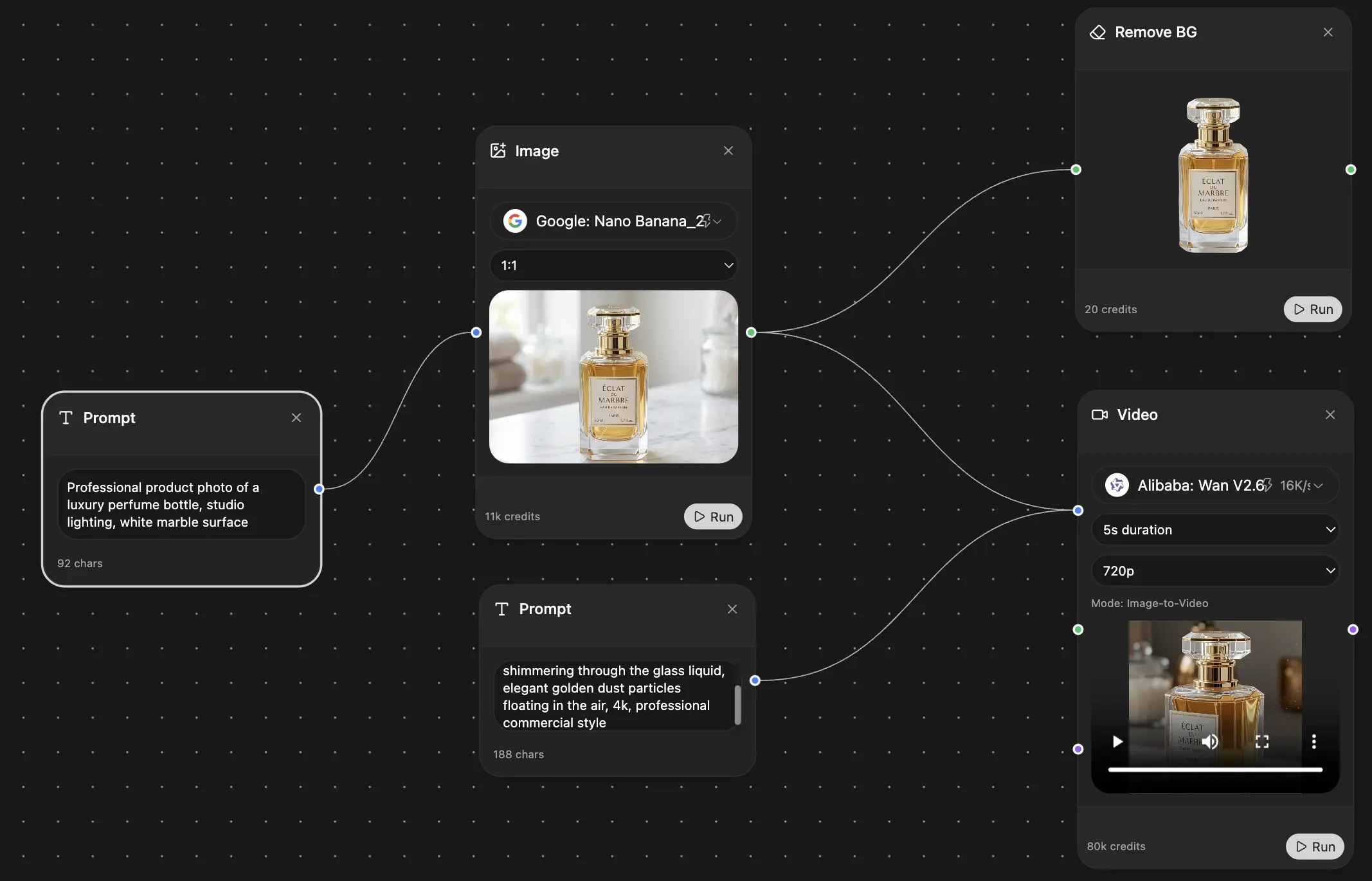
Chat, image, video & motion tools — side by side
Save hours of work and research
Transparent, High-Value Pricing
Trusted by teams at






Free
No credit card required
- 100 credits daily
- 3 AI models to try
- Basic AI chat
Plus
- 1,000,000 credits/month
- 25+ AI models — GPT, Claude, Gemini, Grok & more
- Agent Mode with web search, computer tools and more
- Creative Studio: image generation and video generation
- Project Library: chat with document, website and youtube, podcast generation, flashcards, reports and more
- Workflow Studio and FocusOS
Professional
- Everything in Plus, and:
- 2,100,000 credits/month
- Pro-exclusive models (Claude Opus, Grok 4, Sonar Pro)
- Motion Tools & Max Mode
- First access to latest features
- Access to additional offers
What Our Users Say
Great Tool after 2 months usage
simplyzubair
I love the way multiple tools they integrated in one platform. So far it is going in right dorection adding more tools.
Best in Kind!
barefootmedicine
This is another game-change. have used software that kind of offers similar features, but the quality of the data I'm getting back and the sheer speed of the responses is outstanding. I use this app ...
simply awesome
MarianZ
I just tried it - didnt wanna stay with it, because there is so much like that out there. But it convinced me, because: - the discord-channel is very response and fast - the number of models are quite...
A Surprisingly Comprehensive and Engaging Experience
bruno.battocletti
Zemith is not just another app; it's a surprisingly comprehensive platform that feels like a toolbox filled with unexpected delights. From the moment you launch it, you're greeted with a clean and int...
Great for Document Analysis
yerch82
Just works. Simple to use and great for working with documents and make summaries. Money well spend in my opinion.
Great AI site with lots of features and accessible llm's
sumore
what I find most useful in this site is the organization of the features. it's better that all the other site I have so far and even better than chatgpt themselves.
Excellent Tool
AlphaLeaf
Zemith claims to be an all-in-one platform, and after using it, I can confirm that it lives up to that claim. It not only has all the necessary functions, but the UI is also well-designed and very eas...
A well-rounded platform with solid LLMs, extra functionality
SlothMachine
Hey team Zemith! First off: I don't often write these reviews. I should do better, especially with tools that really put their heart and soul into their platform.
This is the best tool I've ever used. Updates are made almost daily, and the feedback process is very fast.
reu0691
This is the best AI tool I've used so far. Updates are made almost daily, and the feedback process is incredibly fast. Just looking at the changelogs, you can see how consistently the developers have ...