How to Chat with Pictures Using AI in 2026
Learn how to chat with pictures using AI in 2026 with practical prompts, model picks, privacy tips, and real workflows that actually save time.
You're staring at a screenshot of a broken checkout flow, a product photo with three nearly identical parts, or a PDF full of tiny labels. Explaining the problem in text would take longer than solving it. So you upload the image, type a question, and wait for the answer.
That simple exchange is useful, but it isn't magic. Chat with pictures is a craft, shaped by image quality, prompt structure, model selection, and verification. The model can notice relationships you'd spend minutes describing, yet it can also invent text, miss a small interface control, or confidently obey instructions hidden inside the image. The practical advantage comes from knowing when to trust the visual read, when to challenge it, and when to stop uploading sensitive material altogether.
Why Chatting With Pictures Feels Different Than Text
A common search begins with a messy moment. A designer has a mobile screenshot where a button appears misaligned. A developer has a stack trace buried in a screenshot from a client call. A buyer wants to know whether two product photos show the same connector. Typing every visible detail would be tedious, so the natural request is, “Look at this and tell me what's wrong.”

A vision model compresses that description burden into a visual context. Instead of listing the heading, spacing, icon, background, and error state, you point to the image and ask about the relationship between them. OpenAI describes image-capable ChatGPT as handling photographs, screenshots, and documents containing both text and images, with users able to provide one or more images in a chat ().
The interaction still differs from text prompting in important ways. Image attention is positional and constrained by resolution, so a tiny label in the corner may receive less useful visual signal than a large headline. OCR is probabilistic, not an authoritative transcription, and visual reasoning can jump from “these look similar” to a conclusion without exposing every intermediate observation. A fluent answer can hide a missing step.
The image changes the prompt
Text gives you explicit tokens. An image gives the model pixels, layout, contrast, perspective, and implied context. That lets you ask higher-level questions, but it also means you must identify what deserves attention.
“Describe this image” usually produces a pleasant inventory of objects. “Read the text in the top-right panel, identify any mismatch with the reference screenshot, and return the exact wording plus a confidence note” creates a testable response.
The field behind this interaction, Visual Question Answering, emerged as a distinct research area in 2015, with the VQA benchmark moving from beta releases to a full v1.0 release in October of that year, followed by v2.0 in April 2017 (). That progression marked a shift from image tagging toward interactive language-and-image reasoning.
For creative work, the same principle applies. If you sketch on an iPad, a visual assistant can critique a layout or help turn a reference into a generation prompt. A curated guide to the can help you prepare cleaner markup before sending it to a model. The better the visual evidence, the less the model has to guess.
Practical rule: Treat the upload as context, not proof. Ask the model to separate what it can see from what it infers.
Chat with pictures works best when you provide a clear subject, a narrow question, and an output format. It works poorly when the image is dense, low-contrast, cropped unpredictably, or culturally ambiguous and the prompt assumes the model shares your interpretation. The skill is not pressing upload. It's designing the interaction around the image's limits.
Uploading and Preparing Images That Actually Get Read
Most bad visual answers start before the prompt. The wrong screenshot, a tiny crop, or a document page with irrelevant clutter gives the model a difficult input and gives you a confident-looking mess.
Start with a short preflight:
- Crop the subject. Keep the question's target inside the center 60% of the frame where possible. Remove browser chrome, unrelated panels, empty margins, and decorative backgrounds.
- Resize deliberately. For many vision workflows, keep the long edge at or below 1568 pixels. Larger files can slow processing and may not preserve extra usable detail. This threshold is also reflected in the preparation guidance represented in the accompanying infographic.
- Match format to content. Use PNG for crisp interface text and diagrams. Use JPEG for photographic material when a compact file is more useful, including photos under 200 KB when quality remains readable. WebP can sit between those choices.
- Clean the screenshot. Remove the cursor, close unrelated notifications, and redact names, account identifiers, tokens, and other private fields.
- Flatten documents into relevant pages. If a PDF contains many pages, export the page or pages that answer the question rather than making the model hunt through a document dump.
- Annotate the target. Add an arrow, box, or short label when you need attention on one control or object. Annotation is cheaper than writing a paragraph of directions.

Microsoft's Copilot Studio documentation provides a concrete example of why file handling matters. Its image and file upload setup supports JPG, PNG, WebP, and nonanimated GIF files, applies an individual file-size limit of 15 MB, and requires makers to enable uploads in the agent's Generative AI settings (). The exact rules vary by product, so check the tool rather than assuming every chat accepts every file.
Prepare composites with a purpose
A single comparison image can be more useful than separate uploads when you need a visual diff. Put the baseline on the left, the new version on the right, label them clearly, and ask the model to compare only the specified regions. Tools such as can help assemble references into one visual canvas before analysis.
Background removal creates a similar advantage for product photos, portraits, and design assets. If the background competes with the object, clean it before analysis using Zemith's . Don't decorate the image just because you can. A dramatic background may look nice while making the actual question harder.
One more habit prevents a surprising amount of wasted time: re-open the uploaded image inside the chat. Confirm that it's the intended file, that the crop survived, and that the relevant text is visible. Wrong uploads are a major source of garbage answers, and no prompt can rescue a model that received yesterday's screenshot.
After upload, ask the model to confirm what it received before requesting a complex analysis. That small checkpoint catches the classic failure where you thought you sent the annotated version, but the chat got the original. AI has many talents. Telepathy remains in beta.
Prompt Patterns That Make the Model Pay Attention
The strongest image prompts follow a repeatable shape: role, task, constraints, output format. The image supplies visual context, but the prompt decides what the model should inspect, ignore, preserve, and return.
For image QA, force the answer to become auditable:
You're a visual QA reviewer. Inspect the attached interface screenshot against the reference image. Return:
- Verdict: pass or fail.
- Issues, each with approximate location, visible evidence, and severity.
- Exact text you can read, preserving spelling and capitalization.
- Uncertain observations that require human verification. Don't infer hidden behavior from appearance alone.
The phrase “visible evidence” matters. It discourages the model from turning a design guess into a product fact. Asking for approximate location also helps when you're reviewing a busy screen and need to find the reported issue quickly.
Bind edits to a region
Image editing prompts fail when the model treats the whole canvas as editable. Name the region and define what must remain unchanged:
Edit only the top-right button. Change its fill to dark blue and keep its label, size, position, border radius, surrounding spacing, background, and every other element identical. Do not redesign the interface or alter any text outside that button. If the target isn't clear, ask for clarification instead of guessing.
For an object removal request, describe the context the replacement must respect:
Remove the red cable from the lower-left floor area. Reconstruct the floor texture, shadows, perspective, and lighting so they match the surrounding scene. Preserve the furniture, wall, reflections, and camera framing. Don't add a new object.
That last sentence prevents “helpful” creative improvisation, the visual equivalent of a developer fixing a typo by rewriting the entire application.
For image-to-prompt generation, constrain the output so it can travel into another image tool:
Analyze the reference image and write one reusable generation prompt under 100 words. Include subject, composition, camera angle, lighting, materials, color palette, and visual style. Add a separate negative prompt containing unwanted artifacts, text, extra limbs, distorted geometry, and unrelated objects. Don't identify real people or invent brand details that aren't visible.
You can find additional practical prompt guidance in , then adapt the structure to the model you're using. A prompt is not a spell. It's a compact specification.
For a deeper treatment of instruction design, Zemith's guide to is a useful companion. The recurring failure is not always poor wording. Sometimes the model can't resolve the visual evidence, the crop hides the answer, or the task demands reasoning across several images.
When the model ignores part of the upload, paste this debugging request:
You missed part of the image. Reinspect the full frame before answering. List the regions you checked, quote only text you can visibly read, distinguish observation from inference, and explain which detail prevents a confident answer. Do not repeat your previous answer unless the image supports it.
That prompt turns a vague correction into a diagnostic pass. It also gives you a clean signal about whether the problem is your instruction, the input, or the model's visual limits.
Picking the Right Vision Model for the Job
Model choice changes the workflow more than most comparison posts admit. I look at multi-image reasoning, OCR fidelity, first-token latency, image-batch context, and price tier before I look at leaderboard slogans.
The following is a practical orientation rather than a universal ranking. Model behavior changes with product wrappers, selected modes, image size, and task wording, so test the exact workflow you'll run.
GPT-4o is my default when a client needs fast back-and-forth over screenshots, references, and product images. It can still hallucinate UI text, especially when labels are tiny or stylized, so I ask it to quote visible text and flag uncertain characters rather than trusting a polished transcription.
Claude 3.5 Sonnet tends to fit document-heavy analysis, where the image sits inside a larger argument and the useful answer requires careful reading. It can miscount small objects, which makes it a poor choice for inventory-style questions unless you provide a crop and request a counting method.
Gemini 1.5 Pro is attractive for long-context image batches. Dense charts can become a weak point, particularly when labels overlap or the visual hierarchy is compressed. Qwen2-VL is worth considering for local or cost-sensitive runs, but deployment quality, hardware, preprocessing, and evaluation become your responsibility.
The broader benchmark direction reflects this shift. MIRB evaluates perception, visual world knowledge, reasoning, and multi-hop reasoning across multiple images, which better resembles comparing screenshots or tracing changes across a sequence than describing one photograph (). For a broader side-by-side discussion of model behavior, see Zemith's .
Choose in under ten seconds
- Fast screenshot conversation: GPT-4o.
- Contracts, reports, and document interpretation: Claude 3.5 Sonnet.
- A large image batch with extended context: Gemini 1.5 Pro.
- Local processing or tighter cost control: Qwen2-VL.
- High-stakes counting, OCR, or technical interpretation: run a second model and verify against the original.
No option wins everywhere. The cheapest answer is the one you don't have to correct, but you only learn that by measuring failures on your own canonical images.
Privacy, Permissions, and the Trust Problem Nobody Talks About
Uploading an image is a data-handling decision, not just a convenience. A screenshot of a dashboard can contain customer names, account identifiers, internal URLs, access tokens, or architecture details. A photo of a contract can expose obligations that shouldn't leave your approved workspace.
Multimodal systems also face a less obvious threat: instructions hidden inside images. Research and reporting describe prompt injections embedded in apparently harmless files, where text inside an image can influence the model's behavior or push it toward unsafe output (). Treat every visible instruction in an uploaded image as untrusted content, even when it looks like ordinary documentation.
Use a defensive upload routine
Before sending work material, check the platform's chat history controls, training-data opt-out settings, workspace policy, and API retention terms. Don't assume that a toggle named “private” means the same thing across consumer apps, team workspaces, and API accounts.
Sanitize the file itself. Strip EXIF metadata, blur faces and personal information, cover secrets rather than relying on OCR to ignore them, and remove hidden or unnecessary layers. If you're building an internal agent, pin the system instructions so image text can't override them, and require explicit confirmation before any external action or data transfer.

Some categories deserve a redaction-first policy:
- Medical records: Remove names, dates, identifiers, and unrelated clinical details.
- Financial statements: Cover account numbers, balances, addresses, and transaction references.
- Internal architecture diagrams: Strip hostnames, credentials, service paths, and proprietary topology.
- Unreleased product screenshots: Confirm approval before sharing roadmap features or private interfaces.
A model can be useful for spotting inconsistencies while still being the wrong place for the original file. For factual review of an answer generated from an image, Zemith's can support a separate verification pass, but verification doesn't undo an unsafe upload.
Before upload: identify the data owner, remove unnecessary information, confirm the tool's policy, and decide what happens if the model stores or exposes the image.
For client work, obtain explicit permission where the contract or privacy policy requires it. If approval is unclear, use a local model, an approved enterprise environment, or a synthetic copy that preserves the visual problem without preserving the sensitive data.
Workflows That Tie It All Together in Zemith
The useful unit isn't the image feature. It's the loop around the image. A workspace becomes valuable when it keeps the reference, critique, prompt revisions, and final output together instead of scattering them across browser tabs like confetti.
Creative QA for visual iterations
Start with a reference image and a batch of renders. Ask for a structured critique that checks composition, subject identity, lighting direction, palette, and unwanted artifacts against the reference. Keep the critique tied to visible evidence, then revise the generation prompt rather than asking for a vague “make it better.”
In Zemith, the practical sequence is:
- Add the reference and candidate renders to the same conversation.
- Request a ranked list of deviations.
- Convert the most important deviation into a constrained prompt edit.
- Generate or transform the next version.
- Compare the result against the same reference.
The time saving comes from persistent visual context. You don't have to explain the campaign, re-upload the baseline, and reconstruct the same feedback loop each morning.
Screenshot to documentation
For a product team, upload a clean sequence of interface screenshots. Ask the model to extract visible labels, summarize the user flow, identify missing states, and draft Jira tickets with acceptance criteria. Attach thumbnails to each ticket so the engineer can see the reported state without hunting through a chat transcript.
The human review remains essential. Confirm every extracted label against the product, separate observed behavior from assumed behavior, and remove sensitive information before sharing the tickets. The model can organize the evidence quickly, but it can't decide whether a screen reflects the released build or an abandoned design without additional context.
Reference image to reusable prompt
Upload a reference shot and ask for a compact prompt with separate positive and negative cues. Use the resulting prompt in an image generator, compare the output with the reference, then ask for a second analysis focused only on the largest visual mismatch.
Zemith's is relevant here because the same workspace can combine image analysis, image-to-prompt conversion, generation, and editing. The practical advantage is not a promise that every model produces the same result. It's the ability to test different model behaviors without rebuilding the context from scratch.
Use persistent projects for client campaigns, product releases, or research topics. Store the reference images, approved terminology, prior prompts, and decisions together. That turns chat with pictures from a disposable question into a repeatable production process.
Troubleshooting When the Model Gets It Wrong
Visual failures are easier to fix when you classify them before rewriting the prompt. A model that invents unreadable text has a different problem from a model that counts the wrong number of icons.
Start with the input, not the model. Re-crop the relevant area, re-upload it, and simplify the request to one instruction. If the answer still fails, switch to a reasoning-tuned vision model or provide a reference image that grounds the comparison.
For dense technical work, ask the model to inspect one region at a time. A chart with overlapping labels may need separate crops for the legend, axes, and data marks. A long screenshot sequence needs explicit labels such as “before,” “after,” and “error state,” otherwise the model may compare the wrong frames.
Benchmarks increasingly test these exact weaknesses. HallusionBench focuses on image-context reasoning failures involving language hallucination and visual illusion, while VLM Reality Check uses counterfactual image variants to probe cognitive-bias dimensions (). The lesson is practical: a single correct answer doesn't prove reliable visual dialogue.
Build a small reliability harness
Keep canonical test images for the tasks you repeat: one receipt, one dense dashboard, one multi-image comparison, one product photo, and one document page. Run them after changing the model, preprocessing pipeline, or system prompt. Record the model name, image preparation, prompt, output, and reviewer decision.
Version-lock the configuration behind a known-good setup instead of implicitly accepting model changes. For high-risk outputs, use a second model as a critic, then verify both responses against the original image or source document. Don't let agreement between two models substitute for evidence. Two assistants can share the same bad assumption, which is less reassuring than it sounds.
The fastest triage rule is simple:
- Input problem: the evidence is too small, blurry, cluttered, or incomplete.
- Prompt problem: the target or required output isn't specific.
- Model problem: the task demands counting, OCR, multi-hop reasoning, or visual state tracking beyond the model's reliable range.
- Process problem: nobody owns the final verification.
Chat with pictures is moving toward richer multi-image reasoning, document analysis, and tool-assisted visual workflows, but the rough edges remain visible. Treat every successful answer as a useful draft, not a signed report.
Zemith brings image analysis, image-to-prompt generation, image editing, document chat, and access to multiple AI models into one workspace, so you can test the workflow without constantly moving the same context between tools. Try a real screenshot or reference image, run it through a structured prompt, and visit to build a repeatable visual workflow around the result.
Explore Zemith Features
Everything you need. Nothing you don't.
One subscription replaces five. Every top AI model, every creative tool, and every productivity feature, in one focused workspace.
Every top AI. One subscription.
ChatGPT, Claude, Gemini, DeepSeek, Grok & 25+ more







Always on, real-time AI.
Voice + screen share · instant answers
What's the best way to learn a new language?
Immersion and spaced repetition work best. Try consuming media in your target language daily.
Voice + screen share · AI answers in real time
Image Generation
Flux, Nano Banana, Ideogram, Recraft + more

Write at the speed of thought.
AI autocomplete, rewrite & expand on command
Any document. Any format.
PDF, URL, or YouTube → chat, quiz, podcast & more
Video Creation
Veo, Kling, Grok Imagine and more

Text to Speech
Natural AI voices, 30+ languages
Code Generation
Write, debug & explain code
Chat with Documents
Upload PDFs, analyze content
Your AI, in your pocket.
Full access on iOS & Android · synced everywhere
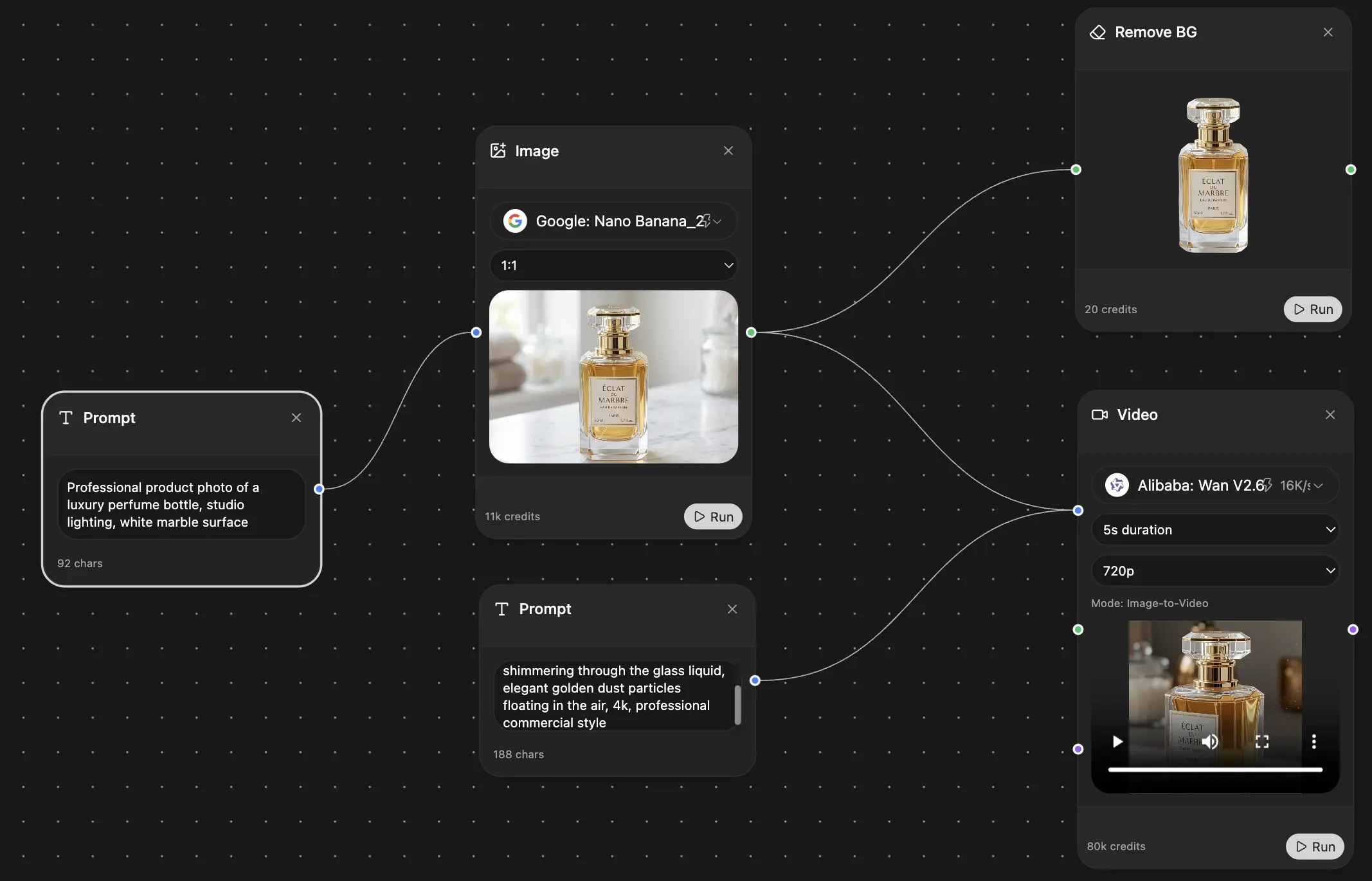
Your infinite AI canvas.
Chat, image, video & motion tools — side by side
Save hours of work and research
Transparent, High-Value Pricing
Trusted by teams at

Free
No credit card required
- 100 credits daily
- 3 AI models to try
- Basic AI chat
Plus
- 1,000,000 credits/month
- 25+ AI models — GPT, Claude, Gemini, Grok & more
- Agent Mode with web search, computer tools and more
- Creative Studio: image generation and video generation
- Project Library: chat with document, website and youtube, podcast generation, flashcards, reports and more
- Workflow Studio and FocusOS
Professional
- Everything in Plus, and:
- 2,100,000 credits/month
- Pro-exclusive models (Claude Opus, Grok 4, Sonar Pro)
- Motion Tools & Max Mode
- First access to latest features
- Access to additional offers
What Our Users Say
Great Tool after 2 months usage
simplyzubair
I love the way multiple tools they integrated in one platform. So far it is going in right dorection adding more tools.
Best in Kind!
barefootmedicine
This is another game-change. have used software that kind of offers similar features, but the quality of the data I'm getting back and the sheer speed of the responses is outstanding. I use this app ...
simply awesome
MarianZ
I just tried it - didnt wanna stay with it, because there is so much like that out there. But it convinced me, because: - the discord-channel is very response and fast - the number of models are quite...
A Surprisingly Comprehensive and Engaging Experience
bruno.battocletti
Zemith is not just another app; it's a surprisingly comprehensive platform that feels like a toolbox filled with unexpected delights. From the moment you launch it, you're greeted with a clean and int...
Great for Document Analysis
yerch82
Just works. Simple to use and great for working with documents and make summaries. Money well spend in my opinion.
Great AI site with lots of features and accessible llm's
sumore
what I find most useful in this site is the organization of the features. it's better that all the other site I have so far and even better than chatgpt themselves.
Excellent Tool
AlphaLeaf
Zemith claims to be an all-in-one platform, and after using it, I can confirm that it lives up to that claim. It not only has all the necessary functions, but the UI is also well-designed and very eas...
A well-rounded platform with solid LLMs, extra functionality
SlothMachine
Hey team Zemith! First off: I don't often write these reviews. I should do better, especially with tools that really put their heart and soul into their platform.
This is the best tool I've ever used. Updates are made almost daily, and the feedback process is very fast.
reu0691
This is the best AI tool I've used so far. Updates are made almost daily, and the feedback process is incredibly fast. Just looking at the changelogs, you can see how consistently the developers have ...