AI Workflow Optimization: A Practical Framework
Master AI workflow optimization with a step-by-step framework to audit, design, and measure AI-driven processes. Boost productivity and avoid common pitfalls.
The most popular advice about AI workflow optimization is also the least useful: add an AI tool to every repetitive task and measure how much faster the team produces output. That approach confuses activity with progress. A workflow can generate more drafts, summaries, tickets, or code while creating more review work, debugging, context switching, and cleanup.
The better question is simple: does the complete process produce a usable result with less coordination and rework? Evidence from workplace studies points in both directions. Generative AI was already assisting between 1% and 5% of work hours in late 2024, while respondents reported time savings equal to 1.4% of total work hours. The same research estimated a 1.1% current productivity gain, and a Federal Reserve analysis found workers were, on average, 33% more productive during the hours when they used generative AI (). Those gains are meaningful, but they don't prove that bolting AI onto broken processes works.
Good optimization redesigns the path from input to approved output. It gives AI the right context, assigns humans the right decisions, and makes hidden rework visible before it spreads.
Why Most AI Adoption Fails at Workflow Optimization
AI usage can rise while workflow performance gets worse. JetBrains' 2025 developer survey found that 85% of developers use AI regularly, but only 44% say it is fully or partially integrated into their workflows (). The gap reflects a common implementation failure: teams add tools before deciding how work, context, approvals, and accountability should move.
A developer might use ChatGPT for a code suggestion, Claude for a review, a prompt library for formatting, a script for automation, and a separate dashboard for approvals. Each tool may work well alone. The workflow still creates extra handling because someone must transfer context, compare outputs, manage permissions, and identify the authoritative version. AI has not removed the work. It has scattered it across smaller chores that are harder to track.
The survey also found that 45% of developers spend more time debugging AI-generated code than they save. That finding does not condemn AI-assisted development. It exposes a weak measurement model. Generation speed matters only when the output moves through review and approval without creating a larger queue behind it.
The adoption gap in plain English
The hidden cost has a name: workslop. Stanford and BetterUp cited an ongoing survey in which 40% of 1,150 full-time U.S. employees said they had encountered low-effort AI-generated work in the previous month. The estimated cost was about $186 per employee per month, or more than $9 million annually for a 10,000-person company. The operational problem is broader than weak writing or imperfect code. Another person must inspect, correct, explain, and route the result.
Practical rule: If AI makes the first person faster but the next three people busier, the workflow is not optimized.
Review the full chain before celebrating adoption. Track where people copy information between systems, wait for missing context, repeat quality checks, or repair outputs that initially looked acceptable. Those handoffs often expose the same that cause an AI pilot to become another isolated workstream. Workflow redesign must remove those failure points, not add another model.
Auditing Your Current Workflows for AI Readiness
AI readiness is a workflow property, not a tool feature. Before selecting a model, trace the process from trigger to delivery and identify where information changes hands. A strong candidate has a repeatable trigger, accessible inputs, a recognizable output, and enough examples to define acceptable quality. Processes built on relationship judgment, confidential context, or ambiguous accountability may still benefit from AI assistance, but they need review controls rather than push-button automation.
Record the work as people perform it, not as the process document describes it. Follow one item from start to finish. Log every file opened, message sent, approval requested, system update, and exception handled. Include the private spreadsheet, copied prompt, and workaround used when the official path fails. Those details reveal hidden rework that a clean flowchart conceals.
Score the work, not the buzzword
Rate each dimension from low to high:
- Frequency: Does the task recur often enough to justify setup and maintenance?
- Structure: Are inputs available in stable formats, or must someone interpret scattered information first?
- Decision complexity: Can explicit rules guide the process, or does undocumented context determine the result?
- Error tolerance: What follows an incorrect output? A draft email and a compliance decision require different review gates.
- Human judgment: Does the task involve empathy, accountability, negotiation, or strategic trade-offs?
- Rework exposure: How much time goes into correcting, formatting, verifying, or chasing the current result?
A high-frequency, structured task with manageable errors is a strong automate-first candidate. A frequent process with judgment-heavy decisions belongs in augment-with-AI, where the system prepares work and a person owns the decision. A workflow with unclear ownership, sensitive consequences, or unreliable source data should remain manual until those foundations improve.

Interview the people who absorb the mess
Ask operators questions that expose friction:
- Where do you wait for information?
- Which step do you repeat because the prior output is unreliable?
- What do reviewers correct most often?
- Which exceptions force you into a private message or spreadsheet?
- What would make you reject an automated result immediately?
- Who owns the decision when the system is uncertain?
The customer-support study linked here found that AI assistance increased productivity by 15% on average, measured as issues resolved per hour, with the largest gains among less-skilled agents (). Use that finding carefully. Start pilots with repetitive support patterns whose quality and rework are visible, then compare results by agent experience instead of treating the team as uniform.
Track downstream effort alongside first-pass speed. A faster draft can still create more review, correction, and routing work. For a practical checklist covering , document those costs before approving automation.
Designing AI-Integrated Processes That Actually Work
Complex workflows fail when teams ask one AI step to understand every scenario, make every decision, and produce the final output in one pass. Break the process into smaller units with explicit contracts. Each unit should have a defined input, a specific action, an output format, and a rule for escalation.
FlowBench illustrates why this matters. GPT-4o scored 92.5% on single-scenario tasks but 84.0% on cross-scenario tasks, while GPT-3.5-Turbo dropped from 77.9% to 57.3% as the evaluation moved across scenarios (). The practical lesson is not that one model wins forever. It's that orchestration quality declines when a workflow asks a model to carry too much ambiguity across tools and situations.
Decompose before you orchestrate
Take a customer-support workflow. Don't create one instruction that says, “Read the ticket, solve the issue, update the account, and reply to the customer.” Separate it into stages:
- Classify the request using a controlled set of categories.
- Retrieve relevant context from approved documentation and account records.
- Draft a response in the required tone and format.
- Check risk signals, such as billing disputes or unusual access requests.
- Route uncertain cases to a human reviewer.
- Record the approved outcome in the system of record.
This structure makes failure visible. If classification is wrong, you can fix the category logic. If the draft lacks context, you can improve retrieval. If escalation happens too often, you can inspect the threshold instead of blaming the entire model.

Put humans at decision gates
Human review shouldn't mean reading every line of every output. It should mean reviewing the points where judgment, accountability, or risk matters. Use automatic checks for required fields, formatting, duplicate content, and obvious inconsistencies. Send edge cases, low-confidence classifications, and high-impact decisions to a named reviewer.
Prompt design matters here, but prompts aren't the architecture. Give each step its own instructions, examples of acceptable output, prohibited assumptions, and a fallback when information is missing. Ask the system to identify uncertainty instead of filling gaps with confident nonsense. A little humility in the workflow can save a lot of apologetic email later.
For content creation, AI can outline, summarize source material, and produce variants, while a human approves factual claims and brand-sensitive language. For data analysis, AI can clean and classify inputs, but a person should validate definitions and investigate anomalies. For project management, AI can extract actions and draft updates, while owners confirm commitments and dates.
The strongest design keeps a feedback loop. Store corrections in a usable form, tag recurring failure types, and revise the specific workflow step responsible. A process that merely reruns the same prompt after every mistake isn't learning. It's doing déjà vu with better typography. Guidance on is useful here because the orchestration layer should reduce handoffs, not just add another screen.
Implementing Your Optimized Workflow with Unified Tools
AI workflow optimization often fails after approval, when each team adds another tool around the original one. A chatbot becomes surrounded by an automation service, prompt library, document store, review queue, and reporting layer. The result is hidden rework: people search for context, transfer outputs between systems, and repair low-quality drafts that looked finished.
Start by tracing the critical path. Record every tool, the context it receives, the output it produces, and the person or system responsible for the next step. Remove transfers that add no judgment or control. A generated answer that must be copied into another system before review is a process defect, not merely an inconvenience.
Consolidate the working surface
A unified workspace can place model access, document context, writing, research, coding, and project information closer together. Zemith combines multiple AI models with document assistance, organized workspaces, contextual memory, creative tools, coding support, and workflow automation in one environment. That arrangement does not mean every task belongs in one application. It can reduce context hunting when a process uses several AI capabilities, provided ownership and review rules remain clear.
Map the workflow before deployment:
- Trigger: What event starts the workflow?
- Context: Which documents, records, and instructions must be available?
- Action: What transformation should AI perform?
- Gate: Which output requires human approval?
- Destination: Where does the approved result belong?
- Fallback: What happens when information is missing or the workflow stops?
Teams connecting communication and automation tools can consult this for practical integration patterns. The tool names matter less than assigning each system a clear responsibility. Without that boundary, unified tooling hides duplicated work inside a cleaner interface.

Roll out in controlled phases
Select a pilot group that performs the workflow regularly and can describe failures precisely. Run the redesigned path beside the existing process long enough to compare output quality, reviewer effort, and exception handling. Give users a visible reporting route for bad results, missing context, and unsafe recommendations.
Write fallback behavior before the first run. If AI fails, the operator should know whether to add context and retry, complete the step manually, or escalate to the process owner. Training should cover those decisions and boundaries, not only button locations.
The goal is assistance embedded in normal work. If users must leave their process, consult AI, copy the result, and return to finish the task, adoption will remain fragile. A can support different workflow steps without forcing every problem into the same model or interface. Recheck the pilot for rework before expanding it. A faster first draft is not a gain if reviewers spend longer correcting it.
Measuring Real Productivity Gains Beyond Vanity Metrics
“Time saved” is a useful starting signal, not a verdict. A workflow may shorten drafting while increasing revision time, raise throughput while reducing the share of work that survives review, or help experienced users while leaving others with a confusing process. Hidden rework and workslop belong in the productivity calculation.
Measure three layers together. Throughput covers cycle time, completion rate, queue age, and handoffs. Quality covers error rate, revision cycles, rejected outputs, and downstream rework. Experience covers context switches, perceived cognitive load, confidence, and whether people know when to override the system.
Stratify before you average
The customer-support research cited earlier found the largest productivity gains among less-skilled agents, while the developer survey documented substantial debugging overhead. Break results down by experience, task type, and reviewer. A team-wide average can hide a workflow that helps new staff but frustrates experts, or one that handles routine requests but fails on unusual cases.
Use a monthly scorecard like this:
For a practical internal measure, I use the unchanged-survival ratio, a term for the share of AI-generated output that passes human review without substantive rewriting. Treat it as a diagnostic, not a success score. A high ratio may reflect strong output, weak review, or reviewers who have adapted by accepting defects. Pair the measure with sampled audits, correction reasons, and downstream outcomes.
A Bank for International Settlements study found AI adoption increased labour productivity by 4% on average among European firms, with gains driven mainly by capital deepening rather than job displacement (). Statistics Canada reported that AI adopters had a 16.8% higher productivity level than non-adopters, while cautioning that pre-existing advantages, complementary digital investment, and firm selection explained much of the gap. These findings make the baseline matter. Compare the same work before and after the workflow change, and record the reviewer time and rework that the headline metric omits.
For teams building a more disciplined operating cadence, can help frame the dashboard around decisions rather than decorative charts. A useful dashboard should show where time moved, which outputs required repair, and whether AI reduced total effort or merely shifted it to reviewers.
Common Pitfalls and How to Avoid Costly Rework
AI workflows often fail after approval, not during generation. A content team can publish more drafts while editors repair unsupported claims, inconsistent terminology, and awkward structure. A software team can accept code because tests pass, then discover an edge case changed business logic. The quality gate tested surface signals instead of the failure that mattered.
Workslop multiplies after approval
Workslop starts with output that looks finished enough to forward. The next person assumes it was checked, builds on it, and passes the defect downstream. By the time the original error surfaces, the team is repairing a chain of dependent work rather than one draft.
Require source-linked generation, evidence fields, and a review question such as, “What would make this output unsafe or unusable?” For recurring tasks, sample approved work after delivery. Check whether it reads well, then check whether another person had to redo part of the task.
Debugging can erase the headline gain
The broader survey finding, noted earlier, matters because debugging cost depends on where AI enters the process. Treat generated code as an input to verification, not a completed change. Tests should reflect business behavior, including edge cases and error handling. Route unfamiliar dependencies, permission changes, and high-impact logic to an experienced reviewer.
Quality control can become theater
A flood of mediocre outputs changes reviewer behavior. People skim, rely on familiar wording, and approve work that appears consistent. Insert a short delay between generation and review when the task allows it. Use stratified sampling to inspect routine outputs, edge cases, and escalated items separately. Set confidence thresholds that route uncertain work to specialists instead of giving every result the same approval status.

The fix is operational: define acceptable output, test relevant failure modes, and measure rework after delivery. More output is a loss when the cleanup queue grows faster than the production queue. Track who performs the repair, which workflow step allowed the defect through, and whether changing that step prevents recurrence.
Your Action Plan for Sustainable AI Workflow Optimization
Sustainable optimization starts with a narrow process, a visible rework problem, and an owner who can change the process when evidence demands it. A practical rollout fits into a 90-day operating cycle.
Weeks 1 to 2, audit. Trace one workflow from trigger to final output, including handoffs, review queues, and corrections that happen outside the formal process. Interview the people who perform and approve the work. Assess frequency, structure, decision complexity, error tolerance, human judgment, and exposure to hidden rework or workslop. Choose a process whose output can be evaluated, not merely counted.
Weeks 3 to 6, design and prototype. Break the process into scenario-specific steps. Specify inputs, output formats, review gates, escalation rules, and fallback behavior. Run a controlled pilot through a unified platform such as Zemith, while keeping the current process available for comparison. Compare quality, coordination effort, and repair work, rather than rewarding faster generation alone.
Weeks 7 to 12, measure and refine. Track cycle time, throughput, revision cycles, downstream rework, exceptions, and context switching. Separate findings by experience level and task type. Sample outputs with a human reviewer, record recurring failure patterns, and change the workflow step that permits the defect. Rewriting one large prompt rarely fixes a broken handoff or unclear decision rule.
Governance checklist
- Data boundary: Define which sources AI may use and which information requires restricted handling.
- Approval ownership: Name the person accountable for each high-impact decision.
- Escalation path: Document where uncertain, incomplete, or risky outputs go.
- Audit trail: Preserve inputs, instructions, output versions, corrections, and approvals.
- Change management: Train users on decision rules, fallback procedures, and failure reporting.
- Retirement rule: Remove workflows that continue creating more rework than value after repeated optimization attempts.
Agentic workflows make this discipline more demanding. Systems that chain actions can handle richer processes, but orchestration quality declines as scenarios become more complex, as shown by . Decompose work, define decision gates, capture execution traces, and measure downstream quality before expanding autonomy.
The advantage comes from process clarity. Teams need explicit boundaries for AI actions, human decisions, and the feedback used to correct both.
Zemith combines multi-model AI, document assistance, research, writing, coding, creative tools, organized workspaces, and workflow automation in one environment. That setup can reduce context switching while teams redesign recurring processes. Visit to explore a unified way to build, run, and improve AI workflows.
Explore Zemith Features
Everything you need. Nothing you don't.
One subscription replaces five. Every top AI model, every creative tool, and every productivity feature, in one focused workspace.
Every top AI. One subscription.
ChatGPT, Claude, Gemini, DeepSeek, Grok & 25+ more








Always on, real-time AI.
Voice + screen share · instant answers
What's the best way to learn a new language?
Immersion and spaced repetition work best. Try consuming media in your target language daily.
Voice + screen share · AI answers in real time
Image Generation
Flux, Nano Banana, Ideogram, Recraft + more

Write at the speed of thought.
AI autocomplete, rewrite & expand on command
Any document. Any format.
PDF, URL, or YouTube → chat, quiz, podcast & more
Video Creation
Veo, Kling, Grok Imagine and more

Text to Speech
Natural AI voices, 30+ languages
Code Generation
Write, debug & explain code
Chat with Documents
Upload PDFs, analyze content
Your AI, in your pocket.
Full access on iOS & Android · synced everywhere
Your infinite AI canvas.
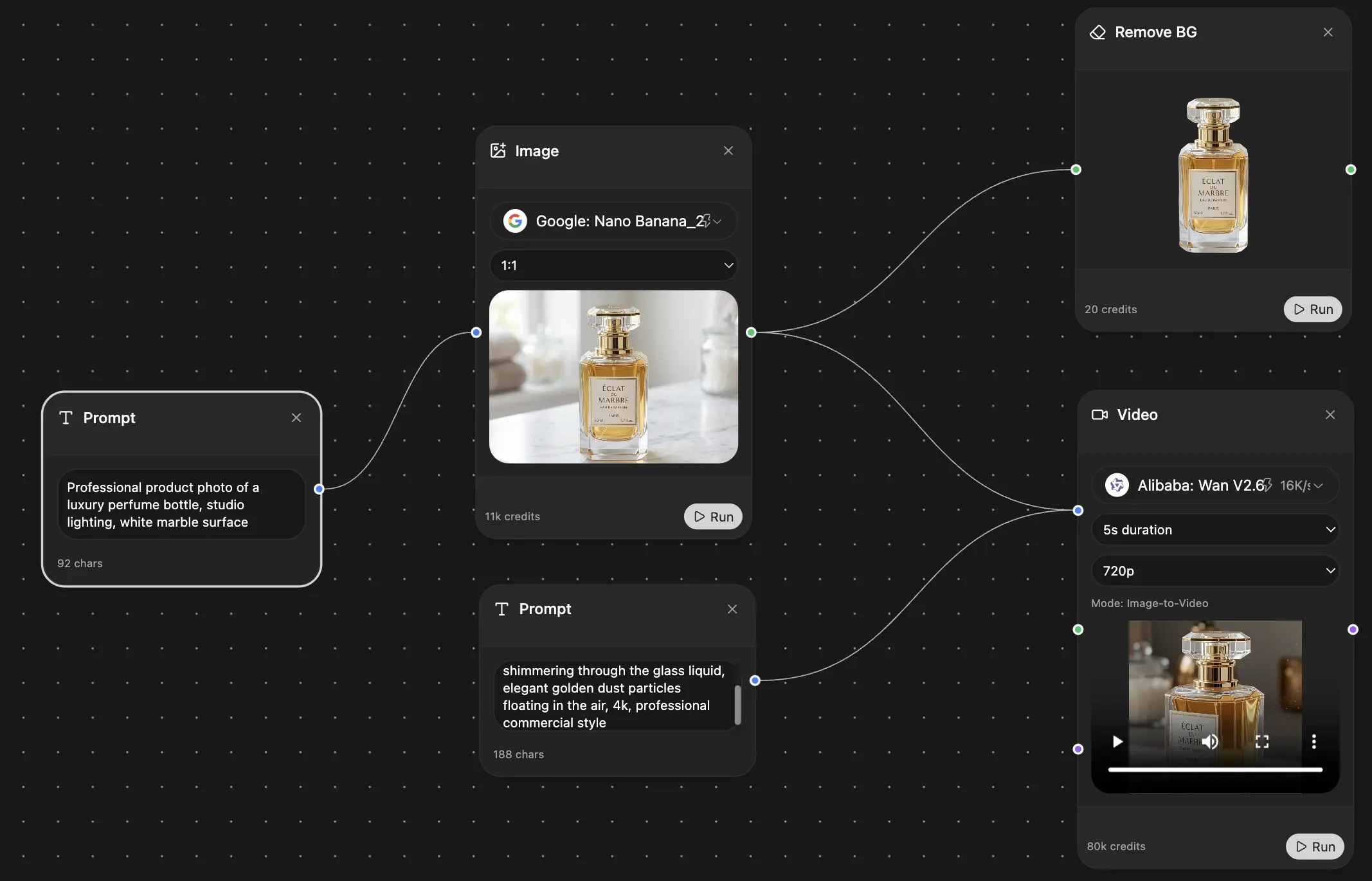
Chat, image, video & motion tools — side by side
Save hours of work and research
Transparent, High-Value Pricing
Trusted by teams at






Free
No credit card required
- 100 credits daily
- 3 AI models to try
- Basic AI chat
Plus
- 1,000,000 credits/month
- 25+ AI models — GPT, Claude, Gemini, Grok & more
- Agent Mode with web search, computer tools and more
- Creative Studio: image generation and video generation
- Project Library: chat with document, website and youtube, podcast generation, flashcards, reports and more
- Workflow Studio and FocusOS
Professional
- Everything in Plus, and:
- 2,100,000 credits/month
- Pro-exclusive models (Claude Opus, Grok 4, Sonar Pro)
- Motion Tools & Max Mode
- First access to latest features
- Access to additional offers
What Our Users Say
Great Tool after 2 months usage
simplyzubair
I love the way multiple tools they integrated in one platform. So far it is going in right dorection adding more tools.
Best in Kind!
barefootmedicine
This is another game-change. have used software that kind of offers similar features, but the quality of the data I'm getting back and the sheer speed of the responses is outstanding. I use this app ...
simply awesome
MarianZ
I just tried it - didnt wanna stay with it, because there is so much like that out there. But it convinced me, because: - the discord-channel is very response and fast - the number of models are quite...
A Surprisingly Comprehensive and Engaging Experience
bruno.battocletti
Zemith is not just another app; it's a surprisingly comprehensive platform that feels like a toolbox filled with unexpected delights. From the moment you launch it, you're greeted with a clean and int...
Great for Document Analysis
yerch82
Just works. Simple to use and great for working with documents and make summaries. Money well spend in my opinion.
Great AI site with lots of features and accessible llm's
sumore
what I find most useful in this site is the organization of the features. it's better that all the other site I have so far and even better than chatgpt themselves.
Excellent Tool
AlphaLeaf
Zemith claims to be an all-in-one platform, and after using it, I can confirm that it lives up to that claim. It not only has all the necessary functions, but the UI is also well-designed and very eas...
A well-rounded platform with solid LLMs, extra functionality
SlothMachine
Hey team Zemith! First off: I don't often write these reviews. I should do better, especially with tools that really put their heart and soul into their platform.
This is the best tool I've ever used. Updates are made almost daily, and the feedback process is very fast.
reu0691
This is the best AI tool I've used so far. Updates are made almost daily, and the feedback process is incredibly fast. Just looking at the changelogs, you can see how consistently the developers have ...