AI Prompt Optimizer: Practical Workflows That Deliver
Master prompt optimization with the AI Prompt Optimizer, a tool that refines your queries for better AI responses and measurable outcomes.
You know the feeling. A prompt works fine on Monday, then by Wednesday it's hallucinating structure, ignoring tone, and turning a simple summary into a mini dissertation. At that point, you're not “prompting,” you're feeding the model into the same rabbit hole for the seventeenth time and hoping it comes back with a cleaner answer.
That's exactly why the ai prompt optimizer conversation matters now. The field has moved from casual tweak-and-pray behavior into benchmarked, data-driven optimization, with methods like APE, InstructZero, PromptBreeder, EvoPrompt, INSTINCT, and PromptWizard showing up in a 2025 ACL survey of automatic prompt optimization methods (). In practice, that means teams are treating prompts like engineered assets, not sticky notes with nicer fonts.
Why Your Prompts Keep Falling Short
The frustrating part isn't that prompts fail. It's that they fail inconsistently. You'll write something that produces a sharp answer once, then the next run gives you a wandering paragraph, a different tone, or a format that breaks downstream tooling.

The real problem is prompt shape
A prompt isn't just instructions, it's a control surface. Change the order of constraints, add one example, or remove a sentence of context, and the output can shift hard enough to wreck consistency. That's why a simple “write a summary” prompt often feels fine for one-off use but falls apart when a workflow needs repeatable structure.
If you've already spent too long polishing prompt phrasing, is a useful gut check because the biggest wins usually come from clearer task framing, not poetic instruction writing. The same idea shows up in Gemini and OpenAI-style optimizer flows too, where the prompt is treated like a testable artifact rather than a one-time draft.
Casual prompting breaks at production speed
A hand-tuned prompt can survive a demo. It usually struggles when the input varies, the task is measurable, or the output has to land in a fixed format. That's the gap between hobby prompting and production prompt optimization.
Practical rule: if you can't tell whether a prompt got better, you probably don't have an optimization process yet.
For readers mapping this into a broader workflow, the basics of still matter, but the difference now is discipline. The teams that get stable results stop debating adjectives and start measuring outputs against a known target.
Building Your First Optimization Dataset
An ai prompt optimizer only has something useful to improve when the dataset is concrete. Without examples, labels, and a stable evaluation set, you are just rewriting prose and calling it engineering, which is a very expensive hobby with a nicer name.

Start with the output you actually want
OpenAI's prompt optimizer guidance is refreshingly non-mystical. Build a dataset around the target prompt, create an evaluation set, include at least three response rows, and attach at least one grader result or human annotation to each row before you run optimization (). That is the part people skip when they are in a hurry, then wonder why the optimizer does not understand the task.
For practical workflows, the dataset should reflect the actual spread of inputs, not just the happy path. If you are optimizing content generation, include short briefs, messy briefs, and edge cases. If you are optimizing extraction or classification, include borderline examples that force the model to prove it is reading the right signal. A prompt for summarizing clean meeting notes behaves very differently from a prompt for that is half-structured, noisy, and full of junk the model has to ignore.
Make the rubric boring on purpose
A good rubric is not clever. It is consistent. Gemini Enterprise Agent Platform's data-driven optimizer flow supports optional custom metrics, which helps when generic quality checks do not match the actual domain goal ().
A practical starter setup looks like this:
- Define success metrics. Use accuracy, relevance, or fluency, depending on the task.
- Collect diverse sample prompts. Real inputs beat synthetic perfection every time.
- Record baseline responses. Keep the model's current output so you know what changed.
- Score each example consistently. A simple 1 to 5 rubric is often enough to expose weak spots.
The important part is coverage. Sparse or skewed datasets make the optimizer chase odd artifacts, especially in structured outputs or tool-use behaviors. If the set does not represent the task, the optimizer will confidently improve the wrong thing.
For teams building reusable prompt workflows, can help you separate stable structure from task-specific content, which makes evaluation far less chaotic when multiple people touch the same prompt library.
Keep the dataset small enough to review by hand and broad enough to catch failure modes. That is the sweet spot.
Testing Prompts Across Multiple AI Models
The same prompt can look brilliant on one model and strangely stubborn on another. That's not a bug, it's the reality of working across different training styles, instruction-following behaviors, and output priors.

Compare behavior, not vibes
A multi-model test should answer one question, which model handles this prompt and this task best under the same rubric? Google's Vertex AI Prompt Optimizer uses an iterative LLM-based search loop where one model generates candidate instructions, another scores them, and the system keeps the version that best matches the chosen metric (). That setup is useful because it forces comparison instead of intuition.
If you're testing manually, don't just read the outputs and say one “feels better.” Score the same response dimensions each time. Accuracy, relevance, and fluency are common starting points because they separate correctness from polish, which is where a lot of prompt tuning mistakes hide.
Optimize for one model or many
There's a trade-off here. A prompt tuned tightly for your primary model can outperform a generic version, especially when your use case is stable and production-bound. A broader prompt can be easier to port across platforms, but it often gives up sharpness.
becomes useful when you need to decide whether model-specific optimization is worth the maintenance cost. If a prompt only works because it relies on one model's quirks, you'll spend more time chasing compatibility than improving output.
Practical rule: if the prompt is business-critical, test it on at least the model you plan to ship and one close alternative.
The useful part of multi-model testing is not discovering a universal winner. It's seeing where a prompt is effective and where it only appears effective because you haven't compared it properly yet.
Measuring What Actually Matters
You can make a prompt longer, more detailed, and more “professional” without making it better. That is the trap. Optimization should improve the thing you care about, not reward the prompt for sounding serious in a meeting.
Quality metrics should match the job
If the task is classification, measure correctness first. If it is reasoning, track whether the output reaches the right conclusion with usable justification. If it is content generation, relevance and tone may matter more than exact wording. The optimizer only helps if the metric reflects the actual downstream goal.
A useful comparison is shown below.
Those token and latency ranges come from the and the comparative prompting analysis it cites. The core lesson is simple. Better output is not free, and some prompting styles buy quality at a real cost.
Use human review where the model can't grade itself
Automated scoring is great when the target is clear. Human review still matters when the task needs judgment, nuance, or domain knowledge. OpenAI's guidance treats graders and human annotation as part of the dataset itself, which is the right direction because label quality often decides whether the optimizer learns anything useful.
For teams already using prompt tooling, even a narrow internal checker can catch nonsense faster than a broad “looks okay” pass. Zemith, for example, includes a prompt gallery and multi-model workspace features that fit naturally into this kind of evaluation loop, especially when you are comparing outputs side by side across tasks.
If the metric can be gamed by nicer wording, it is not the right metric.
A sharp prompt is usually the one that wins on the rubric while staying simple enough for your team to maintain six months later.
Iterative Optimization Workflows That Scale
One rewrite almost never fixes a prompt. The versions that hold up in production usually come from a loop, not a lucky draft, and the loop is where the actual work sits.

Treat the prompt like a versioned asset
The strongest teams I've worked with keep a history of every change and the reason behind it. That means the prompt text, the evaluation set, the model version, and the scoring rubric all live together. If the output gets worse, nobody has to reconstruct the change log from Slack fragments and half-remembered hunches.
Google's Gemini Enterprise documentation lays out a data-driven optimizer flow that starts with a template, uses sample preparation, can include custom metrics, then moves through job setup, optimization, and review. The point is not that every team has to copy that exact process forever. The point is that optimization becomes a repeatable workflow instead of a one-off edit.
Use tools that make iteration less painful
Prompt versioning gets messy fast when it lives in scattered docs. Workspaces, galleries, and prompt libraries earn their keep by making it easier to compare runs, preserve context, and avoid rebuilding the same prompt from scratch every time someone asks for “just one more clarification.”
If you are doing keyword-heavy work or content research alongside prompt tuning, is a practical example of how prompt workflows spill into adjacent tasks. The pattern stays the same. Test, compare, annotate, keep the best version, and do not trust memory alone.
Teams that want a broader template system can also use the to standardize starting points before the first test run. That does not replace evaluation, it just keeps everyone from reinventing the same prompt skeleton in five slightly different ways.
Know when to stop
Optimization has a point of diminishing returns. Once the output stabilizes and the failure cases are clear, the next tweak is often noise dressed up as progress. That becomes especially obvious when the dataset is small or the task has already been narrowed into a repeatable format.
A simple stop rule helps:
- Stop when scores flatten. If the same rubric keeps landing in the same range, the prompt is probably mature enough.
- Stop when the improvement is cosmetic. Better wording does not matter if downstream quality does not change.
- Stop when maintenance starts to outweigh gains. If every model update breaks the prompt, the workflow is not stable yet.
When Optimization Isn't Worth the Effort
Not every prompt deserves a full optimization pipeline. Some tasks are too volatile, too subjective, or too cheap to justify the setup, and knowing that saves real time.
Simple prompts still win in some cases
A quick instruction can outperform a heavily tuned workflow when the task changes constantly or the output is mostly for human consumption. If the model's job is to draft a rough idea, a lightweight prompt is often enough. Spending hours building a dataset for a task that only runs once a week can become an elaborate way to avoid making a decision.
That's why the cost side matters. The prompt tools market is growing, with the global LLM Prompt Generation Tools segment valued at USD 456 million in 2024 and projected to reach USD 1,018 million by 2031 at a 12.0% CAGR (). Growth doesn't automatically mean every workflow needs optimization, it just means the tooling is getting easier to adopt.
The wrong prompt can be too unstable to fix
Some tasks are moving targets. Model updates, changing product terminology, or shifting policy language can invalidate a prompt that used to work fine. In those cases, the maintenance burden can become larger than the gain, and manual writing stays the sane choice.
For a useful adjacent reference point, when you're comparing search workflows, because prompt-heavy systems in discovery use cases often face the same maintenance question. The deeper lesson is that not every quality problem is a prompt problem.
Use the model's economics to make the call
The right decision often comes down to whether the task is repeatable enough to amortize the setup. In a practical workflow, the answer hinges on how often the prompt runs, how painful failures are, and whether the output feeds something operational.
helps frame that trade-off in plain terms. If a prompt saves time but only for a one-off use case, manual editing is probably fine. If it powers a workflow that repeats all week, the optimizer starts to make more sense.
If a prompt only runs a few times and nobody cares about small variance, stop optimizing and ship the simpler version.
The best teams aren't the ones that optimize everything. They're the ones that know exactly when not to.
If you want a workspace for comparing models, organizing prompt versions, and keeping evaluation artifacts in one place, brings those pieces together in a single AI environment. It's built for the kind of iterative testing this article covers, so you can spend less time juggling tabs and more time finding prompts that hold up.
Explore Zemith Features
Everything you need. Nothing you don't.
One subscription replaces five. Every top AI model, every creative tool, and every productivity feature, in one focused workspace.
Every top AI. One subscription.
ChatGPT, Claude, Gemini, DeepSeek, Grok & 25+ more







Always on, real-time AI.
Voice + screen share · instant answers
What's the best way to learn a new language?
Immersion and spaced repetition work best. Try consuming media in your target language daily.
Voice + screen share · AI answers in real time
Image Generation
Flux, Nano Banana, Ideogram, Recraft + more

Write at the speed of thought.
AI autocomplete, rewrite & expand on command
Any document. Any format.
PDF, URL, or YouTube → chat, quiz, podcast & more
Video Creation
Veo, Kling, Grok Imagine and more

Text to Speech
Natural AI voices, 30+ languages
Code Generation
Write, debug & explain code
Chat with Documents
Upload PDFs, analyze content
Your AI, in your pocket.
Full access on iOS & Android · synced everywhere
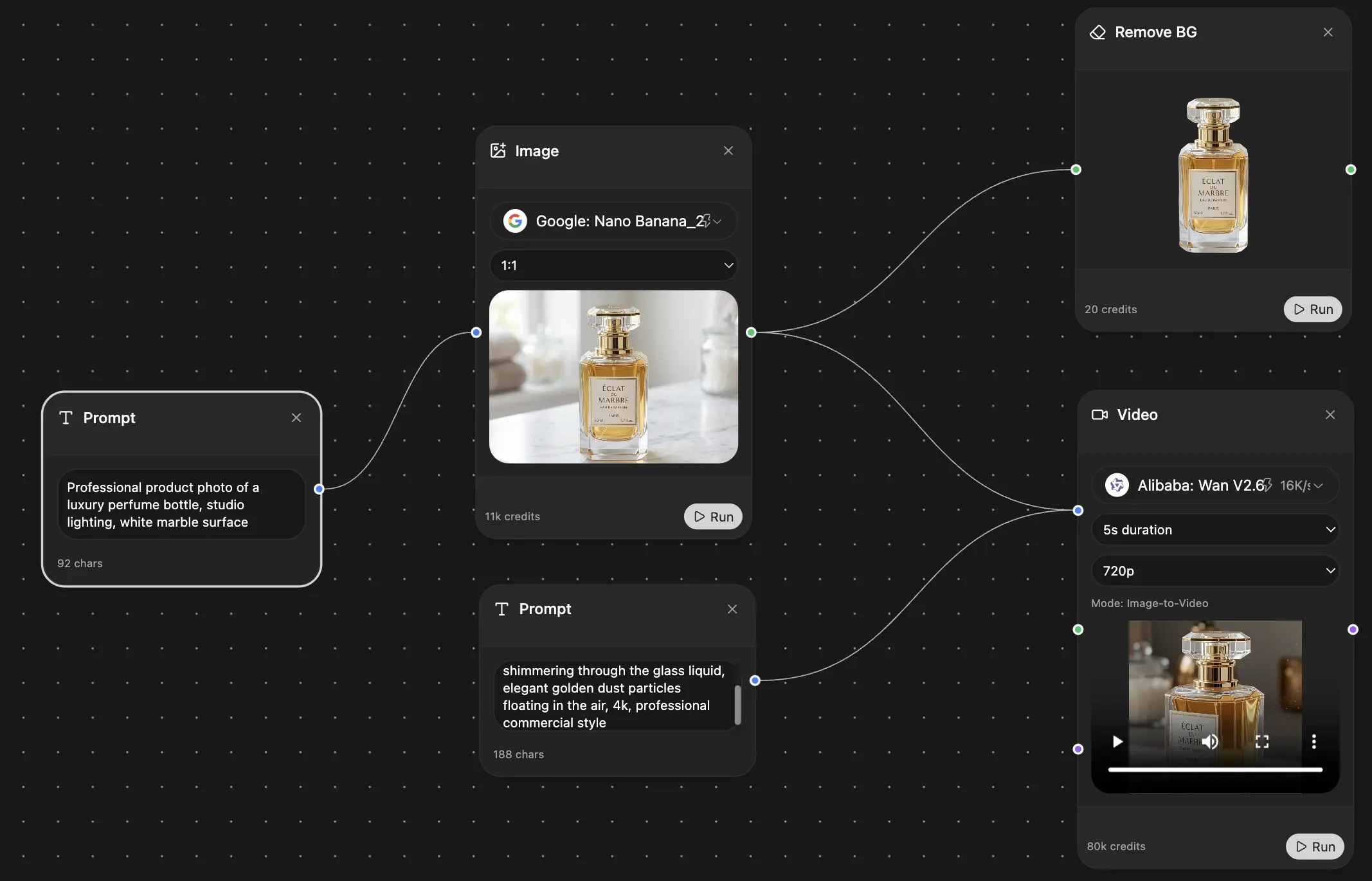
Your infinite AI canvas.
Chat, image, video & motion tools — side by side
Save hours of work and research
Transparent, High-Value Pricing
Trusted by teams at






Free
No credit card required
- 100 credits daily
- 3 AI models to try
- Basic AI chat
Plus
- 1,000,000 credits/month
- 25+ AI models — GPT, Claude, Gemini, Grok & more
- Agent Mode with web search, computer tools and more
- Creative Studio: image generation and video generation
- Project Library: chat with document, website and youtube, podcast generation, flashcards, reports and more
- Workflow Studio and FocusOS
Professional
- Everything in Plus, and:
- 2,100,000 credits/month
- Pro-exclusive models (Claude Opus, Grok 4, Sonar Pro)
- Motion Tools & Max Mode
- First access to latest features
- Access to additional offers
What Our Users Say
Great Tool after 2 months usage
simplyzubair
I love the way multiple tools they integrated in one platform. So far it is going in right dorection adding more tools.
Best in Kind!
barefootmedicine
This is another game-change. have used software that kind of offers similar features, but the quality of the data I'm getting back and the sheer speed of the responses is outstanding. I use this app ...
simply awesome
MarianZ
I just tried it - didnt wanna stay with it, because there is so much like that out there. But it convinced me, because: - the discord-channel is very response and fast - the number of models are quite...
A Surprisingly Comprehensive and Engaging Experience
bruno.battocletti
Zemith is not just another app; it's a surprisingly comprehensive platform that feels like a toolbox filled with unexpected delights. From the moment you launch it, you're greeted with a clean and int...
Great for Document Analysis
yerch82
Just works. Simple to use and great for working with documents and make summaries. Money well spend in my opinion.
Great AI site with lots of features and accessible llm's
sumore
what I find most useful in this site is the organization of the features. it's better that all the other site I have so far and even better than chatgpt themselves.
Excellent Tool
AlphaLeaf
Zemith claims to be an all-in-one platform, and after using it, I can confirm that it lives up to that claim. It not only has all the necessary functions, but the UI is also well-designed and very eas...
A well-rounded platform with solid LLMs, extra functionality
SlothMachine
Hey team Zemith! First off: I don't often write these reviews. I should do better, especially with tools that really put their heart and soul into their platform.
This is the best tool I've ever used. Updates are made almost daily, and the feedback process is very fast.
reu0691
This is the best AI tool I've used so far. Updates are made almost daily, and the feedback process is incredibly fast. Just looking at the changelogs, you can see how consistently the developers have ...