AI for Creative Writing: Your Ultimate Co-Author
Unlock your best work with AI for creative writing. Learn practical workflows, prompt secrets, and how to use tools like Zemith without losing your voice.
The cursor is blinking. Your coffee is cooling. The opening line still sounds like a hostage note written by someone who once skimmed a poetry book in an airport.
That's where a lot of writers are right now with AI for creative writing. Curious, suspicious, a little annoyed, and secretly hoping it can help without turning every sentence into glossy oatmeal.
Used badly, AI gives you exactly that. Smooth, generic, oddly overconfident prose that sounds like it was assembled by a committee of motivational LinkedIn posts. Used well, it becomes something more useful: a sparring partner, a research assistant, a line editor with infinite patience, and occasionally the friend who says, “That plot twist makes no sense, but I support your chaos.”
The Blank Page Is Not So Scary Anymore
Writer's block rarely looks dramatic. It looks like reopening the same document six times, changing the protagonist's name twice, and convincing yourself that checking the fridge counts as “letting the subconscious work.”
The practical shift is this. AI no longer has to be treated like a machine that spits out full stories. It can sit beside your process and help you get moving. That matters because the category itself isn't fringe anymore. The AI writing market is projected to hit $4.2 billion by the end of 2026, more than ten times its 2022 size, and the same adoption wave is tied to AI-assisted content production being 60% to 85% cheaper than traditional methods, according to .

That scale changes the question. It's no longer “Should writers care?” They already do. The better question is “How do you use it without flattening your voice?”
What the blank page needs first
Most stalled drafts don't need brilliance first. They need motion.
A useful AI session at the beginning of a story can help you:
- Break inertia: Ask for five conflicting motivations for your protagonist.
- Stress-test a premise: Have it poke holes in your setup before readers do.
- Surface fresh angles: Request scene seeds based on mood, not just plot.
- Restart momentum: Turn a vague hunch into a rough outline you can argue with.
AI works best when it gives you something to react to, not something to obey.
That's why the most helpful use often feels less like outsourcing and more like sparring. You throw a weak idea at it, it throws back three stronger ones and one terrible one, and suddenly your own instincts wake up.
If the problem right now is getting unstuck, a practical place to start is this guide on . The useful part isn't the promise of magic. It's having a repeatable way to get words moving again.
What AI Actually Does For Your Writing
Writers often talk about AI as if it has one mode. It doesn't. It plays different jobs depending on what you ask for, and most of those jobs are support roles.
A 2025 survey of over 1,200 authors found that the top uses were research at 81%, marketing copy at 73%, and outlining at 72%, while direct structural drafting was only 13% among AI-using authors, as reported in . That sounds about right. Serious writers tend to trust AI more with scaffolding than soul.

The Brainstormer
This is the easiest role to grasp. You feed AI a premise, mood, constraint, or character problem, and it throws possibilities back.
It's good at divergent thinking when you're tired of your own loops. Ask for:
- Plot pressure: “Give me seven ways this dinner scene could go wrong without violence.”
- Character friction: “List tensions between a father and daughter that don't involve open conflict.”
- World texture: “Suggest rituals for a city that fears mirrors.”
The key is volume with selection. You are not there to accept the first answer. You are there to steal the one line that wakes up your own imagination.
The Researcher
For fiction, research is usually less about gathering trivia and more about avoiding stupid mistakes. If you're writing historical fiction, legal drama, fantasy with real-world physics, or anything involving weapons, medicine, religion, or geography, AI can help you frame the questions.
It's especially useful for building a quick brief before deeper verification. Think of it as the intern who gathers the folders, not the attorney arguing the case.
A good research prompt asks for uncertainty, not confidence. Make the model tell you what needs checking.
The Wordsmith
This role is underrated. Sometimes the sentence is almost right, but not alive yet.
AI can help with:
- Rephrasing without flattening
- Finding the right verb
- Reducing repetition
- Adjusting rhythm for tone
That's where tools focused on can be practical. Not because they “improve” every line by default, but because they let you test alternatives fast. You still decide whether the rewrite sounds like you or like a brochure for artisanal rain.
The Editor
This is where AI earns its keep.
Not as a replacement for human editorial judgment. As a first-pass filter for clunky phrasing, repeated sentence openings, accidental contradiction, and scenes that explain what readers already understood three paragraphs ago.
A compact way to consider this:
One workspace helps because switching tools mid-draft kills rhythm. A platform like Zemith keeps brainstorming, rewriting, and document-based analysis in one place, which is handy when you're trying to stay inside the story instead of juggling tabs like a circus understudy.
Your First AI-Powered Writing Workflow
Let's make this concrete. Say you want to write a short story about a locksmith who starts receiving keys that open places that shouldn't exist. Good premise. Slightly haunted. Nice.
The common mistake is asking AI to “write the story.” That's the fastest route to generic prose and the shortest route to disappointment.
A stronger workflow uses AI for creative writing the way a working writer would use an assistant. For support, pressure, and cleanup.

Data supports that approach. Only 11% of fiction authors using AI generate publishable text with it, while the most valued tasks are suggesting titles at 72%, brainstorming at 68%, and finding the right words at 68%, according to the .
Step one, generate pressure not plot
Don't start with “write me a story about a locksmith.”
Start with constraints.
Try prompts like:
- Conflict-first: “Give me six complications for a locksmith who receives impossible keys. Keep them grounded and eerie, not horror parody.”
- Theme-first: “Suggest story directions built around guilt, debt, and entry.”
- Image-first: “List ten vivid opening images involving keys, doors, and secrecy.”
This gives you raw material without handing over authorship. You're gathering sparks, not accepting furniture assembly instructions from a robot.
Step two, outline only the bones
Once one idea has bite, ask for structure. Short structure.
Have AI produce:
- A one-paragraph premise
- A six-scene progression
- Three possible endings with different emotional payoffs
Keep it skeletal. If the outline gets too detailed too early, it starts deciding the story for you.
A practical rule here is to preserve blank spaces on purpose. Leave some scene transitions unresolved. Leave emotional turns unpinned. Those gaps are where your actual writing happens.
Practical rule: If the outline feels finished, it's probably too finished.
If you want a related workflow for moving faster from idea to clean draft, this guide on is useful even for fiction. The core lesson carries over. Speed comes from better sequencing, not from skipping thought.
Step three, draft snippets not chapters
Now use AI for isolated tasks.
Ask it for:
- an opening paragraph in three different tonal directions
- ten sensory details for the locksmith's shop
- dialogue variants for a suspicious customer
- three metaphors for keys that don't sound like fortune cookies
Write the actual scene yourself. Lift fragments if they help. Reject most of them if they don't.
This often surprises people. AI is often better at giving you ingredients than meals. One strange image, one cleaner verb, one sharper line of dialogue can rescue a page. The whole generated chapter usually cannot.
A quick demonstration can help if you want to see how people are building practical prompt-driven workflows:
Step four, refine in passes
Once you've drafted a scene, don't ask, “Is this good?”
That question gets mushy answers. Ask for specific diagnoses.
Use prompts like:
That sequence matters. Clean logic first. Style second. Rhythm third. If you polish the music before fixing the bones, you end up with elegant nonsense.
The whole workflow is simple: generate tension, outline lightly, draft selectively, refine in focused passes. That's how AI becomes useful without becoming the author.
Advanced Prompts For Unique Storytelling
Most AI writing advice stops at “be specific.” That's beginner advice. It helps, but it doesn't solve the actual problem.
The problem is slop. Not bad grammar. Not obvious errors. Slop is the polished, serviceable, personality-light prose that sounds fine until you realize nobody would recognize it as yours.
That's why the high-value move in AI for creative writing isn't idea generation. It's voice enforcement.
Research points in that direction. The biggest value for writers is often refinement rather than creation, and advanced workflows are needed because stories can become 5.2% more similar to AI's default ideas without deliberate style training, according to .
What anti-slop prompting means
An anti-slop prompt teaches the model two things at once:
- what your writing should sound like
- what your writing should never sound like
Individuals often only do the first half.
They say, “Write in a lyrical literary style.” The model hears “be elegant” and responds with the verbal equivalent of decorative soap. It's shiny and weirdly unsatisfying.
A stronger prompt includes negative style constraints.
For example:
- Avoid generic uplift
- Do not summarize emotions after showing them
- Keep metaphors physical, not abstract
- No fake profundity
- Do not make every line symmetrical
That's anti-slop. You're defining the traps.
A weak prompt and a useful one
Here's the lazy version:
Write a moody literary scene where a woman returns to her childhood home and feels haunted by memory.
That will usually produce competent mush.
Here's a stronger version:
Analyze the attached sample pages for sentence length, metaphor style, emotional restraint, and how interiority is handled. Then write a new scene in which a woman returns to her childhood home. Keep the prose intimate but unsentimental. Use concrete sensory details over abstract reflection. Avoid lines that sound inspirational, over-polished, or vaguely “writerly.” Do not explain the emotion after the image. Keep dialogue sparse. If a sentence could belong in any contemporary literary novel, replace it with something more specific.
That second prompt does something important. It treats the model like an apprentice copy editor studying your habits, not a vending machine for vibes.
Build a small voice file
If you want AI to sound less like everyone else, give it a stable reference set.
Use a mini packet that includes:
- Three to five pages of your own writing
- A short note on recurring habits you like
- A blacklist of habits you hate
- One paragraph describing the emotional range you aim for
Prompt libraries are helpful. A set of reusable can save time, but the trick is personalizing them until they stop sounding like templates.
Don't ask AI to “be original.” Ask it to preserve your decisions.
The prompts worth keeping
A few anti-slop prompts earn permanent status in your toolkit:
- Voice audit: “Mark five sentences that sound like default AI prose and explain why.”
- Overwriting check: “Cut ornament where the image already carries the feeling.”
- Character diction filter: “Revise this dialogue so each speaker sounds distinguishable without adding quirks.”
- Specificity rescue: “Replace vague nouns and generic descriptors with details implied by setting and class.”
If you do this well, AI stops being a ghostwriter and starts acting like a style-conscious assistant. That's a much safer arrangement for anybody who'd like to keep their soul, or at least their syntax.
Using Multiple AI Models For The Best Results
One model rarely does everything well. Writers feel this fast, even if they can't always name it.
One model gives you energetic brainstorming but messy structure. Another is cleaner with outlines but stiffer on voice. A third can help with image generation for mood boards or character references. The practical workflow isn't “pick one forever.” It's “match the model to the task.”

A multi-model story task
Take a single creative task. You're building a secondary character for a novel.
A sensible sequence looks like this:
In practice, that might mean using one model to brainstorm, another to pressure-test continuity, and an image model to generate visual references for clothing, posture, or setting. Then you write the scene with those materials in front of you.
Why this matters for actual writing days
The problem isn't that writers lack tools. The problem is that most tool stacks are annoying.
Too many tabs. Too many chat histories. Too many half-finished prompt experiments scattered across platforms like breadcrumbs from a technologically stressed fairy tale.
A central workspace solves a boring problem that matters more than people admit. Continuity. If your notes, drafts, source documents, and model outputs live together, you can build a project instead of a pile.
That's the appeal of comparing options through something like an . Different models have different writing strengths, and the useful question is never “Which one wins?” It's “Which one should handle this part of the job?”
One project, several passes
A compact example:
- First pass: Generate a character portrait and a few costume references.
- Second pass: Turn those visuals into social class clues, habits, and personal history.
- Third pass: Check whether the backstory supports the character's role in the plot.
- Fourth pass: Review scene dialogue for consistency with that profile.
That kind of layered process is where all-in-one systems become practical rather than flashy. Writers don't need novelty. They need fewer interruptions and better recall across a project.
The useful mindset is this: use multiple models like specialists in one room. You're still the one running the meeting.
Your Guide To AI Ethics And Creative Pitfalls
The most honest conversation about AI for creative writing isn't about speed. It's about sameness.
AI can help a weak draft become more coherent. It can also make a thousand unrelated writers drift toward the same sentence patterns, the same scene logic, the same safe emotional beats. That's not a theoretical problem. It's already visible in the texture of a lot of machine-assisted prose.
Research shows AI can increase the novelty of stories for less creative writers by up to 10.7%, while also making all writers' stories 5.0% to 5.2% more similar to the AI's ideas, reducing the collective diversity of new content, according to .
The uncomfortable trade-off
Individually, AI can help. Collectively, it can narrow the field.
That means the ethical issue isn't only plagiarism or disclosure. It's whether your workflow is training you to converge on obvious choices.
If the tool keeps offering the most statistically likely next move, your job is to notice when the story becomes too agreeable.
How to push against homogenization
A few habits help:
- Ask for opposites: If the model suggests the obvious turn, ask for three less marketable but more revealing alternatives.
- Use AI after your own draft: Don't let the first shape of the scene come from the machine every time.
- Prompt for divergence: Ask for interpretations from conflicting emotional lenses.
- Keep your lived detail human: Family rituals, regional phrasing, sensory memory, and odd personal fixations are where sameness breaks.
What not to outsource
Some parts of writing lose too much when delegated.
Avoid handing over:
Core emotional decisions
The machine can suggest possibilities. It shouldn't decide what your story means.Moral tension
AI likes resolution and clarity. Good fiction often doesn't.Personal weirdness
The strange detail from your life is usually worth more than ten polished generated ones.
There's also the trust question. Readers may forgive assistance more easily than they forgive blandness. If the prose feels bloodless, they won't care how efficient your process was.
So the ethical line isn't merely “Did AI touch this?” It's also “Did I remain the author in any meaningful sense?” That's the version worth taking seriously.
Your New AI-Powered Creative Process
A workable creative process with AI is less glamorous than the hype suggests. It's also more useful.
You don't need a machine to replace imagination. You need a system that helps you start faster, test ideas harder, revise more critically, and protect the part of the work that truly belongs to you. That usually means using AI for exploration, structure, and refinement while keeping final judgment in human hands.
The process that tends to hold up
The pattern is simple:
- Start with your premise or image
- Use AI to generate friction, not finality
- Outline lightly
- Draft the living parts yourself
- Run focused revision passes
- Use anti-slop prompts to guard your voice
That workflow respects the trade-off. AI is good at acceleration. It's terrible at caring. Caring is still your department.
Keep your toolkit practical
A lot of writers overcomplicate this. They collect tools instead of building habits.
A better stack is small and boring:
For side tasks around publishing, formatting, or book-adjacent cleanup, are worth bookmarking. They're the kind of simple helpers that save time without trying to become your personality.
What matters most is staying deliberate. If you train AI on your preferences, reject generic output aggressively, and keep your own judgment at the center, the tool becomes useful without becoming invasive.
That's the sweet spot. Faster drafting, sharper revision, less tab chaos, and a stronger grip on your voice instead of a weaker one.
If you want one place to handle drafting, rewriting, document analysis, prompts, research, and multiple AI models without bouncing between separate apps, is a practical place to start.
Explore Zemith Features
Everything you need. Nothing you don't.
One subscription replaces five. Every top AI model, every creative tool, and every productivity feature, in one focused workspace.
Every top AI. One subscription.
ChatGPT, Claude, Gemini, DeepSeek, Grok & 25+ more







Always on, real-time AI.
Voice + screen share · instant answers
What's the best way to learn a new language?
Immersion and spaced repetition work best. Try consuming media in your target language daily.
Voice + screen share · AI answers in real time
Image Generation
Flux, Nano Banana, Ideogram, Recraft + more

Write at the speed of thought.
AI autocomplete, rewrite & expand on command
Any document. Any format.
PDF, URL, or YouTube → chat, quiz, podcast & more
Video Creation
Veo, Kling, Grok Imagine and more

Text to Speech
Natural AI voices, 30+ languages
Code Generation
Write, debug & explain code
Chat with Documents
Upload PDFs, analyze content
Your AI, in your pocket.
Full access on iOS & Android · synced everywhere
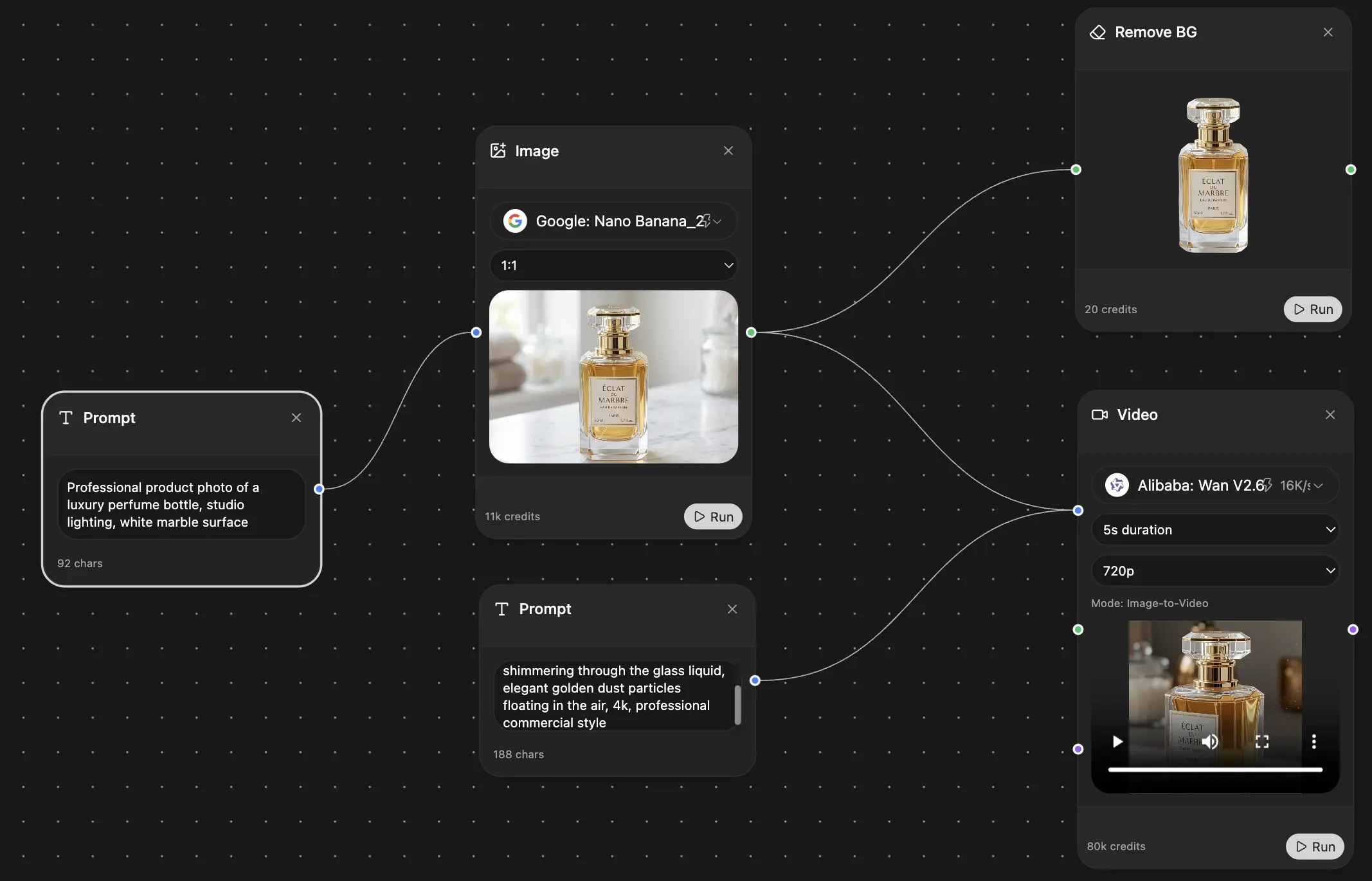
Your infinite AI canvas.
Chat, image, video & motion tools — side by side
Save hours of work and research
Transparent, High-Value Pricing
Trusted by teams at






Free
No credit card required
- 100 credits daily
- 3 AI models to try
- Basic AI chat
Plus
- 1,000,000 credits/month
- 25+ AI models — GPT, Claude, Gemini, Grok & more
- Agent Mode with web search, computer tools and more
- Creative Studio: image generation and video generation
- Project Library: chat with document, website and youtube, podcast generation, flashcards, reports and more
- Workflow Studio and FocusOS
Professional
- Everything in Plus, and:
- 2,100,000 credits/month
- Pro-exclusive models (Claude Opus, Grok 4, Sonar Pro)
- Motion Tools & Max Mode
- First access to latest features
- Access to additional offers
What Our Users Say
Great Tool after 2 months usage
simplyzubair
I love the way multiple tools they integrated in one platform. So far it is going in right dorection adding more tools.
Best in Kind!
barefootmedicine
This is another game-change. have used software that kind of offers similar features, but the quality of the data I'm getting back and the sheer speed of the responses is outstanding. I use this app ...
simply awesome
MarianZ
I just tried it - didnt wanna stay with it, because there is so much like that out there. But it convinced me, because: - the discord-channel is very response and fast - the number of models are quite...
A Surprisingly Comprehensive and Engaging Experience
bruno.battocletti
Zemith is not just another app; it's a surprisingly comprehensive platform that feels like a toolbox filled with unexpected delights. From the moment you launch it, you're greeted with a clean and int...
Great for Document Analysis
yerch82
Just works. Simple to use and great for working with documents and make summaries. Money well spend in my opinion.
Great AI site with lots of features and accessible llm's
sumore
what I find most useful in this site is the organization of the features. it's better that all the other site I have so far and even better than chatgpt themselves.
Excellent Tool
AlphaLeaf
Zemith claims to be an all-in-one platform, and after using it, I can confirm that it lives up to that claim. It not only has all the necessary functions, but the UI is also well-designed and very eas...
A well-rounded platform with solid LLMs, extra functionality
SlothMachine
Hey team Zemith! First off: I don't often write these reviews. I should do better, especially with tools that really put their heart and soul into their platform.
This is the best tool I've ever used. Updates are made almost daily, and the feedback process is very fast.
reu0691
This is the best AI tool I've used so far. Updates are made almost daily, and the feedback process is incredibly fast. Just looking at the changelogs, you can see how consistently the developers have ...