Academic Writing Assistant: Master Your Research in 2026
Struggling with papers? An academic writing assistant streamlines research, drafting, and editing. Use AI to write smarter in 2026.
You know the feeling. You open the doc, type a title that sounds vaguely intelligent, and then nothing happens. Your tabs multiply. One has a PDF. Another has a citation guide. Another has a chatbot giving you suspiciously confident nonsense. The cursor blinks like it pays rent.
That's usually the moment people either panic-write garbage or start looking for a shortcut that crosses into cheating. There's a better option. A real academic writing assistant doesn't replace your thinking. It helps you move from scattered notes to an actual argument without turning your paper into robot oatmeal.
That Blinking Cursor Is Judging You
At some point, nearly every student or researcher ends up in the same scene. It's late. The paper is long. You've read enough sources to feel overwhelmed, but not organized enough to write. You know the topic. You just can't get the first paragraph to cooperate.
The worst part is that academic writing bottlenecks rarely come from laziness. They come from friction. You're trying to remember what that one article argued, where the useful quote was, whether your framing is too broad, and why your introduction sounds like a committee wrote it.
Why this stopped being a niche problem
An academic writing assistant has become a real category of tool because this pain is universal, and because the amount of reading and synthesis modern academic work demands is brutal. The market reflects that shift. The global academic writing assistants market was $6.2 billion in 2025 and is projected to reach $15.8 billion by 2034 according to .
That matters for one simple reason. This isn't some novelty app students use to dodge writing. It's becoming normal infrastructure for research and writing work.
The useful version of AI in academia doesn't write your ideas for you. It removes the dumb friction that keeps your ideas trapped in bullet points.
What actually helps when you're stuck
When writer's block hits, generic advice like “just start” isn't much help. Starting is exactly the problem. What helps is lowering the activation energy.
A good assistant can help you:
- Interrogate your notes: Ask what themes repeat across your sources.
- Build momentum: Turn rough bullets into a cleaner outline.
- Clean the prose later: Fix clunky sentences after the argument exists.
- Stay anchored in evidence: Work from your materials instead of free-floating text generation.
If your current system is “open seven tabs and vibe,” it's worth reading practical guidance on . The trick usually isn't inspiration. It's giving yourself a workflow that creates motion before perfectionism kicks in.
And yes, the cursor is still blinking. It's just less smug when you've got backup.
Meet Your New Research Intern
The easiest way to misuse an academic writing assistant is to treat it like a “write my paper” button. That's where bad paraphrasing, fake citations, and awkward, overpolished mush come from.
A better mental model is this. Treat it like a research intern.
Not a ghostwriter. Not a substitute brain. A fast, tireless, occasionally overconfident intern who needs supervision.

What your intern is actually good at
A solid assistant can play several roles in one session.
- Librarian mode: It scans your papers, notes, and excerpts fast enough to surface patterns you would have taken much longer to spot.
- Brainstorm partner: It's useful when you need angles, counterarguments, alternate framings, or a cleaner research question.
- Copy editor: It catches repetitive wording, awkward phrasing, and structure problems when your brain is too fried to see them.
- Explainer: It can restate dense material in plain English so you can test whether you understand it.
That last one matters more than people admit. If you can't explain your source material clearly, you probably aren't ready to synthesize it.
What your intern is terrible at
At this point, people get into trouble.
Your assistant should not decide your thesis, invent literature, or fake confidence about claims it can't verify. It will do those things if you let it. That's not rebellion. That's just software behaving like software.
Practical rule: If the tool gives you a sentence you couldn't defend in office hours, don't paste it into your paper.
For discipline-specific work, external expert communities can also help pressure-test questions before you draft. If you're working in biology or biochemistry, a niche prompt like can be useful when you need to clarify a pathway or process before you write about it.
If you want a broader view of where AI fits into actual scholarly workflows, this guide on is a helpful place to start.
The right attitude makes the tool useful
Think of the relationship like this:
- You provide the question.
- You provide the sources.
- The assistant helps sort, phrase, compare, and refine.
- You keep final control over interpretation.
That's the whole game. Once you stop asking AI to “do the assignment” and start asking it to support the assignment, the quality gets better fast.
Also, unlike a real intern, it won't steal your yogurt from the department fridge.
The Ultimate Academic Toolbox Explained
Not all writing help deserves the same label. Built-in spellcheck is useful, but it's not an academic writing assistant in the full sense. It's more like a seatbelt. Necessary, but not enough to drive the car.
The difference emerges when the work gets scholarly. Academic writing isn't just sentence cleanup. It's literature review, synthesis, conceptual framing, evidence handling, and keeping your claims aligned with sources.
Surface fixes versus academic tasks
Here's where basic tools run out of road.
That integration matters more than people think. Even productivity advice outside academia makes the same point. If you already live inside Google tools, this guide to is a good reminder that fragmented systems create hidden drag.
Why specialized tools win
This is the part most students discover the hard way. General writing tools can be decent at polishing everyday English. They're much shakier when your paragraph includes method terms, field-specific phrasing, cautious claims, or citation-heavy discussion.
Domain-specific accuracy is critical. In academic writing benchmarks, specialized models like Claude achieve 81% accuracy, while general tools like Grammarly score 71% according to . That gap matters because academic writing is full of language that looks odd to generic tools but is perfectly normal in context.
A general tool might “correct” something that isn't wrong. It might flatten nuance. It might push you toward clearer prose at the cost of precision, which is a bad trade in a methods section.
A tool that improves readability but distorts meaning is not helping. It's editing your paper into a different paper.
The features worth caring about
When you're choosing an academic writing assistant, don't get distracted by flashy promises. Look for a toolkit that supports research work.
A strong setup usually includes:
- Document-aware chat: Ask direct questions about uploaded PDFs instead of relying on memory.
- Theme extraction: Pull recurring arguments and tensions across sources.
- Outline support: Turn notes into a structure before drafting full paragraphs.
- Paragraph rewriting: Refine wording without losing the original claim.
- Model flexibility: Different tasks benefit from different models, especially when one is better at reasoning and another is better at concise phrasing.
If you're comparing options, a curated view of the is more useful than random feature lists because it keeps the focus on actual research tasks, not marketing glitter.
The right toolbox doesn't just make sentences prettier. It helps you think on the page without constantly switching contexts.
A Smarter Workflow Not A Shortcut
The cleanest use of an academic writing assistant starts before you write a single paragraph. If your sources, notes, and draft all live in different places, the tool can't save you from chaos. It can only accelerate it.
A better workflow starts by building one source of truth.

Step one, build a project around your sources
Create one workspace for the paper. Put your PDFs, notes, and article excerpts there. Don't leave half the evidence in a downloads folder named “final_final_REAL.”
An integrated platform like Zemith proves practical. It lets you keep documents, chats, notes, and drafting tools in one workspace, so you're not bouncing between separate apps for reading, asking questions, and rewriting.
That matters because the biggest risk with general AI is hallucinated citations. The safer approach is source-grounded autocomplete, where suggestions are tied to a specific uploaded PDF library with verifiable page references, as discussed in .
Step two, interrogate the literature instead of rereading everything
Once your sources are in one place, start asking actual research questions.
Not “summarize this.” That usually gives you mush.
Ask things like:
- Which authors disagree on the causal mechanism?
- What limitations appear across these studies?
- Which papers define this term differently?
- Pull passages about methodology with page references.
This changes the job. You stop using AI as a text vending machine and start using it as a retrieval and synthesis layer.
If your paper involves a lot of sources or datasets, this guide to is worth bookmarking because messy input almost always leads to messy output.
Step three, turn notes into a working outline
Now build an outline from the evidence you've already surfaced. Keep it ugly at first.
I like a structure that looks something like this:
- Core claim
- Key supporting themes from the literature
- Tensions or disagreements
- Method or lens
- What the paper adds
That's enough to start. Once the skeleton exists, you can ask the assistant to transform note clusters into paragraph candidates. The key is that the raw material came from your sources, not from generic web-shaped guesswork.
Don't ask for a polished introduction too early. Ask for a rough map of the argument first. Pretty prose is cheap. Structure is the hard part.
Here's a walkthrough-style video if you want to see the workspace pattern in action before trying it yourself.
Step four, draft with supervision
This is where people either use AI wisely or go off the rails.
Use it to:
- Rephrase clunky sentences when your meaning is already clear
- Shorten bloated paragraphs that sound like you swallowed a textbook
- Generate transition options between sections
- Check whether a paragraph answers the research question
Don't use it to invent evidence, decide what your sources mean, or produce final claims you haven't validated.
A literature review, after all, isn't just summary. It requires systematically identifying, evaluating, and synthesizing scholarship into a coherent narrative, as explained in . That synthesis has to come from you.
The workflow is simple. Gather sources. Interrogate them. Organize the findings. Draft from grounded notes. Revise with AI, not through AI.
That's not a shortcut. It's just a smarter lab bench for writing.
How to Use AI Without Annoying Your Professor
Professors usually aren't upset because a student used software. They get annoyed when the writing sounds detached, unsupported, and weirdly overconfident. You've seen that tone before. It's the paragraph that says a lot and proves nothing.
Ethical use of an academic writing assistant comes down to role clarity. You are the director. The tool is the assistant. The second you hand over judgment, you're asking for trouble.
Fact-check everything that smells like a number
One of the easiest ways to get burned is to trust AI-generated facts because they look tidy. Don't.
Writers need to fact-check every key statistic and data point against original sources because AI-generated numbers are often wrong, and prompts need to leave little room for ambiguity, as explained in .
That rule applies even when the sentence sounds polished. Especially then.

Don't outsource the hard thinking
Here's the uncomfortable trade-off. AI can help you produce cleaner prose faster, but that doesn't mean it improves your deeper writing ability.
A 2025 linguistic study found that while AI improves surface-level accuracy, deeper skills like syntactic variation, critical thinking, and creativity aren't automatically strengthened and can even be impaired when AI substitutes for cognitive effort, according to .
That tracks with what many students notice in practice. If the tool always resolves the hard part immediately, you never sit with the problem long enough to sharpen your own reasoning.
Use AI for friction. Keep the struggle that produces insight.
Rules that keep you safe and useful
A decent ethical framework is boring, which is how you know it works.
- Own the argument: Let the assistant help shape phrasing, but your thesis and interpretation should come from your reading.
- Check citations manually: If a reference matters, open it. Verify it exists. Verify it says what you claim.
- Keep your voice in the final pass: Read the paper aloud. If a sentence sounds like a committee of robots earned a fellowship, rewrite it.
- Use paraphrasing carefully: Changing wording isn't the same as understanding. This practical guide on is useful because it focuses on preserving meaning rather than doing cosmetic synonym swaps.
- Prefer assistance over generation: Ask for outlines, comparisons, explanations, and edits more often than full draft blocks.
If you want a broader education context for this shift, is a solid companion read. It helps frame why classroom and research use cases need more care than casual content generation.
Keep the paper readable
One more thing. Academic writing doesn't need to sound like you're hiding behind jargon. Strong reports and papers guide the reader through a problem, key findings, and a clear conclusion. They also benefit from plain language when possible, as noted in .
That doesn't mean dumbing it down. It means respecting the reader enough to be clear.
Professors usually like clarity. They just also like honesty, evidence, and signs that a human being actually thought about the material.
Stop Juggling Tools Start Writing
The core upgrade isn't “use AI.” That advice is too vague to help. The upgrade is building a workflow where your sources, notes, questions, and draft live close enough together that you can think without constant interruption.
That's why the research-intern framing works. You're still doing the scholarship. You're still deciding what matters, what counts as evidence, what the literature gets wrong, and what your paper contributes. The assistant just makes the busywork less punishing.
What usually fails
Most bad workflows look like this:
- Separate PDF reader: One place for reading
- Separate chatbot: Another place for questions
- Separate doc editor: Another place for drafting
- Separate grammar tool: Another place for cleanup
That setup doesn't just waste time. It breaks concentration. By the time you switch tools, copy text, re-explain context, and chase citations, the writing session is half gone.
What tends to work
A better system keeps the research loop tight.
Read the source. Ask a targeted question. Save the useful note. Turn that note into an outline point. Turn that point into a paragraph. Revise the paragraph with the source still visible. Repeat.
That's why all-in-one workspaces are gaining traction with students and researchers. They reduce the hidden tax of context switching. Less tool management. More actual thinking.
And that's the whole appeal of a good academic writing assistant. Not cheating. Not auto-writing. Just fewer pointless obstacles between your reading and your argument.
If your current research process feels like juggling tabs, notes, and half-finished drafts, is worth a look as a single workspace for documents, drafting, and AI-assisted research support.
Explore Zemith Features
Everything you need. Nothing you don't.
One subscription replaces five. Every top AI model, every creative tool, and every productivity feature, in one focused workspace.
Every top AI. One subscription.
ChatGPT, Claude, Gemini, DeepSeek, Grok & 25+ more








Always on, real-time AI.
Voice + screen share · instant answers
What's the best way to learn a new language?
Immersion and spaced repetition work best. Try consuming media in your target language daily.
Voice + screen share · AI answers in real time
Image Generation
Flux, Nano Banana, Ideogram, Recraft + more

Write at the speed of thought.
AI autocomplete, rewrite & expand on command
Any document. Any format.
PDF, URL, or YouTube → chat, quiz, podcast & more
Video Creation
Veo, Kling, Grok Imagine and more

Text to Speech
Natural AI voices, 30+ languages
Code Generation
Write, debug & explain code
Chat with Documents
Upload PDFs, analyze content
Your AI, in your pocket.
Full access on iOS & Android · synced everywhere
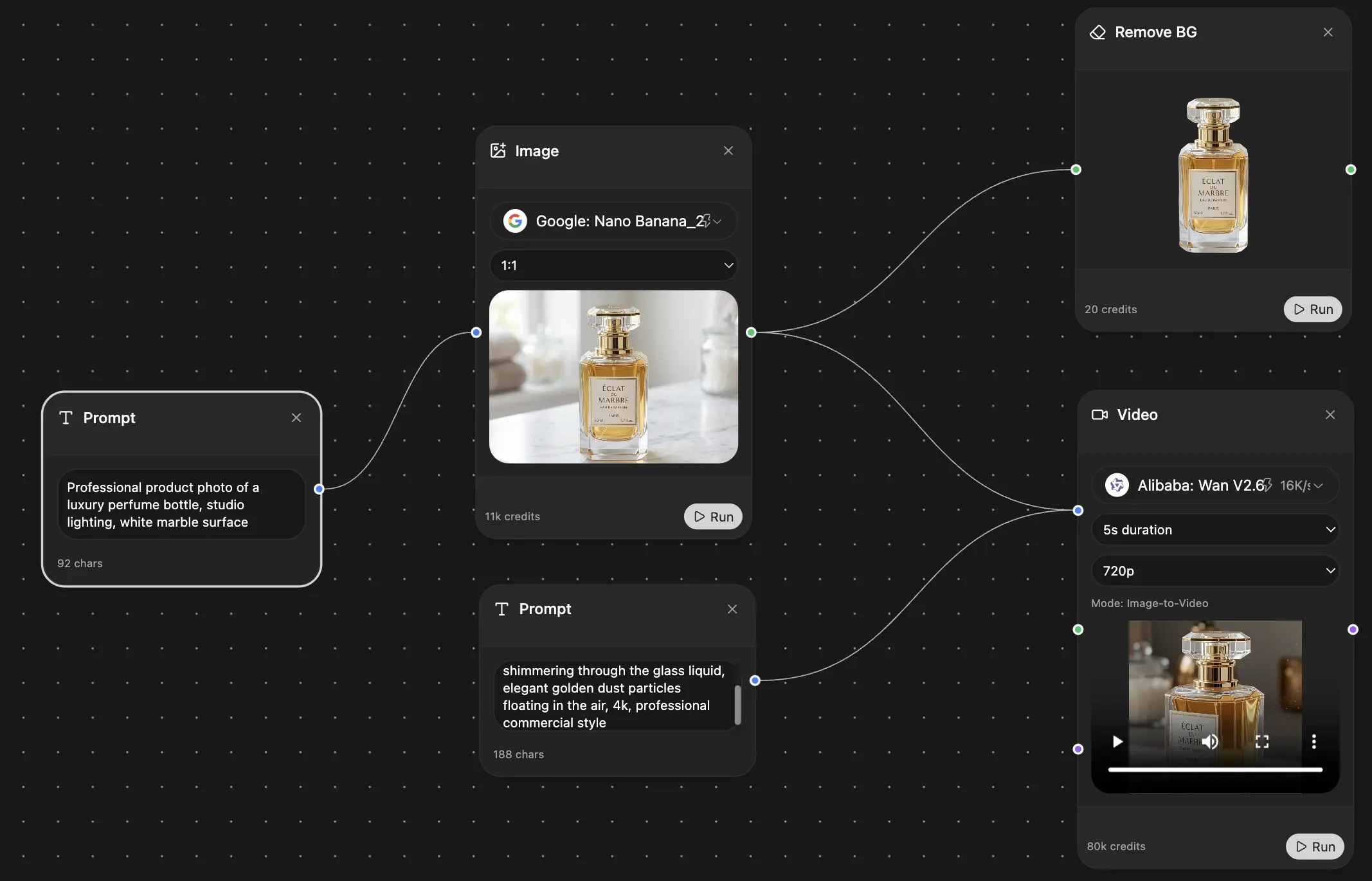
Your infinite AI canvas.
Chat, image, video & motion tools — side by side
Save hours of work and research
Transparent, High-Value Pricing
Trusted by teams at






Free
No credit card required
- 100 credits daily
- 3 AI models to try
- Basic AI chat
Plus
- 1,000,000 credits/month
- 25+ AI models — GPT, Claude, Gemini, Grok & more
- Agent Mode with web search, computer tools and more
- Creative Studio: image generation and video generation
- Project Library: chat with document, website and youtube, podcast generation, flashcards, reports and more
- Workflow Studio and FocusOS
Professional
- Everything in Plus, and:
- 2,100,000 credits/month
- Pro-exclusive models (Claude Opus, Grok 4, Sonar Pro)
- Motion Tools & Max Mode
- First access to latest features
- Access to additional offers
What Our Users Say
Great Tool after 2 months usage
simplyzubair
I love the way multiple tools they integrated in one platform. So far it is going in right dorection adding more tools.
Best in Kind!
barefootmedicine
This is another game-change. have used software that kind of offers similar features, but the quality of the data I'm getting back and the sheer speed of the responses is outstanding. I use this app ...
simply awesome
MarianZ
I just tried it - didnt wanna stay with it, because there is so much like that out there. But it convinced me, because: - the discord-channel is very response and fast - the number of models are quite...
A Surprisingly Comprehensive and Engaging Experience
bruno.battocletti
Zemith is not just another app; it's a surprisingly comprehensive platform that feels like a toolbox filled with unexpected delights. From the moment you launch it, you're greeted with a clean and int...
Great for Document Analysis
yerch82
Just works. Simple to use and great for working with documents and make summaries. Money well spend in my opinion.
Great AI site with lots of features and accessible llm's
sumore
what I find most useful in this site is the organization of the features. it's better that all the other site I have so far and even better than chatgpt themselves.
Excellent Tool
AlphaLeaf
Zemith claims to be an all-in-one platform, and after using it, I can confirm that it lives up to that claim. It not only has all the necessary functions, but the UI is also well-designed and very eas...
A well-rounded platform with solid LLMs, extra functionality
SlothMachine
Hey team Zemith! First off: I don't often write these reviews. I should do better, especially with tools that really put their heart and soul into their platform.
This is the best tool I've ever used. Updates are made almost daily, and the feedback process is very fast.
reu0691
This is the best AI tool I've used so far. Updates are made almost daily, and the feedback process is incredibly fast. Just looking at the changelogs, you can see how consistently the developers have ...